ナイフ鋼

420HC vs S35VN Steel: A Guide for Knife Wholesalers

420hc vs s35vn

420HC and S35VN represent two very different tiers on the knife steel spectrum. 420HC is an affordable, easy-to-sharpen stainless steel ideal for budget knives, while S35VN is a premium powder steel built for superior edge retention and corrosion resistance.

This direct comparison breaks down composition, hardness, and wholesale positioning to help you stock the right steel for your customers’ budgets.

主な相違点

  • 420HC is an entry-level マルテンサイト系ステンレス鋼 (~13% Cr, ~0.46% C, 55–58 HRC). It excels in toughness, corrosion resistance, and ease of sharpening — ideal for budget-friendly knives and beginner buyers.
  • S35VN is a premium powder metallurgy steel (14% Cr, 1.4% C, 3% V, 0.5% Nb, 58–61 HRC). It delivers significantly better edge retention and wear resistance, targeting mid-to-high-end EDC and outdoor knives.
  • Edge retention gap: S35VN holds an edge roughly 2–3× longer than 420HC under typical use.
  • Sharpening advantage: 420HC can be touched up in minutes with basic stones; S35VN requires diamond or ceramic abrasives and more time.
  • Wholesale strategy: These steels serve entirely different customer segments. Stock 420HC for price-sensitive volume sales and S35VN for premium margins and brand positioning.

A brief background on 420HC and S35VN

420HC: The entry-level standard

420HC belongs to the 420 family of martensitic stainless steels that have been used in cutlery since the mid-20th century. The “HC” designation stands for High Carbon, distinguishing it from standard 420 with slightly elevated carbon levels for improved hardness.

Buck Knives famously adopted 420HC in the 1960s and developed proprietary heat treatments that pushed the steel well beyond its base performance, establishing it as a benchmark for affordable, reliable blades. Today, 420HC remains a staple in budget-friendly knives, multi-tools, and entry-level hunting blades worldwide.

S35VN: The powder metallurgy evolution

CPM S35VN was introduced in 2009 by Crucible Industries in collaboration with Chris Reeve Knives, building on the success of the revolutionary S30V. The addition of niobium — signified by the “N” in its name — refined the carbide structure to improve toughness and machinability without sacrificing wear resistance.

Developed using Crucible’s patented powder metallurgy process, S35VN quickly became the go-to premium steel for mid-to-high-end production folders and outdoor knives. It is often called the “Goldilocks steel” for its balanced combination of edge retention, corrosion resistance, and real-world durability.

Chemical composition comparison

Chemical composition comparison

Understanding the chemistry behind each steel explains why they perform so differently in real-world knives.

要素420HCS35VNなぜそれが重要なのか
炭素(C)~0.46%1.38 – 1.40%Drives hardness and carbide formation. S35VN’s 3× carbon content enables far superior edge retention.
クロム(Cr)~13%14%Creates stainless properties. Both qualify as stainless, with S35VN holding a slight edge.
バナジウム(V)0.3%3.0%Forms extremely hard vanadium carbides for wear resistance — a key reason S35VN outlasts 420HC in cutting tasks.
モリブデン(Mo)トレース2.0%Improves hardenability and pitting corrosion resistance.
ニオブ(Nb)0.5%Refines carbide structure in S35VN, improving toughness and grindability over its predecessor S30V.
マンガン(Mn)0.4%~0.5%Aids deoxidation and hardenability.
シリコン(Si)0.4%~0.5%Contributes strength during heat treatment.

情報源 NJSB CPM S35VN Data; ZKnives Steel Database – 420HC

重要なポイント: 420HC relies on a simple, low-alloy recipe that keeps costs down but limits performance ceiling. S35VN uses a complex, high-alloy powder metallurgy formula with niobium-enhanced carbides — a fundamentally different metallurgical approach that delivers premium cutting performance.

Deep dive: 420HC vs S35VN performance analysis

Deep dive 420HC vs S35VN performance analysis

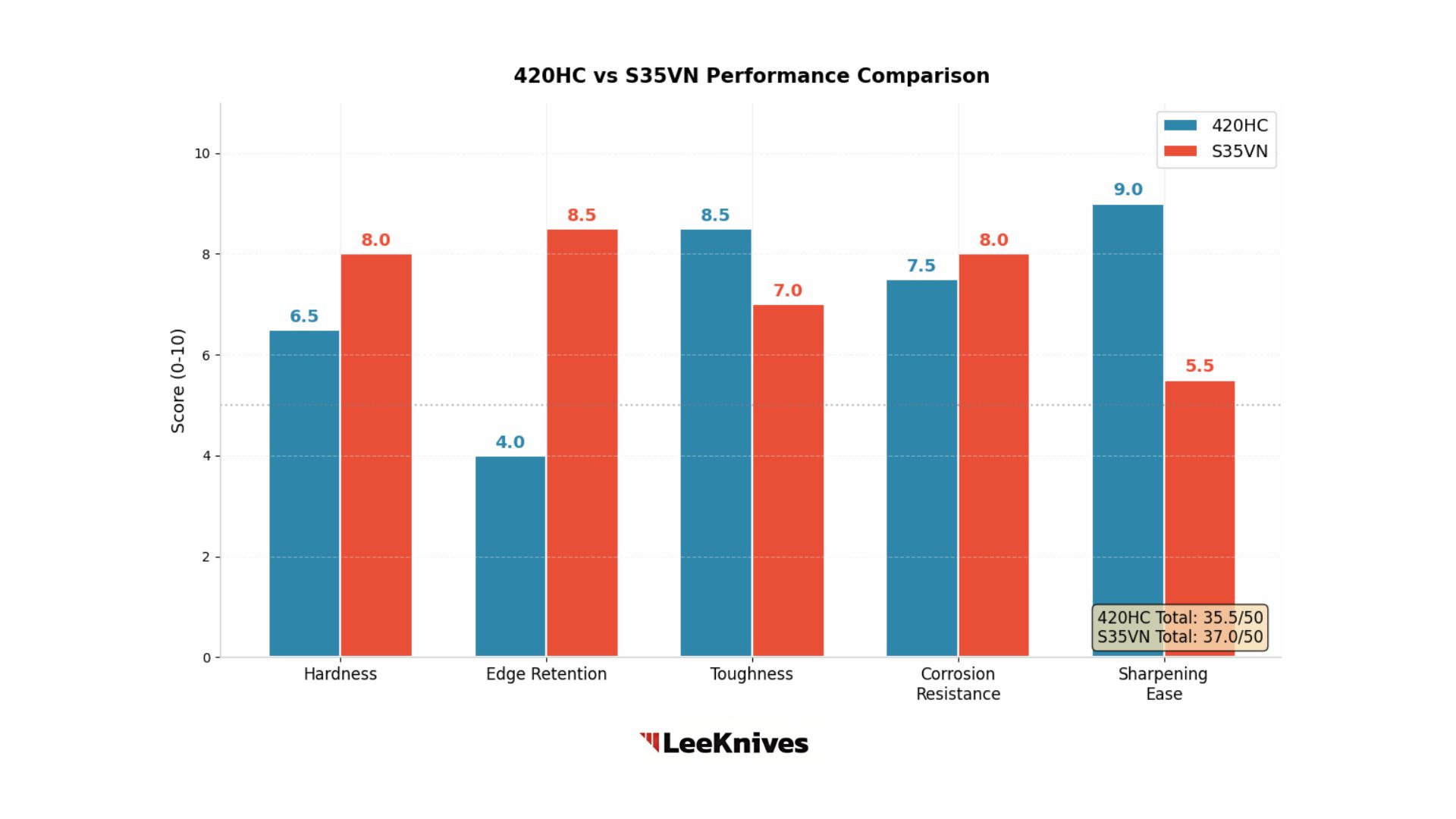
硬度

Hardness determines how well a blade resists deformation and maintains its edge under load. 420HC typically reaches 55–58 HRC in standard production, though Buck Knives’ proprietary heat treatment pushes select models closer to 58–60 HRC.

S35VN, produced through Crucible’s powder metallurgy process, consistently achieves 58–61 HRC with more uniform carbide distribution.

For knife manufacturers, S35VN’s narrower hardness variance reduces batch-to-batch quality issues, while 420HC’s wider tolerance window demands tighter incoming inspection if you are sourcing from multiple suppliers.

エッジ保持

Edge retention is where the gap between these two steels becomes most apparent to end users. 420HC’s modest carbon content produces relatively few hard carbides, meaning the edge dulls faster during abrasive cutting tasks like cardboard or rope.

S35VN’s 3% vanadium forms extremely hard vanadium carbides that resist abrasion far longer, giving it roughly 2–3× the edge life of 420HC in typical EDC use.

For wholesalers, this translates directly into customer satisfaction and fewer complaints — but it also means S35VN knives command higher retail prices that not every buyer is willing to pay.

強靭さ

強靭さ

Toughness measures a steel’s resistance to chipping and cracking under impact. 420HC’s lower hardness gives it an inherent toughness advantage; the steel flexes rather than fractures when subjected to lateral stress or prying.

S35VN addresses the traditional brittleness of high-carbide steels through its niobium-refined microstructure, which improves toughness by an estimated 15–20% over its predecessor S30V.

From a business standpoint, 420HC knives suit customers who abuse their tools, while S35VN appeals to users who prioritize cutting performance over outright ruggedness.

耐食性

Both steels qualify as stainless, but their real-world corrosion behavior differs subtly. 420HC’s ~13% chromium content provides solid rust resistance in normal conditions, and Buck’s optimized heat treatment further enhances this by ensuring proper martensitic structure.

S35VN’s 14% chromium plus 2% molybdenum offers slightly better pitting resistance, though neither steel matches the saltwater performance of dedicated marine grades. For retailers, both steels are low-maintenance enough for mainstream kitchen and EDC markets.

シャープニングのしやすさ

Sharpening ease heavily influences repeat purchase behavior and brand perception. 420HC can be restored to a working edge in minutes using basic Arkansas stones or even a ceramic rod, making it ideal for customers who lack advanced sharpening equipment.

S35VN’s high carbide volume requires diamond or CBN abrasives for efficient reprofiling, though routine touch-ups are manageable with quality systems. Retailers should consider bundling sharpening accessories with S35VN knives or offering sharpening services to close the maintenance gap for less experienced users.

B2B strategy: Volume vs. margin

From a procurement perspective, 420HC and S35VN represent two distinct business models: high-volume velocity 対. premium margin authority. While 420HC minimizes post-sale support through its sheer ruggedness, S35VN builds brand prestige and attracts repeat business from the lucrative enthusiast community.

要素420HCS35VN
最適な用途Volume sales, beginner buyers, price-sensitive marketsMargin-focused sales, brand reputation, repeat customers
小売価格帯$15 – $50$80 – $250+
Customer ProfileFirst-time buyers, casual users, gift purchasersEDC enthusiasts, outdoorsmen, collectors
Warranty Riskより低い: Extremely tough and easy for customers to maintain.適度: Potential for edge chipping if misused by inexperienced users.

Procurement Insight: For wholesalers, 420HC is the “safe” inventory—it moves fast with minimal returns. S35VN is the “status” inventory—it requires a higher initial investment but positions your brand as a professional-grade supplier. At LeeKnives, we recommend a 70/30 stock split for general retailers to capture both the mass market and the premium enthusiast segment.

Best use cases for each steel

Best use cases for each steel

To build a balanced catalog, you must match the steel to the intended activity of the end-user. Here is where each steel truly shines:

When to choose 420HC

  • Multi-Tools: Because multi-tool blades are often thin and subjected to prying or twisting, 420HC’s superior toughness prevents snapping where harder steels might fail.
  • Entry-Level Hunting/Camping: Ideal for beginners who haven’t mastered sharpening yet. It can be easily restored to a razor edge in the field using a simple stone or ceramic rod.
  • Saltwater/Wet Environments: While not a “marine grade” steel, 420HC’s high corrosion resistance makes it a safe bet for fishing knives or budget dive tools.
  • Corporate Gifts & Souvenirs: For customers who value aesthetics and low maintenance over extreme cutting performance.

When to choose S35VN

  • Premium Everyday Carry (EDC): For enthusiasts who use their knives daily for opening boxes, cutting rope, or heavy utility tasks and want to go weeks without needing a sharpen.
  • Professional Skinning/Hunting: S35VN can process an entire large game animal without losing its edge, making it the top choice for serious outdoorsmen.
  • Tactical & 折りたたみナイフ: The “Goldilocks” balance of S35VN makes it the industry standard for high-end folders where the user expects professional-grade performance.
  • Collector & Boutique Lines: If your brand is targeting the “steel snob” or enthusiast community, the CPM (Powder Metallurgy) label is a mandatory marketing requirement.

Conclusion: Which steel should your knife line carry?

Success in the competitive knife market doesn’t come from choosing one steel over the other—it comes from a tiered inventory strategy.

Use 420HC to drive high-volume sales and capture the entry-level retail market, while leveraging S35VN to anchor your premium collections and build brand authority among enthusiasts.

By carrying both, you effectively cover the entire consumer spectrum, maximizing your market share without cannibalizing your own sales.

Partner with LeeKnives: Scaling your knife line

Partner with LeeKnives: Scaling your knife line

Choosing the right steel is only half the battle. The real value lies in the 熱処理 そして manufacturing precision.

LeeKnives, we help you bridge the gap between material specs and market success:

  • Precision Heat Treatment: We utilize advanced vacuum furnaces to ensure every 420HC or S35VN blade meets strict HRC tolerances.
  • Certified Sourcing: We guarantee authentic CPM S35VN from Crucible Industries, preventing the “mystery steel” risks common in low-tier OEM.
  • Design-to-Delivery: Whether you need a 500-unit run of budget 420HC folders or 1,000 premium S35VN blades, we offer competitive B2B pricing and custom branding.

無料見積もりをリクエスト today and connect with our sales team to discuss your steel requirements, MOQ, and custom branding options.

LeeKnivesでカスタムナイフラインをより早く立ち上げましょう

設計から最終出荷まで、OEM/ODM の完全なサポートにより、成長に集中できます。
米国の倉庫に保管されているため、迅速で信頼性の高い配送が可能です。

よくある質問

Is S35VN a high end steel?

Yes, S35VN is widely considered a high-end or premium-tier knife steel. Developed by Crucible Industries using powder metallurgy, it sits above mainstream stainless grades like 440C and AUS-8 but below ultra-premium options like マグナカット and M390. For wholesalers, S35VN positions your products in the $80–$250 retail range where enthusiast buyers expect proven performance.

S35VNより良いものは?

Several steels outperform S35VN in specific categories, though few match its overall balance. MagnaCut exceeds S35VN in both toughness and corrosion resistance, while M390 and CPM-20CV offer superior wear resistance and edge retention.

However, S35VN remains the “sweet spot” steel for most production knives because it delivers premium performance without the machining challenges or price tag of top-tier alloys.

Is 440C steel better than 420HC steel?

はい、 440C generally outperforms 420HC in edge retention and achievable hardness due to its higher carbon (0.95–1.20% vs ~0.46%) and chromium (16–18% vs ~13%) content.

That said, 420HC offers better toughness and is significantly easier to sharpen, making it more forgiving for casual users. Many wholesalers carry both: 420HC for entry-level lines and 440C for customers seeking a modest performance upgrade without jumping to powder steel prices.

What is the most durable steel for a knife?

“Durability” depends on how you define it — toughness, wear resistance, or corrosion resistance. For outright toughness (resistance to chipping and breaking), tool steels like CPM-3V そして クルーウェア lead the market. For balanced real-world durability combining edge retention, stain resistance, and reasonable toughness, S35VN is one of the most proven choices, while 420HC excels in toughness-per-dollar for budget lines.

What are the disadvantages of carbon steel knives?

炭素鋼 knives offer excellent edge retention and toughness but require significantly more maintenance than stainless grades like 420HC or S35VN. They are prone to rust, staining, and patina formation if not dried and oiled after use, which makes them less appealing to casual or first-time buyers.

For retailers, this higher maintenance burden often translates into more customer complaints and returns, which is why stainless steels dominate mass-market sales.

Will a magnet stick to 420 stainless steel?

Yes, 420 stainless steel — including 420HC — is magnetic in both its annealed and hardened states. Unlike austenitic stainless steels such as 304 or 316, 420 is a martensitic grade with a crystalline structure that responds to magnetic fields. This property has no negative impact on knife performance, but it is worth noting if your customers inquire about metal detectors or magnetic knife strips.

ナイフ鋼について

OEMナイフメーカー

カスタムパッケージとロゴ

お客様の基準を満たす品質

グローバル配送とフルフィルメント

jaJA