
Worried your blade finish will scratch, rust, or push your knife line over budget? Start with three options, each with different strengths.
ダウンロードコンテンツ suits wear resistance, low friction, and a premium black look. セラコート offers corrosion protection and broad color choices. Hard PVD films offer metallic colors in thin coatings.
Still, the results depend on the exact coating, blade steel, surface preparation, and application.
Here, PVD vs DLC vs Cerakote gets a closer look. You will learn how to compare test data, check costs per blade, and ask your coater the right questions before you approve samples or place your next bulk knife order.
重要なポイント
- DLC: Best suited to wear resistance, low friction, and premium black finishes.
- PVD: Best suited to thin metallic finishes; specify the exact coating chemistry.
- Cerakote: Best suited to custom colors and corrosion protection; check clearances around folder interfaces.
- Before ordering: Approve physical samples and compare complete quotes, including preparation, masking, and inspection. Sharpening removes coating from the edge.
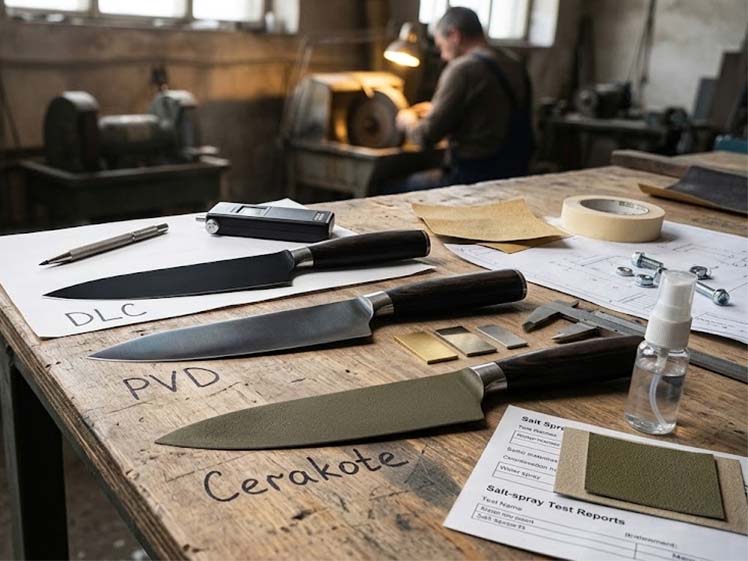
PVD vs DLC vs Cerakote: The Three Coatings at a Glance
These terms are often compared, but they do not belong to exactly the same category. PVD is a deposition process, DLC is a family of carbon coatings, and Cerakote is a coating brand. Some DLC coatings can also be deposited by PVD.
- DLC (Diamond-Like Carbon) is usually black or dark gray. Its main strengths are wear resistance and low friction. Performance varies considerably between formulations, so premium ta-C and conventional DLC should not be treated as the same specification.
- PVD (Physical Vapor Deposition) deposits thin films in a vacuum. Materials such as TiN, CrN, and ZrN offer different colors and properties, making PVD useful for metallic decoration and everyday wear resistance.
- セラコート is a sprayed, oven-cured ceramic-polymer coating. It offers a wider choice of colors and usually builds a thicker film than PVD or DLC.
Also, keep coatings separate from mechanical finishes: satin has fine sanding lines; stonewash has a scattered, worn texture. Our knife blade finishes guide explains these differences.
Quick Pros & Cons
ダウンロードコンテンツ
- 長所: Strong wear resistance, low friction, and a premium black appearance that suits flagship or higher-end EDC models
- 短所: Usually higher cost, limited color choices, difficult rework, and demanding surface preparation
PVD
- 長所: Thin films, metallic color options, balanced wear performance, and suitability for consistent volume production
- 短所: Properties vary by material, minimum batch requirements may apply, and sharpening removes coating from the edge
セラコート
- 長所: Excellent corrosion protection, extensive custom colors and camouflage, relatively practical rework, and small-batch flexibility
- 短所: A thicker film, more visible rub marks with repeated contact, and additional masking work on folding knives
Side‑by‑Side Coating Comparison
| 要素 | ダウンロードコンテンツ | PVD | セラコート |
|---|---|---|---|
| Scratch and wear resistance | 素晴らしい | Good to excellent | 適度 |
| Corrosion protection | 良い | 良い | 素晴らしい |
| 耐熱性 | Moderate; grade-dependent | Relatively high; material-dependent | Moderate; product-dependent |
| Film thickness | Ultra-thin | Ultra-thin | Relatively thick |
| Colors | Mostly black and dark gray | Mainly metallic tones | Extensive custom colors and camouflage |
| Surface friction | Very low | 低い | 適度 |
| Food contact | Confirm the exact coating and use | Confirm the exact coating and use | Confirm the exact product, cure, and use |
| Cost per blade | Usually higher | Usually mid-range | Usually low to mid-range; complex masking adds cost |
| Strip and recoat | 難しい | 難しい | Relatively practical |
要するに: DLC leans toward wear resistance and low friction, PVD toward metallic colors and thin films, and Cerakote toward color flexibility and corrosion protection. The sections below explain the differences in more detail.
LeeKnivesでカスタムナイフラインをより早く立ち上げましょう
設計から最終出荷まで、OEM/ODM の完全なサポートにより、成長に集中できます。
米国の倉庫に保管されているため、迅速で信頼性の高い配送が可能です。
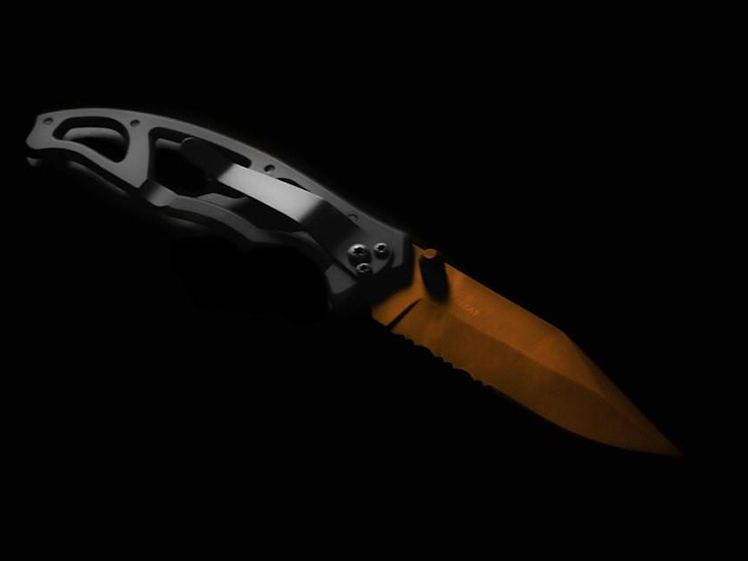
Detailed Coating Breakdown
Deposition Process
For a knife manufacturer, the key question is not simply how each process works, but whether its temperature is compatible with the blade.
PVD and many DLC coatings are deposited in a vacuum, while Cerakote is sprayed and oven-cured. Oerlikon’s PVD process guide gives a common processing range of approximately 150–500°C, but decorative PVD and some DLC systems can run at lower temperatures. For example, Ionbond’s decorative PVD portfolio lists a range of 20–200°C.
Cerakote lists a standard H-Series cure schedule of 250°F (121°C) for two hours on metal substrates in its official curing guide.
Before sampling, give the coater your steel grade, hardness target, and heat-treatment details. That is more useful than asking which coating is “best” without the application context.
Scratch & Wear Resistance
If wear resistance on a black blade is your priority, DLC is often worth sampling first—but ask which type of DLC is being quoted.
Common a-C and a-C:H coatings are approximately 1,500–3,500 HV, while high-sp³ ta-C can reach approximately 4,000–9,000 HV, according to this academic overview of DLC and ta-C. As a specific product example, Ionbond Tetrabond Plus is listed at more than 5,000 HV.
PVD also depends on the material. Ionbond TiN is listed at 2,800 HV, while eifeler CrN is listed at 2,000 ± 200 HV0.05. Both can provide useful wear protection, but their appearance and other properties differ.
Cerakote data uses a different test method. The H-265 official product page, for example, lists ASTM D3363 results of 8H scratch hardness and 9H gouge hardness. These pencil-hardness results cannot be compared directly with the HV values above.
Hardness is useful for screening options, but it should not decide the whole project. Sheath contact, drops, edge loads, and substrate support all affect what customers see in real use.p visible rub marks from repeated sheath contact.
腐食防止
For humid, coastal, or outdoor products, Cerakote is an attractive starting point, but steel selection and edge exposure still matter.
The manufacturer reports an ASTM B117 salt-spray result of more than 2,000 hours for Cerakote H-265. This demonstrates strong barrier protection under the stated laboratory conditions; it does not tell you how many years a knife will resist rust in real use.
Even with DLC or PVD, scratches, pinholes, and uncoated edges can become starting points for corrosion. With semi-stainless steels such as D2, coating selection should be considered alongside steel choice and user maintenance.
When reviewing a salt-spray report, ask three practical questions: Which coating product was tested? Was the sample scribed? What level of corrosion counted as failure? ASTM B117 is a test method; it does not establish one universal pass time for every product.
Continuous Heat Resistance
For most knife projects, there is little value in chasing the highest temperature number alone. It is usually more important to know whether production will affect blade hardness or geometry.
PVD deposition temperature, Cerakote cure temperature, and the finished coating’s maximum service temperature are different properties. For example, the standard H-Series cure is 121°C for two hours, while the H-265 product data separately lists coating stability above 500°F, approximately 260°C. These figures should not be compared as if they described the same condition.
For production, confirm that the complete heating cycle will not change blade hardness, straightness, or assembled components before approving the process.
LeeKnivesでカスタムナイフラインをより早く立ち上げましょう
設計から最終出荷まで、OEM/ODM の完全なサポートにより、成長に集中できます。
米国の倉庫に保管されているため、迅速で信頼性の高い配送が可能です。
Coating Thickness & Folding Knife Tolerance
Fixed blades often focus on appearance and protection. Folding knives add another question: Will the coating affect action or lockup?
Representative DLC and PVD films are only a few microns thick. Ionbond decorative PVD is listed at 0.2–2 μm, while the Oerlikon BALINIT DLC data gives 1–3 μm for the stated applications. Cerakote H-265 has a recommended thickness of approximately 25.4 μm.
A simple example makes the difference easier to visualize. A 2 μm film on both sides of a blade adds approximately 4 μm in total. A 25.4 μm film on both sides adds approximately 50.8 μm. This does not mean every folder will change in the same way, but it shows why pivot bores, bearing seats, detent tracks, and lock faces need a coating or masking decision.
Whichever coating you choose, check action, lock engagement, and centering on assembled samples. A blade that passes cosmetic inspection may still be unsuitable once assembled.
Consider the coating together with your pocket knife steel and base finish. Polished, satin, and bead-blasted substrates can look different under the same coating.
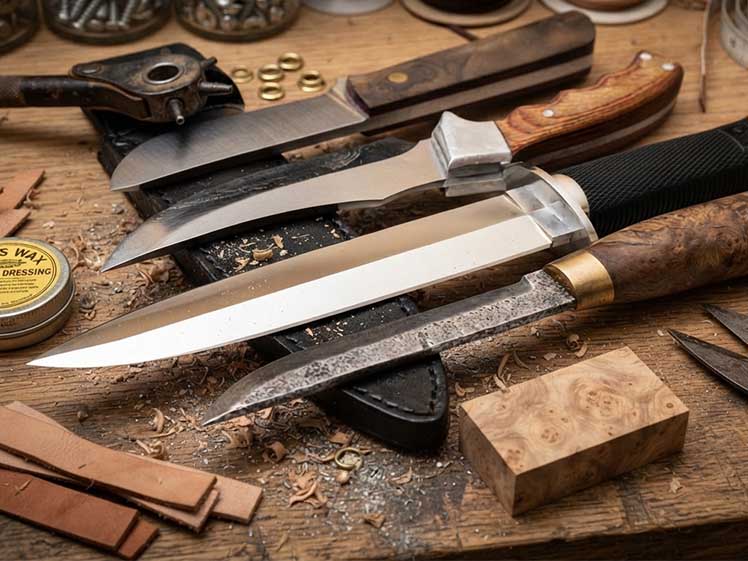
Available Colors
For metallic finishes, start with PVD. For a wider range of solid colors, brand colors, or camouflage, Cerakote offers more flexibility.
PVD can produce gold, champagne, steel, bronze, and gray-black effects through different materials and processes. TiN is known for its classic gold color, while the Ionbond decorative PVD portfolio shows additional metallic options. DLC is generally limited to black and dark gray.
If color is central to your product line or brand identity, keep a signed-off physical color standard and agree on batch consistency with the supplier. A digital rendering is not a substitute for an approved sample.
Surface Friction
Low friction is one of the key properties that distinguishes DLC from many PVD and sprayed coatings.
その Oerlikon BALINIT DLC data lists a coefficient of friction of 0.1–0.2 against steel. Ionbond TiN is listed at approximately 0.5 under its stated dry-running conditions, while eifeler CrN lists 0.3–0.4 against 100Cr6 steel.
These values help explain why DLC is often used on low-friction surfaces, but they do not directly predict cutting feel or folding-knife smoothness. Sheath material, contact pressure, surface texture, and mechanism fit still need to be evaluated on finished samples.
Food Contact & Regulatory Compliance
For kitchen knives, do not ask only whether a coating family is “food-safe.” Ask which product, use condition, and market the documentation covers.
その Ionbond food-contact TiN page is a useful example. It identifies FDA-TOR 2020-003 for a specific product rather than describing all PVD coatings as food-safe.
DLC and Cerakote should be reviewed in the same way. Also consider dishwashing, cleaning chemicals, and the other materials used in the complete knife. If the project timeline is tight and the documentation is unclear, an appropriate uncoated stainless-steel design may be easier to qualify.
LeeKnivesでカスタムナイフラインをより早く立ち上げましょう
設計から最終出荷まで、OEM/ODM の完全なサポートにより、成長に集中できます。
米国の倉庫に保管されているため、迅速で信頼性の高い配送が可能です。
Unit Coating Cost (Volume Reference)
When comparing coating costs, the application fee is only part of the picture. Preparation, masking, and assembly can be just as important.
Based on LeeKnives’ internal volume-project references, PVD is approximately $1–5 per blade, DLC $5–20+, and Cerakote $3–12. These figures are useful for early budgeting, not universal market quotes. Premium ta-C, complex colors, and multi-zone masking can increase cost.
One quote of a few dollars per blade may include application only, while another includes cleaning, masking, and inspection. Request separate sample and production quotes with a clear scope so that suppliers can be compared on the same basis.
Strip & Recoat / Rework
If your line requires frequent color changes or has a higher risk of color-batch rework, Cerakote is usually more flexible.
Removing DLC or PVD may require chemical stripping or aggressive abrasive processing, which can affect edges, contours, markings, and dimensions. Cerakote is generally easier to strip and reapply, although the applicator should still confirm the effect on the blade and critical dimensions.
Agree on the rework approach before mass production rather than waiting for a color or adhesion problem to occur.
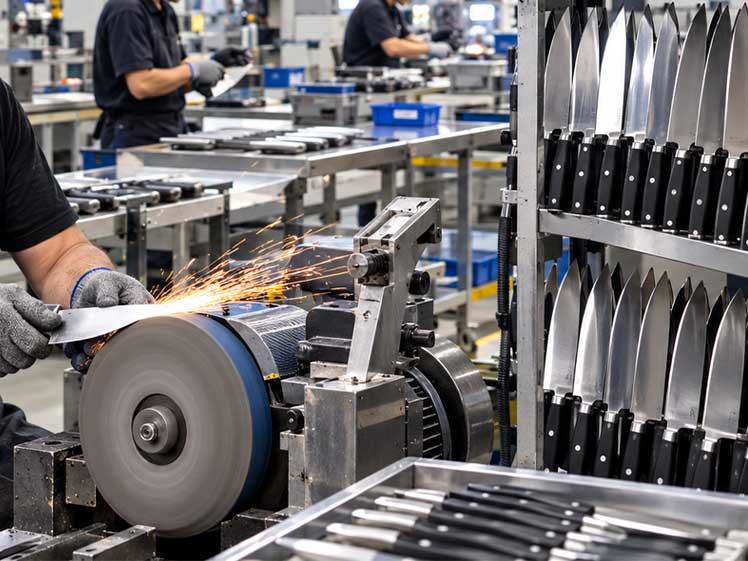
Quick Line-Planning Reference
If you already have a general product direction, use this table to narrow the options:
| Product Scenario | Starting Point | 主な理由 |
|---|---|---|
| Premium black tactical folder | ダウンロードコンテンツ | Wear resistance, low friction, and a black finish suit a premium position |
| Volume EDC series with metallic colors | PVD | Thin films and repeatable colors work well across a series |
| Hunting or fixed-blade line for humid markets | Cerakote plus suitable steel | A barrier coating and appropriate steel work together to improve protection |
| Gift knife with gold accents | PVD TiN | Recognizable gold appearance with decorative appeal |
| Seasonal or collaboration colors on one platform | セラコート | Broad color choice and relatively flexible color changes and rework |
| Premium limited run sensitive to wear reviews | DLC or ta-C | Supports a wear- and friction-focused specification, provided the cost works |
| Kitchen line with food-contact requirements | Documented coating or uncoated stainless | Makes it easier to review the exact product and cleaning conditions |
How to Choose: A 4-Step Check
If you are still comparing options, these four steps will help narrow them down:
- Start with the environment. For regular exposure to saltwater, sweat, or humidity, prioritize corrosion protection. For everyday carry and sheath contact, focus more on wear.
- Define the appearance. Consider DLC for premium black models, PVD for metallic colors, and Cerakote for brand colors, camouflage, or seasonal releases.
- Calculate the complete cost. Include preparation, masking, inspection, and assembly before deciding whether the coating fits the product’s retail position.
- Give each finish a role in the line. You might use PVD for volume models, DLC for the flagship, and Cerakote for colorful or outdoor versions. One coating does not need to cover every product.
As you plan the wider production run, our B2B knife sourcing guide can help with the next steps.
LeeKnivesでカスタムナイフラインをより早く立ち上げましょう
設計から最終出荷まで、OEM/ODM の完全なサポートにより、成長に集中できます。
米国の倉庫に保管されているため、迅速で信頼性の高い配送が可能です。
Sourcing, QC and Common Coating Failures
A good coating project requires more than choosing the right name. The factory also needs to know what counts as acceptable.
Check these four issues during sampling:
- Rust spots: Review cleaning, pinholes, handling damage, and exposed edges, and define the acceptance conditions for salt-spray or other corrosion tests.
- Flaking on blade flats: Review contamination, blasting, bond layers, and deposition or curing. Some Cerakote products publish ASTM D3359 adhesion data, such as the 5B result for H-220, but the same method may not suit every vacuum film.
- Edge chipping: Review edge geometry, substrate hardness, loading, and sharpening rather than simply increasing coating hardness.
- Sheath rub marks: Review contact pressure, abrasive debris, and sheath material, and run cycle tests with the actual sheath.
Our team incorporates coating requirements into drawings and the カスタムポケットナイフ workflow for OEM/ODM customers. You can also use our blade finishes guide to build a clearer specification:
- DLC: Specify a-C:H, ta-C, metal-doped DLC, or multilayer construction, together with thickness and acceptance methods
- PVD: Specify TiN, CrN, ZrN, or another exact material, plus the approved color, thickness, and preparation—not just “black PVD”
- Cerakote: Specify the product code, color, film thickness, cure schedule, and masked areas
Keep signed-off samples and agree on rework and retesting before shipment to reduce later disputes.mplaints appear.
Conclusion: Which Coating Belongs in Your Line?
If you remember only one thing: DLC is a strong starting point for black, wear-resistant, low-friction finishes; PVD for thin metallic colors; and Cerakote for custom colors and corrosion protection.
The next step is to apply that choice to your steel, construction, use environment, and budget. Sampling and approving appearance, assembly, and test requirements is usually more reliable than comparing promotional specifications alone.
LeeKnives has manufactured blades in Yangjiang City for over 30 years and supports knife brands evaluating PVD, DLC, and Cerakote programs. Share your blade style, target appearance, order quantity, and timeline through our 見積もりを依頼する page, and we can discuss the options for your project.
For a broader overview of coating selection, see our blade coating guide.
よくある質問
Is DLC better than Cerakote?
If scratch resistance and a premium black finish are your selling point, DLC outperforms Cerakote and stays clean-looking after years of pocket carry. Cerakote, however, delivers superior corrosion resistance and unlimited custom colours. The right choice depends entirely on your target customer and use case.
Does PVD coating wear off?
It wears gradually over time. Quality PVD protects blade flats for years, though the cutting edge will lose its coating after the first sharpening. Deep scratches can expose bare steel underneath. Widespread flaking across flats is not normal wear; it points to inadequate surface preparation.
Can you Cerakote over PVD or DLC?
Direct overcoating does not work reliably. The existing vacuum coating must be aggressively media-blasted down to bare steel for proper mechanical adhesion. For this reason, factories almost always select one coating system per blade. If refinishing is required later, Cerakote is far easier to strip and reapply.
Is DLC coating worth the cost?
It is worthwhile only if your retail price point supports the premium. DLC typically commands a 30–80% retail uplift and drastically reduces complaints about scratched blades on premium tactical and EDC knives. It rarely makes financial sense for budget knife lines, where PVD delivers most of the wear performance at a lower cost.
How much does blade coating cost per knife at volume?
Per-piece factory pricing only tells part of the landed cost story. Folding knives need manual masking around pivot holes and lock interfaces, which adds labour. Skipping masking ruins blade action.
Note: Coating selection does not change HTS classification. Knives under tariff line 8211929045 typically carry 50–55% import duty, a separate expense from coating. Always ask your supplier to itemise masking and assembly work to calculate true landed cost.
Can you sharpen a coated knife blade?
Yes. Standard sharpening only removes coating from the thin edge bevel; the rest of the blade remains protected. Use light pressure and finish on a leather strop to minimise micro-chipping at the coating boundary. For sharpening fundamentals, read our guide to 研磨と研ぎ.






 JA
 EN
 DE