You can generally import kitchen knives, manual pocket knives, and outdoor knives into the U.S., but design matters. Switchblades and butterfly knives face strict import rules, with limited exceptions. So, check the knife’s opening mechanism before you pay a supplier.
A low knife price can lose its appeal when customs hold your shipment or extra duties eat into your profit.
Even tariff codes need care: searching “knives” in the U.S. tariff schedule returns more than 20 results.
This 2026 guide helps you understand import rules, find the right tariff code, estimate costs, and check suppliers. You’ll learn what to confirm before importing knives from China.
重要なポイント
- Knife admissibility depends on the knife’s design, opening mechanism, intended use, and applicable federal rules.
- その USD 800 duty-free de minimis treatment was suspended for covered shipments effective 29 August 2025. The duty-free parcel era is over, so plan for full customs entry.
- Indicative MOQs can range from a few hundred units for some standard or private-label programs, but actual MOQ varies by factory, SKU, customization, packaging, and materials.
- Typical first-order timeline: about 10–19 weeks, depending on sample iterations, production complexity, inspection, shipping mode, and customs clearance.
- Demand a live Yangjiang knife factory video tour, steel mill certificates, and actual samples to weed out intermediaries before you buy.
Is It Legal to Import Knives from China?
When you import knives from China, moving boxes past the inspection line is your main hurdle. CBP determines admissibility based on the knife’s characteristics, applicable regulations, classification, and entry documentation. The legality depends on the exact knife, its final destination, and your shipping carrier.
The Knife Legality Matrix for U.S. Imports
| ナイフの種類 | US Import Admissibility | Carrier & Mailing Notes | State & Local Layer |
| Kitchen & Chef Knives | Legal | Mailable when securely packaged | Generally unrestricted |
| Manual Pocket Knives | Legal (if biased toward closure) | Mailable; use accurate invoice details | Length and carry rules vary |
| Fixed-Blade Hunting Knives | Legal federally | Mailable when securely packaged | Local restrictions on daggers |
| アシストオープンナイフ | Usually admissible if biased toward closure | Scrutinized by agents; get a binding ruling | Restricted in some states |
| 自動式/スイッチブレード | Prohibited from import | Nonmailable (18 U.S.C. § 1716) | Illegal in many states |
| Balisong (Butterfly) Knives | High federal import risk; included within the federal switchblade definition | Avoid for U.S. import programs | Restrictions vary |
Federal admissibility does not determine whether a knife can be possessed, sold, carried, or shipped to a particular state or municipality.
How Customs Classifies Your Cargo
Federal rules form a strict baseline for what enters the country.
- The Switchblade Ban: Under the Federal Switchblade Act (15 U.S.C. §§ 1241–1245) and CBP regulations (19 CFR §§ 12.95–12.103), you cannot import knives that open automatically via a button, inertia, or gravity. The single statutory exception for one-armed individuals does not apply to commercial inventory.
- Mailing Restrictions: You cannot mail automatic knives. They are strictly nonmailable under 18 U.S.C. § 1716.
- Assisted Openers: Customs generally allows spring-assisted knives if they are biased toward closure. This means the blade only moves after you manually push it partway open.
Clearing federal customs is only your first step. A ポケットナイフ that legally leaves the port can still violate city laws where you store or ship it. Build destination rules into your website checkout system before you buy any inventory.
On the Chinese side, factories must register large blades and daggers for export. Established factories handle this paperwork easily. However, you should never rely solely on a supplier’s promise that a design is legal. Always verify the mechanics and paperwork yourself.
Which Knife Categories Are Right for Your Import Plan?
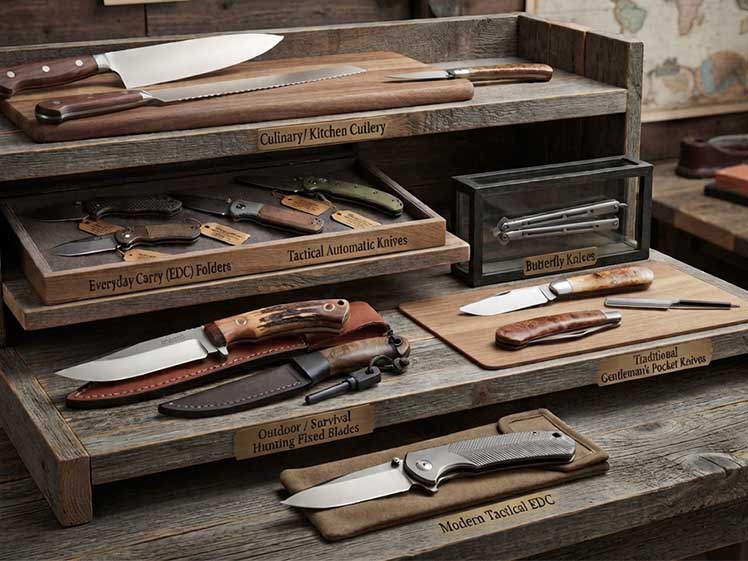
The right import plan depends on the tools you want to bring in. You can’t treat a chef’s blade and a tactical flipper the same way.
Here is how the main knife categories compare:
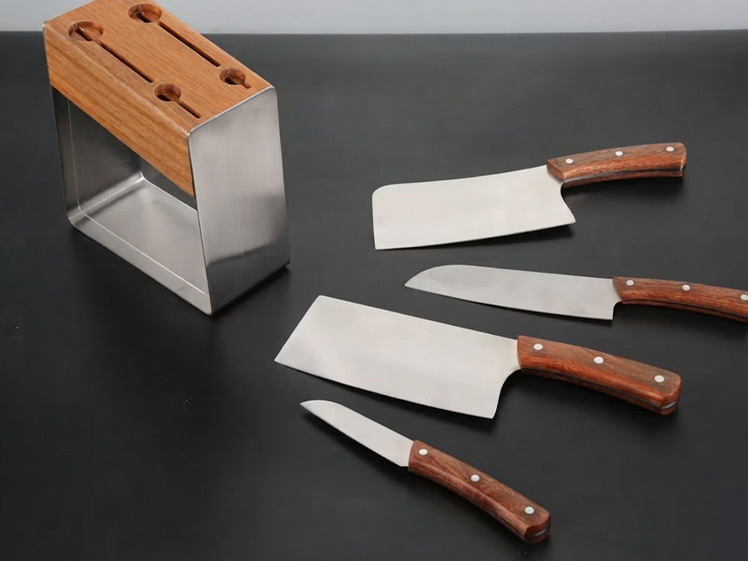
Kitchen and Chef Knife Sets
- 最適な用途: Amazon and direct-to-consumer (DTC) brands, retail chains, and restaurant-supply wholesale distributors.
- Risk Level: Low. This is the most straightforward category for customs and state compliance.
- Typical 最小注文数量: 200–1,000 units per SKU, complete with your logo and packaging.
カスタムキッチンナイフ form the high-volume backbone of the import trade. When you order these, the steel grade and food-contact compliance do the heavy lifting.
Compare standard constructions, 鋼, and packaging before you ask a factory for a quote. If you want something unique rather than a generic catalog item, building a custom kitchen knife program is your natural next step.
Manual Folding Pocket Knives
- 最適な用途: Everyday carry (EDC) retailers, outdoor shops, and promotional buyers.
- Risk Level: Low-to-moderate. They are admissible if genuinely manual, but you must document the opening mechanism.
- Typical 最小注文数量: 200–500 units for standard models with custom branding.
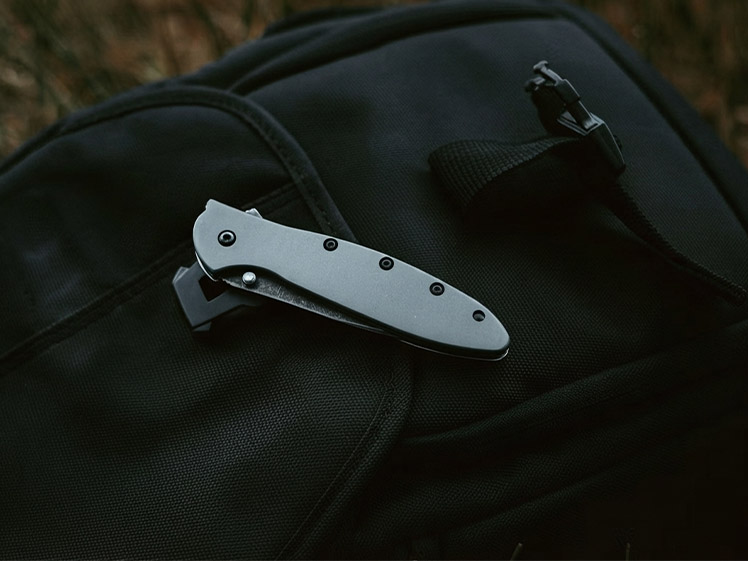
For every 折りたたみナイフ you import, get a video of the opening action and written proof from the factory that the blade is manual and biased toward closure.
If customs agents ever question your shipment at the port, that video file is your immediate defense. You can add a laser-engraved logo to the handle to make standard catalog designs your own.
Outdoor and Fixed-Blade Knives
- 最適な用途: Hunting, camping, and work-gear retailers.
- Risk Level: Moderate federally. You must check state laws regarding daggers and double edges.
- Typical 最小注文数量: 200–500 units. Factories usually quote sheaths and packaging along with the knife.
固定刃 are rugged, reliable, and federally legal. However, local laws often ban specific shapes like double-edged daggers.
Always map out your destination states before you order a full container. You do not want a pallet of perfectly good camping knives stuck in a warehouse because the blade shape violates a local ordinance.
Assisted-Opening and Tactical Designs
- 最適な用途: Experienced importers who have dedicated legal review.
- Risk Level: High scrutiny. Do not build your first import program around these.
If a knife uses springs to assist the opening, customs agents will test it rigorously. Never let an overseas supplier ship assisted knives directly to your U.S. customers.
If you have any doubt about a borderline mechanism, applying for a binding U.S. Customs ruling under 19 CFR Part 177 is cheap insurance compared to losing a seized shipment.
Low-Risk Add-Ons for Your Container
You can load 包丁研ぎ器, まな板, leather 鞘、 そして storage blocks into the same shipping container. These accessories generally avoid knife-specific import restrictions tied to automatic opening mechanisms, although product, material, and labelling requirements still apply.
However, you should still check applicable product and material requirements. Adding a simple sharpening stone can turn a single knife purchase into a complete retail package.
卸売ナイフを購入して、今すぐ私たちと一緒にスケールアップを始めましょう
弊社にお問い合わせいただき、営業担当者と連絡を取り、無料の見積もりを入手してください。
Where to Find Reliable Knife Suppliers in China
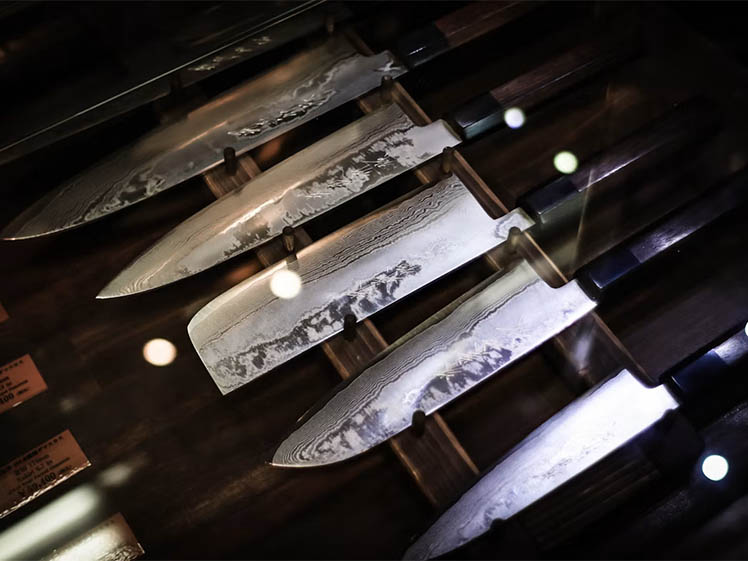
China powers the global knife industry. China is a major global exporter of knives and knife blades under HS heading 8211. The United States buys more of these blades than any other country. You only need to look at one city.
Yangjiang is one of China’s main knife-making hubs. Local government sources have reported that its hardware knife-and-scissors industry accounts for roughly 70–75% of national output and about 85% of national exports, depending on the reporting year and category.
Top Sourcing Channels for Your Import Business
How do you connect with these factories? You have four main paths:
- B2B Platforms: Websites like Alibaba, Made-in-China, and Global Sources help you build a shortlist fast. Filter your search for verified manufacturer badges. Send the same request for quote (RFQ) to 5-8 suppliers so you can compare their prices directly.
- 1688: This is China’s domestic wholesale platform. Prices often sit 10% to 30% lower than export listings. However, the site is entirely in Mandarin and targets local buyers. You will need a China-based sourcing agent to buy from here smoothly.
- Direct Factory Outreach: Searching Google for region-specific terms like “kitchen knife manufacturer Yangjiang” often reveals factories that skip platform fees. Whether wholesaling knives or launching custom OEM/ODM lines, Yangjiang partners のように LeeKnives offer better pricing, but you’ll need to do more homework to verify them.
- Trade Shows: Nothing beats holding a knife in your hand. The Canton Fair in Guangzhou runs every spring and autumn. You can also visit the Yangjiang knife fair each October. Yangjiang is just a 2.5- to 3-hour drive or train ride from Guangzhou.
The 5-Step Verification Process
Before you send a single dollar, you must prove the factory actually makes knives. A trading company will take a cut of your money without offering any quality control. Run this simple checklist on every supplier:
- Request a Live Video Factory Tour: Ask the supplier to video call you during their working hours. You want to see unscripted action. Ask the supplier to show the production facility, relevant equipment, and manufacturing processes during a live video call. Then independently verify the legal business entity and manufacturing scope.
- Check the Business License: Ask for their official registration document. Make sure their approved business scope explicitly includes “manufacturing,” not just “trading” or “sales.”
- Demand a Mill Test Certificate (MTC): An MTC can provide important evidence of the steel grade and batch composition, but it should match the production batch and, for higher-risk orders, be supported by independent testing.
- Verify Certifications Independently: Do not just trust the shiny logos on their website. If they claim their kitchen knives are food-safe, look up their company name in the NSF official database. Also verify their ISO 9001 status directly with the issuing body.
- Order Physical Samples: Always pay for three to five sample units. Hold the blade up to the light to check the edge geometry for evenness. Specify the target HRC range in the purchase specification and use an independent lab or qualified inspection provider to verify hardness on production samples.
If you need more help narrowing down your list, look into our guides on OEMナイフ製造業者. These resources give you a broader look at ナイフを卸売価格で購入する方法 from China safely and profitably.
How Much Does It Cost to Import Knives from China?
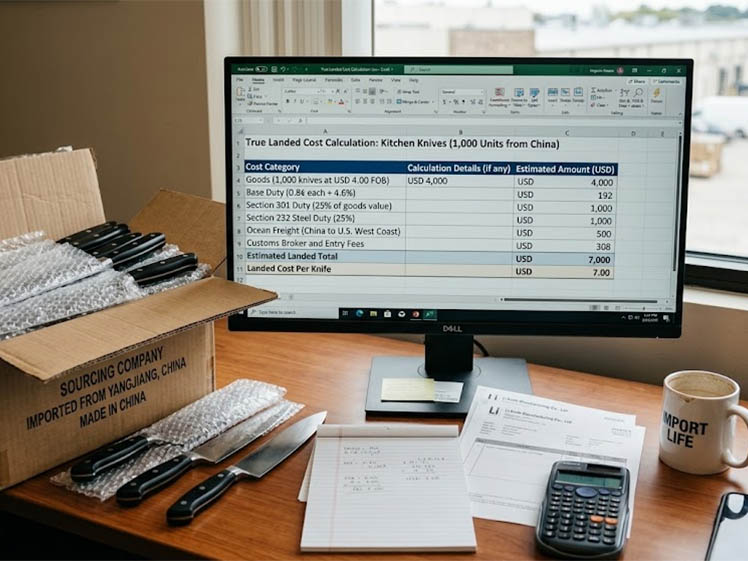
The price your factory quotes is just the beginning of your expenses. To run a profitable business, you need to know your true final price before you place an order. This landed cost includes knives, ocean freight, shipping insurance, and customs taxes.
If you do not plan for these extra fees, your profits will vanish before you sell a single blade. Here is exactly what you will pay:
The True Cost of Customs Duties
The U.S. government uses the Harmonized Tariff Schedule (HTS) to decide your tax rate. You can verify the blade and handle rates on the official HTS website:
| 製品 | HTS Subheading | Base Duty Rate (MFN) |
| Table knives, rubber/plastic handles | 8211.91.50 | 0.7¢ each + 3.7% |
| Kitchen and butcher knives, rubber/plastic handles | 8211.92.20 | 0.8¢ each + 4.6% |
| Other fixed-blade knives (sheath-type) | 8211.92.40 | 1¢ each + 4.6% |
| Hunting knives with wood handles | 8211.92.60 | 4.40% |
| Folding / pocket knives | 8211.93.00 | 3¢ each + 5.4% |
However, the base HTS duty is only one part of the import-cost calculation. Depending on the exact knife classification, Chinese-origin goods may also be subject to additional Section 301 or other Chapter 99 duties.
Check Section 232 treatment separately because not every knife falls under the same steel-derivative provisions. When you stack these together, your effective tax rate jumps to roughly 50–55% of the goods’ value.
Since 29 August 2025, shipments that previously qualified for the USD 800 de minimis exemption are generally no longer eligible for duty-free de minimis treatment. However, the entry type can still vary by shipment, value, and applicable requirements.
Calculating Your True Landed Cost
Imagine you order 1,000 standard kitchen knives. The factory charges you USD 4.00 per knife. The illustrative landed cost, excluding additional Chapter 99 duties:
| Cost Category | Estimated Amount |
| Goods (1,000 knives at USD 4.00 FOB) | USD 4,000 |
| Base Duty (0.8¢ each + 4.6%) | USD 192 |
| Section 301 Duty (25% of goods value) | USD 1,000 |
| Section 232 Steel Duty (25%) | USD 1,000 |
| Ocean Freight (China to U.S. West Coast) | USD 500 |
| Customs Broker and Entry Fees | USD 308 |
| Estimated Landed Total | USD 7,000 |
| Landed Cost Per Knife | USD 7.00 |
Check additional China tariffs, if applicable, separately against the current HTS/Chapter 99 provisions. Notice how the taxes and shipping almost double the original price. Your final landed cost jumps from USD 4.00 to USD 7.00 per knife.
Planning Your Cash Flow
You must pay your heavy tax bill before you sell a single unit. Factories usually require a 30% deposit upfront. You pay the remaining 70% when the goods board the ocean vessel. You must pay import duties and other applicable customs charges based on entry and the rates in effect when the goods are entered.
Material grade is one of several major cost drivers. Actual unit pricing varies substantially with blade construction, heat treatment, handle materials, order volume, packaging, and customization. Your choice of steel, handling material, and packaging will shape your final costs much more than your negotiating skills ever will.
Shipping, Documents, and Customs Clearance
Shipping sharp steel overseas requires steady coordination between your factory, freight forwarders, and border officers. Once your boxed knives leave the assembly line, you need the right transport method and clean paperwork to reduce the risk of customs delays.
Choosing the Right Freight When You Import Knives from China
Selecting the right route keeps your delivery on schedule and safeguards your cash flow:
- Express Courier (DHL, FedEx, UPS): Use couriers for product samples and urgent orders. Always declare the contents honestly. Labeling a box as a “gift” can flag your account and stop delivery.
- 空気 Freight: This is generally much more expensive per kilogram than ocean freight, so it is usually reserved for samples or time-sensitive shipments.
- Sea Freight (LCL or FCL): Ocean transit times vary by origin, destination, carrier, routing, and port conditions. Use the freight forwarder’s current sailing schedule rather than a fixed transit-time assumption.
- Domestic Mail Rules: Standard kitchen and folding blades can travel through the mail in puncture-proof boxes.
Required Paperwork and Smooth Customs Clearance
To clear the docks cleanly, you must keep your documents accurate and filed early:
- Core Paperwork: You need three basic files: an invoice with clear blade descriptions, a packing list, and a bill of lading (B/L).
- Ocean Security Filing: For ocean shipments, the Importer Security Filing (ISF) generally must be submitted before loading, subject to CBP’s applicable timing and filing rules.
- Customs Bonds: Any commercial entry worth over USD 2,500 requires a customs bond. A single-entry bond handles your first test run, while regular importers buy continuous bonds to cover an entire year.
Realistic First-Order Timeline
| Order Phase | Typical Duration |
| Supplier Shortlist & RFQs | 1–2 weeks |
| Sample Production & Delivery | 1–3 weeks |
| Sample Testing & Spec Approval | 1–2 weeks |
| Mass Production Run | 4~6週間 |
| Pre-Shipment Inspection | 2–5 days |
| Ocean Freight & Customs Clearance | 3–5 weeks |
| Total First-Order Window | ≈10–14 weeks |
Your first shipment takes patience because making molds, testing steel, and filing entry paperwork takes time. Once your factory settles these specs, repeat orders run in about half that schedule.
卸売ナイフを購入して、今すぐ私たちと一緒にスケールアップを始めましょう
弊社にお問い合わせいただき、営業担当者と連絡を取り、無料の見積もりを入手してください。
Knife Quality Control: Steel, Samples, and Standards
Quality failures happen far more often than customs seizures, and catching defects early costs much less.
Essential checks before you pay:
- Samples first, always. Order 3–5 units of your exact SKU, not polished showroom models. Slice through printer paper to test blade sharpness right out of the box. Run your fingers over the handle seams to feel for rough pins or loose scales, and check the packaging.
- Verify the steel, not the adjective. Words like “premium steel” are marketing fluff, not technical specifications. Put exact grades in your purchase agreement, such as 3Cr13, 5Cr15MoV, 7Cr17MoV, 8Cr13MoV, D2、 または VG-10, along with an exact Rockwell hardness (HRC) target. Always keep the mill test certificate on file.
- Match certifications to your market. For kitchen knives intended for food contact, review the regulatory status of materials and coatings that may contact food and obtain appropriate supplier documentation for the intended use.
Some commercial food-service buyers may request NSF-related documentation or other food-equipment compliance evidence, depending on their procurement requirements. Confirm the buyer’s specification before treating certification as mandatory. If you also sell in the EU or UK, check market-specific food-contact, product-safety, labelling, and packaging requirements.
Top factories in China craft knives for world-class brands every day. The difference between a high-margin product line and a failed shipment comes down to clean paperwork and verified test results before your cargo leaves the factory floor.
How LeeKnives Simplifies Importing Knives from China
Managing ocean freight, port taxes, and factory inspections takes time. When you partner directly with the factory, much of that paperwork disappears from your desk.
LeeKnives has forged blades in Yangjiang, offering direct factory sourcing, OEM options, and logistics support:
- Low Minimums: Standard production runs start at just 200 pieces. You always test a physical sample before you pay for a bulk order.
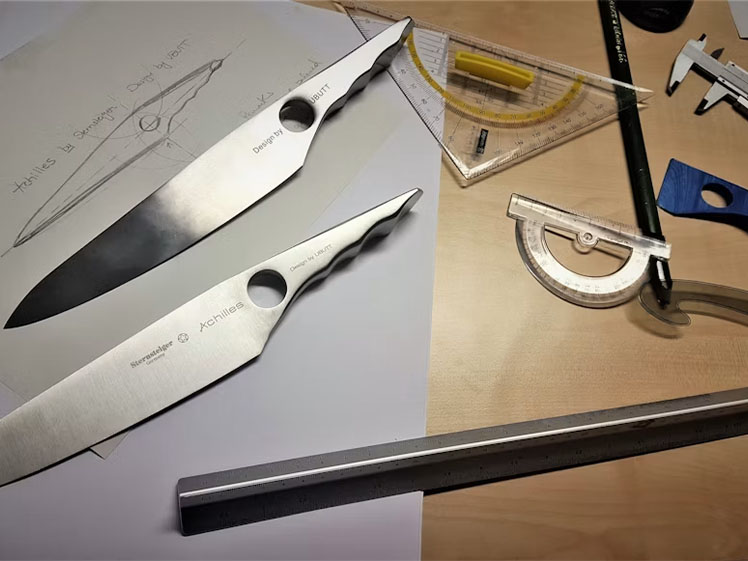
- カスタム OEM Options: You choose the exact blade steels, handle materials, laser-engraved logos, and retail packaging for your market.
- Hands-off Logistics: An internal export team files your shipping documents. If you run a web store, you can use their U.S. warehouse for dropshipping.
Every account gets a dedicated support representative to track their containers. If you want to launch a new knife brand without renting a warehouse, start with the knife dropshipping service.
Shipping directly to your buyers changes how you handle taxes. To keep this setup running smoothly and avoid delays, partner with experienced 中国のナイフメーカー who understand direct-to-consumer fulfillment.
Final Recommendation for Importing Knives
Choose your first order based on how you sell. Keep it small enough to inspect and fund without stretching your budget.
Knife buying tips by business:
- Amazon or DTC brands: Start with one kitchen-knife set or one manual folding SKU. Test samples first; consider 200–500 units only if demand and cash flow support it.
- Store Retailers: Try mixed catalog stock. Track sales and profit per shelf foot before reordering.
- Restaurant Suppliers: Specify polymer handles and verify the knife model in NSF’s listing. Treat 7Cr17MoV as a starting specification, not proof of quality.
- Dropshippers: Check US-warehouse stock and returns. Avoid direct shipping unverified “assisted” knives; ask CBP for a ruling when import eligibility is unclear.
- First-Time Importers: Choose a kitchen knife and inspect samples during meal prep.
Review your results before expanding. Our knife-dealer guide covers licensing, startup costs, and supplier accounts for your next step.
よくある質問
Can you import knives into the U.S.?
Yes, you can import standard knives into the United States. Kitchen tools, manual pocket folders, and hunting blades pass border checks easily. However, the Federal Switchblade Act strictly bans switchblades, gravity knives, and balisongs. Always check state knife laws before reselling inventory. Passing federal customs never protects you from strict local city carry bans or retail fines.
Are knives from China subject to additional U.S. tariffs?
Yes. Beyond standard base duties, Chinese blades face two heavy extra tariffs: a 25% Section 301 tax and a 25% Section 232 steel duty. Together, they add roughly 50% to your invoice value. Always verify your specific code on the official USITC HTS database before wiring a factory deposit, so surprise customs taxes at the port never drain your cash reserves.
How much is import duty on knives from China?
There is no single 2026 duty rate for all knives from China. The applicable rate depends on the exact HTS subheading, country of origin, and any additional Chapter 99 duties in effect at the time of entry. For example, HTS 8211.92.20 has a general rate of 0.8¢ each plus 4.6%, while other knife subheadings have different base rates. Check the current USITC HTS and applicable CBP/USTR guidance before pricing an order.
What is the HS code for knives?
Many consumer knives and knife blades are classified under HTS heading 8211, but certain machine or mechanical-appliance knives and blades fall under heading 8208. The exact HTS subheading depends on the product’s design and intended use. Always confirm the complete 10-digit HTS classification before entry. State the exact blade type and handle build to ensure swift CBP clearance when your ocean crate arrives.
Can you legally ship knives?
Yes, you can legally ship standard knives. Postal carriers accept securely boxed kitchen and pocket blades. However, USPS generally restricts switchblade knives, with limited statutory exceptions for certain government procurement and qualified manufacturers or dealers. Courier acceptance depends on the carrier’s current prohibited and restricted items policy, destination, packaging, and knife type. Confirm acceptance before shipping samples.
Are knives made in Taiwan better than those made in China?
Not necessarily. While Taiwanese makers enjoy an excellent reputation for refined fit and finish, Chinese cutlery factories span the entire quality spectrum. Top Chinese workshops produce custom pocket knives for major global brands using identical powder steels. Judge your supplier by steel mill certificates and physical samples, not geography. The factory’s grinding tolerances matter far more than the flag.
Do I need a license to import knives?
No. You do not need a special federal knife dealer license for legal blades. Instead, you register as the importer of record using your business Employer Identification Number (EIN). Formal commercial entries generally require a customs bond. Whether an entry qualifies for informal treatment depends on the shipment value, commodity, and other applicable requirements.
Import Your Knife Line with LeeKnives
Importing knives from China works best when you follow a clear routine. You can check the legal codes, calculate your landed costs, and test blade hardness before ordering.
If you prefer direct factory guidance, LeeKnives crafts kitchen cutlery, pocket knives, and accessories in Yangjiang. You get direct factory rates, a 200-piece minimum order, and physical samples to test in your hand before production begins.
When you request a quote, share your knife style, target quantity, retail market, and shipping deadline. Our team provides an itemized price sheet and production schedule. Request a Free Quote





 JA
JA  EN
EN  DE
DE