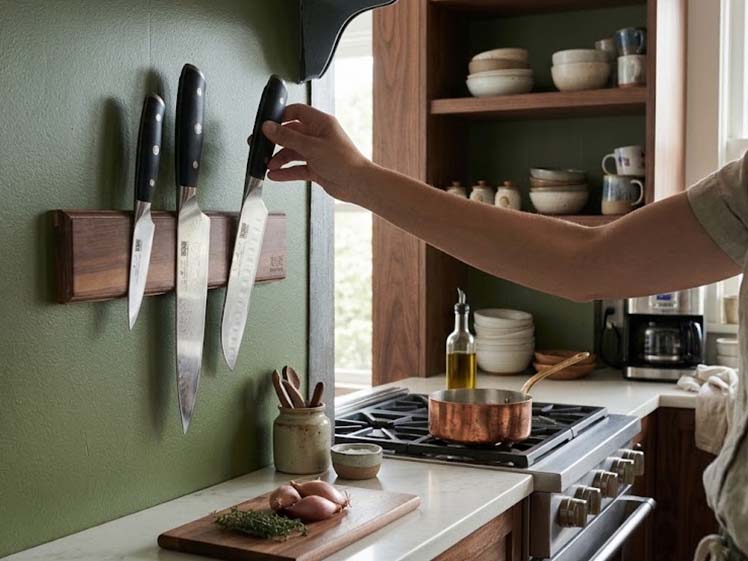
SHAN ZU manufactures its knives in Yangjiang, Guangdong, China. Per its official about us page, every knife is produced at a Yangjiang facility. A Japanese-inspired design or Japanese-sourced steel does not automatically mean the knife was made in Japan.
If you sell knives, that distinction matters. This guide explores SHAN ZU’s product range, steel choices, and brand strategy. You’ll learn what to check when choosing suppliers and how to make clearer product claims for your customers.
Wichtigste Erkenntnisse
- SHAN ZU clearly identifies Yangjiang, China, as its manufacturing location.
- Their root business started in 1996. SHAN ZU knife company launched the brand in 2014.
- Design, material, and manufacturing origin are different parts of a product story.
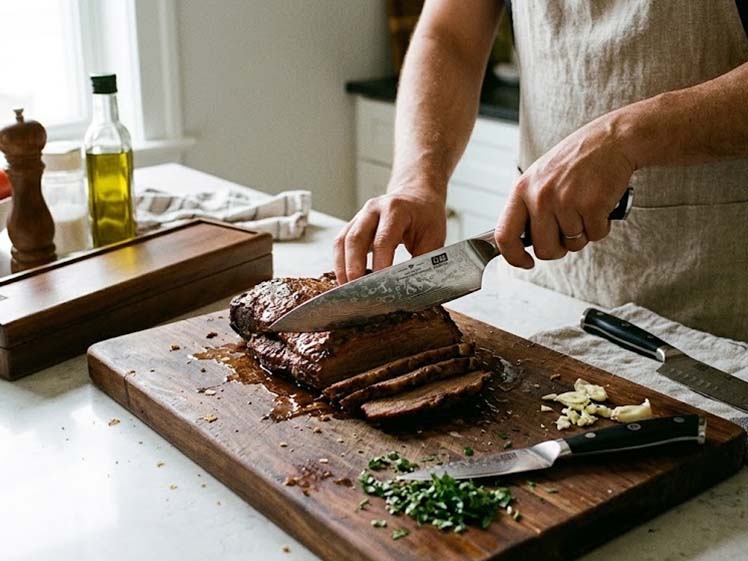
SHAN ZU’s Brand Strategy: Japanese Style with a Clear Origin
SHAN ZU’s model combines Japanese-inspired products with accessible online selling. Damascus patterns, named series, and different blade shapes help customers shop by appearance, task, and budget.
The brand separates that identity from its stated factory location. A Japanese-style knife does not need a vague origin story. Customers can understand both the design and where it is made.
The company’s Climate Pledge profile lists the company as Dongguan Shanzu Trading Co., Ltd. It dates the company to 1996 and SHAN ZU’s launch to 2014, covering kitchen cutlery and EDC items.
| Brand Fact | Details |
| Marke | SHAN ZU |
| Company in brand profile | Dongguan Shanzu Trading Co., Ltd. |
| Production location | Yangjiang, Guangdong, China |
| Company established | 1996 |
| Brand launched | 2014 |
| Main product scope | Kitchen cutlery and EDC items |
| Quelle | Official brand website and company profile |
Where SHAN ZU Knives Are Made: The Yangjiang Connection
Yangjiang and neighboring Yangdong form a major knife-and-scissors district in Guangdong. A University of Tokyo-hosted industry study reported over 1,400 manufacturers there during its fieldwork.
Yangjiang hosts a complete supply chain: skilled blade makers, heat-treatment specialists, handle fabricators, finishing workshops and packaging services. This network supports OEM production and helps sellers develop product tiers without building every process themselves.
Epicurious also discusses Shan Zu in this manufacturing context. Our guide to yangjiang knife manufacturers explores the supply landscape further.
Location does not guarantee quality. Brand and factory must control specifications and production.
Fixed designs and vague specifications make it harder to earn customer trust and stand out. With LeeKnives OEM & ODM, customize the steel, blade design, branding and packaging at factory-direct pricing, with samples approved before bulk production.
MOQ from 100-200 pcs, depending on the product.
SHAN ZU’s Steel and Damascus Strategy
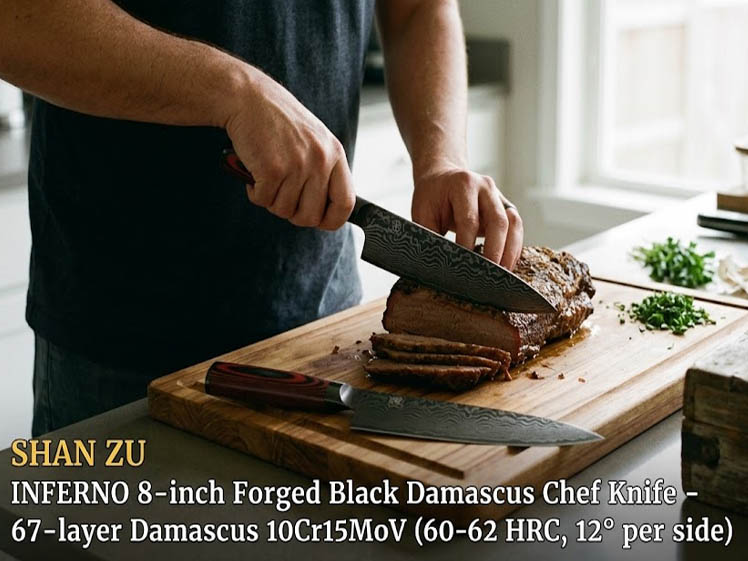
SHAN ZU organizes its lineup by visual tiers and material packages. The INFERNO series features a dark Damascus finish, WHITE TIGER is a higher-hardness filleting knife, and the VENUS set uses copper-toned outer cladding.
“Damascus” only describes the layered, patterned exterior. The cutting core, cladding composition, hardness and edge geometry need separate documentation. You can see how we structure these details in our Damascus steel guide.
| Current Series | Kernstahl | Ebenen | HRC | Rand |
| INFERNO 8-Zoll-Kochmesser aus geschmiedetem schwarzem Damaszenerstahl | 10Cr15MoV | 67-lagiges Damaszenerstahl | 60–62 | 12° pro Seite |
| WHITE TIGER Damaszener-Filetiermesser mit Scheide | SG2-Pulverstahl | 91 Ebenen | 64 | 12° pro Seite |
| VENUS 3-teiliges Damaszener-Kupfer-Set | 10Cr15MoV | Insgesamt 67; 66 äußere Schichten aus Kupfer und Kohlenstoffstahl | 60–62 | 15° pro Seite |
Diese vom Hersteller angegebenen Spezifikationen richten sich an unterschiedliche Nutzergruppen. SG2 bei 64 HRC unterscheidet sich von 10Cr15MoV mit einer Härte von 60–62 HRC, und ein Filetiermesser erfordert eine andere Geometrie als ein Kochmesser.
Die Angabe der Herkunftssprache muss ebenso präzise sein. 10Cr15MoV ist eine chinesische Stahlbezeichnung. SG2 wird mit japanischem Stahl in Verbindung gebracht, doch die Herkunft des Materials ändert nichts daran, wo das fertige Messer hergestellt wird. Unser Japanischer Stahl In diesem Leitfaden werden diese Materialien miteinander verglichen.
Halten Sie in jedem Eintrag drei Aussagen voneinander getrennt:
- Entstehungsgeschichte des Designs: Im japanischen Stil, im westlichen Stil oder nach einer anderen Schwerttradition.
- Herkunft des Materials: Der angegebene Stahl, der für den Schneidkern und andere Bauteile verwendet wird.
- Herkunftsland: Dort, wo das fertige Messer hergestellt wird.
Klare, präzise Produktbeschreibungen helfen Käufern, eine sichere Kaufentscheidung zu treffen, und reduzieren die Anzahl der Rücksendungen.
SHAN ZU Reviews and Quality Lessons
Unabhängige Produkttests liefern aussagekräftige erste Leistungsergebnisse und liefern Anhaltspunkte für Verkäufer.
Epicurious befand, dass das getestete Produkt einen ausgewogenen und harmonischen Geschmack nach Süßkartoffel und Tomate aufwies und in Bezug auf Kräuter das beste Ergebnis innerhalb der Testgruppe erzielte. Die langfristige Schnitthaltigkeit blieb jedoch ungeklärt.
A Rückblick auf „Chefs Resources“ 2019 Getestet wurde ein 8,3-Zoll-GYO: AUS-10V-Kern, 66 Ummantelungsschichten, 60–62 HRC, 15° ±1° Schneidewinkel und ca. 249 g. Die Ergebnisse waren positiv. Das Messer wurde von SHAN ZU zur Verfügung gestellt, und in der Rezension wurde ein Affiliate-Link verwendet.
| Was die Tester festgestellt haben | Was noch zu beachten ist |
| Ausgewogenes Handling, obwohl er 20 % mehr wiegt als der Mac Pro. | Achten Sie auf das Gewicht, nicht nur auf die Klingenlänge. |
| Feine Stücke aus Süßkartoffeln und Tomaten. | Die Ergebnisse beziehen sich auf das jeweils getestete Messer. |
| Die Kräuter zeigten in dieser Testgruppe eine starke Leistung. | Die technischen Daten unterscheiden sich je nach Baureihe erheblich. |
| Das GYO-Modell von 2019 schnitt Basilikum, ohne es zu zerdrücken oder zu zerreißen. | Passen Sie die Bewertungen genau an das jeweilige Modell an. |
Ein Messer muss das Erlebnis bieten, das auf seiner Produktseite versprochen wird. Vier Entscheidungen in der Fertigung sind dafür ausschlaggebend:
- Stahl: Geben Sie den Stahl des Kerns an, anstatt sich auf ein Muster zu verlassen.
- Wärmebehandlung und HRC: Passen Sie die Härte an die Schnitthaltigkeit, die Zähigkeit und den Verwendungszweck an.
- Geometrie: Dicke steuern, mahlen, sowie den Kantenwinkel für die jeweilige Aufgabe.
- Qualitätskontrolle und Endbearbeitung: Kanten prüfen, Griffbaugruppe, Und Oberflächen während des gesamten Produktionsprozesses.
Die Wahl des Stahls bestimmt, für welche Kunden und welche Pflegeanforderungen das Messer geeignet ist. Ein härteres Messer mit feiner Schneide erfordert entsprechende Schneidegewohnheiten. Bei intensiverem Alltagsgebrauch ist möglicherweise eine andere Gewichtsverteilung erforderlich.
Fixed designs and vague specifications make it harder to earn customer trust and stand out. With LeeKnives OEM & ODM, customize the steel, blade design, branding and packaging at factory-direct pricing, with samples approved before bulk production.
MOQ from 100-200 pcs, depending on the product.
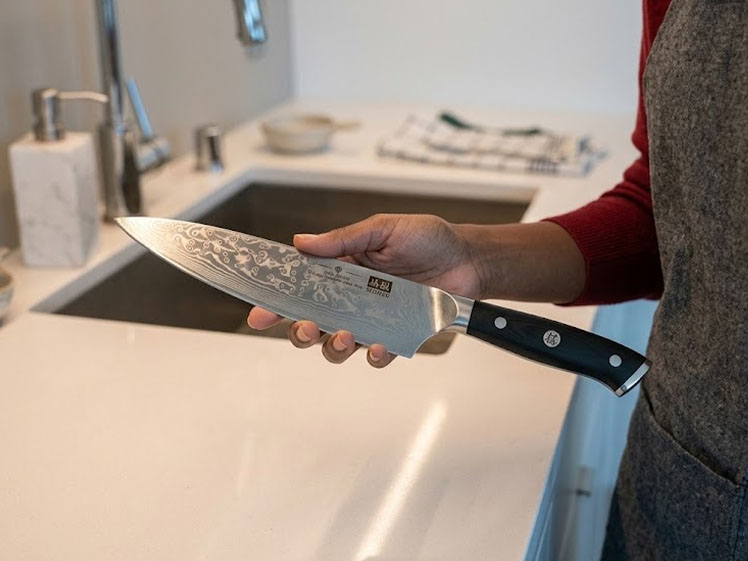
Evaluating Specs Beyond Where Are SHAN ZU Knives Made
Whether you are shopping for your own kitchen or designing a new product line, a detailed listing is your best tool. Digging into the raw specifications helps you see past glossy marketing photos. You can easily judge a knife’s true value when you know what details to check.
- Series and Model: Always keep your technical specifications attached to the correct SKU.
- Core Steel: Remember, the word Damascus describes only the wavy outer layers. You still need to name the solid cutting core.
- Hardness and Rand: Match the Rockwell hardness (HRC) and blade angle to the knife’s intended daily use.
- Physical Build: Clearly list the tang type, handle material, exact blade length, and total weight. Buyers want to know how the handle balances in their grip.
- Buyer Policies: Make current warranty terms and return rules easy to find on the page.
- Real Evidence: Look for independent testing or reviews on that specific model.
For sellers, providing this complete data is good business. It answers buyer questions immediately. Honest specifications build customer trust and keep your support inbox manageable.
SHAN ZU Business Lessons for Your Knife Brand
SHAN ZU’s model offers useful lessons for planning your knife range. Start with your customers’ needs, then tie your designs, materials, pricing, and supplier checks to them.
- Use design to guide buyers. Give each series a clear look. Consistent handles and blade finishes can help customers tell your ranges apart.
- Make price tiers meaningful. Compare steel, blade hardness, cutting shape, and construction. Before charging more, identify the practical benefit your customer receives.
- Check that performance matches your claims. During sample reviews, test the tasks you describe in your marketing. Check slicing, grip comfort, and finish consistency.
- Explain origin clearly. Separate design style, steel source, and manufacturing location. This helps you write product descriptions without implying that Japanese styling means Japanese production.
- Choose steel for everyday use. Consider your buyer’s budget and how they’ll care for it. Then provide clear instructions for cleaning, drying, and storing the material you select.
- Work closely with your manufacturer. Agree on samples, acceptable size differences, and QC checks before production. Use the approved sample as your reference when reviewing batches.
Turn these lessons into a sourcing checklist. Our guides to OEM-Messerhersteller, Hersteller von Handelsmarkenmessern, Und Import von Messern aus China can help you plan your next steps.
Build Your Knife Line with a Yangjiang Manufacturing Partner
LeeKnives is a Yangjiang knife manufacturer and wholesale supplier, with artisans forging knives since 1993. We produce Japanese-, Chinese-, and Western-style knives for retailers, e-commerce sellers, and brand owners.
Our OEM and private-label services cover custom designs, logos, materials, and samples. The typical MOQ is 100-200 pieces per order, depending on the product, with global fulfillment and US warehouse support.
To plan your next custom blade, share your material specifications, unit quantity, target market, and timeline to get a free, detailed quote.
FAQs
Are SHAN ZU knives made in Japan?
No, they are not. On their official About page, you will see that every blade is crafted in a busy factory in Yangjiang, China. A knife might feature a beautiful Japanese-style design or even use imported Japanese steel. However, those raw materials don’t change the final country of manufacture. The finished product ships straight from a Chinese assembly line.
Who makes SHAN ZU knives?
SHAN ZU says its products are made in Yangjiang, China. If you dig into their official Climate Pledge profile, you will find the specific business name: Dongguan Shanzu Trading Co., Ltd. That document outlines the company’s history. So, while you might buy them online, a registered Chinese trading company officially manages the production and local factory partnerships.
Are SHAN ZU knives good quality?
It depends on the model you choose. Carefully check the steel type, heat treatment, blade geometry, and how well the handle fits. Independent tests show these knives offer very useful initial sharpness right out of the box. However, long-term edge retention remains less clear. For the best results, evaluate each specific sample instead of judging the whole brand.
What steel do SHAN ZU knives use?
The metal varies widely across their different series. For instance, current listings show they use solid 10Cr15MoV steel for the INFERNO and VENUS lines. Meanwhile, the premium WHITE TIGER series steps up to SG2 powder steel. Because one model’s material doesn’t apply across the whole catalog, always check the product page to confirm what metal you’re buying.
Is SHAN ZU Damascus steel real Damascus?
Yes, they do describe real layered Damascus constructions on those specific product lines. However, that term alone describes the wavy outer look. It does not identify the actual cutting core or guarantee high performance. Before you buy, check the knife’s core steel, exact layer count, Rockwell hardness rating, and edge specifications to understand how it will cut.
Where is SHAN ZU based?
The official company profile points to Dongguan Shanzu Trading Co., Ltd. Meanwhile, the brand confirms that manufacturing happens in Yangjiang, China. You might notice a US storefront or an American contact point when you shop. However, a local shipping address does not mean the knives are forged there. Main business operations and factory floors remain in Guangdong province.
Source Your Japanese-Style Knife Line with LeeKnives
Building a solid knife brand requires clear blueprints and reliable factory execution. After researching where SHAN ZU knives are made, you may need your own manufacturing partner in Yangjiang.
LeeKnives helps retailers develop Japanese-style knife lines directly on the factory floor. We focus on core buyer needs, delivering strict sample tolerances, consistent batch production, and smooth final fulfillment.
To plan your next custom blade, share your material specifications, unit quantity, target market, and timeline to get a free, detailed quote.




 DE
 EN
 JA