X50CrMoV15 is a highly sought German steel, mainly used for making mid-range knives. It’s a pleasing choice for knife enthusiasts who value corrosion resistance and toughness more than anything. Popular German knife manufacturers like Wüsthof and Zwilling utilize X50CrMoV15 in their entry-level knives.
We can find X50CrMoV15 steel used for making varieties of kitchen cutlery, cleavers, and blades for kitchen electronics. There aren’t many pocket knives made from this steel. If you plan on designing your X50CrMoV15 pocket knives, it might be best to look for better-suiting alternatives.
In this article, we’ll cover everything about X50CrMoV15 steel, how it performs as a knife blade, and compare it to other similar steel.
Key takeaways
- What it is: X50CrMoV15 is a German martensitic stainless steel (DIN 1.4116 / EN 1.4116 / ~AISI 420MoV) widely used in kitchen knives.
- Composition at a glance: ~0.50% Carbon, ~15% Chromium, plus Molybdenum and Vanadium for strength and edge stability.
- Typical hardness: 54–57 HRC when properly heat-treated (Wüsthof / Zwilling target ~56–58 HRC; budget OEMs sometimes ship 52–54 HRC).
- Best at: Excellent corrosion resistance, high toughness, very easy to sharpen, low maintenance — ideal for Western chef’s knives, santokus, paring knives, and bread knives.
- Trade-offs: Edge retention is mediocre versus Japanese steels like VG-10 or AUS-10 — not the right choice for high-volume professional prep or hard-use outdoor knives.
- Best customer fit: Home cooks, hospitality buyers, hotel/restaurant supply, dropshippers, and private-label brands targeting the $25–$120 retail kitchen-knife segment.
X50CrMoV15 steel composition
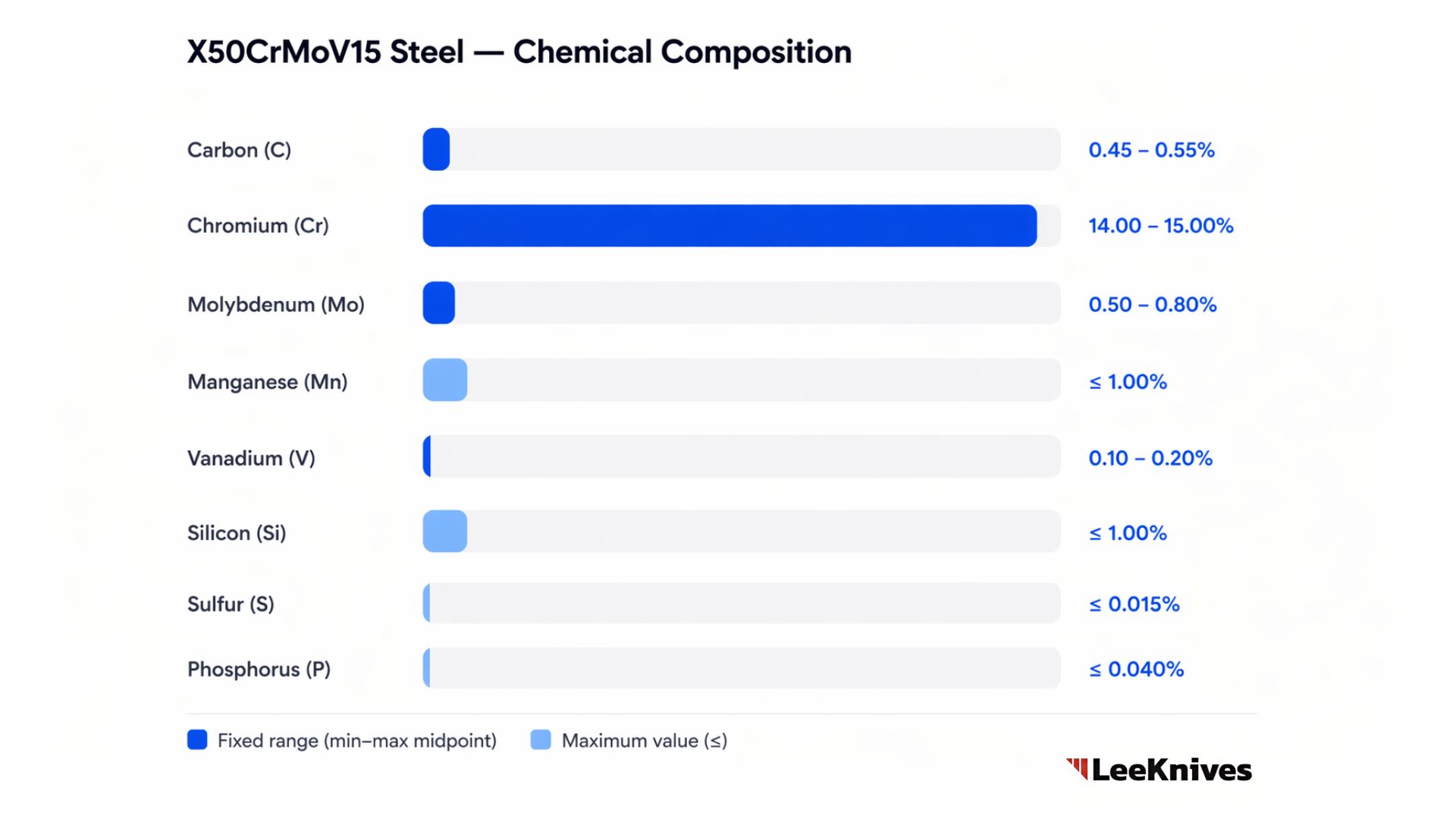
Sources: EN 10088-2:2005 / EN 10088-3:2014; SteelNumber – X50CrMoV15 (1.4116)
Manufacturer’s note (Lee Knives): EN 10088 defines the maximum allowable ranges — the actual chemistry of any given heat (melt) sits inside these limits but can vary slightly from mill to mill. Tighter carbon ranges can be agreed at the time of order, and reputable mills will always supply a Mill Test Certificate (MTC / EN 10204 3.1 cert) documenting the exact chemistry of your batch.
X50CrMoV15 steel characteristics
The composition of X50CrMoV15 is interesting enough. Aside from carbon and chromium, X50CrMoV15 steel has nitrogen, which isn’t ordinary among knife steels. The 0.60% of nitrogen increases the hardness and yield strength of X50CrMoV15. The tiny amounts of vanadium contribute to edge retention, while molybdenum and manganese help with corrosion resistance and strength.
Here is a complete breakdown of what to expect from X50CrMoV15 steel knives, covering critical points, such as hardness and edge retention.
Hardness
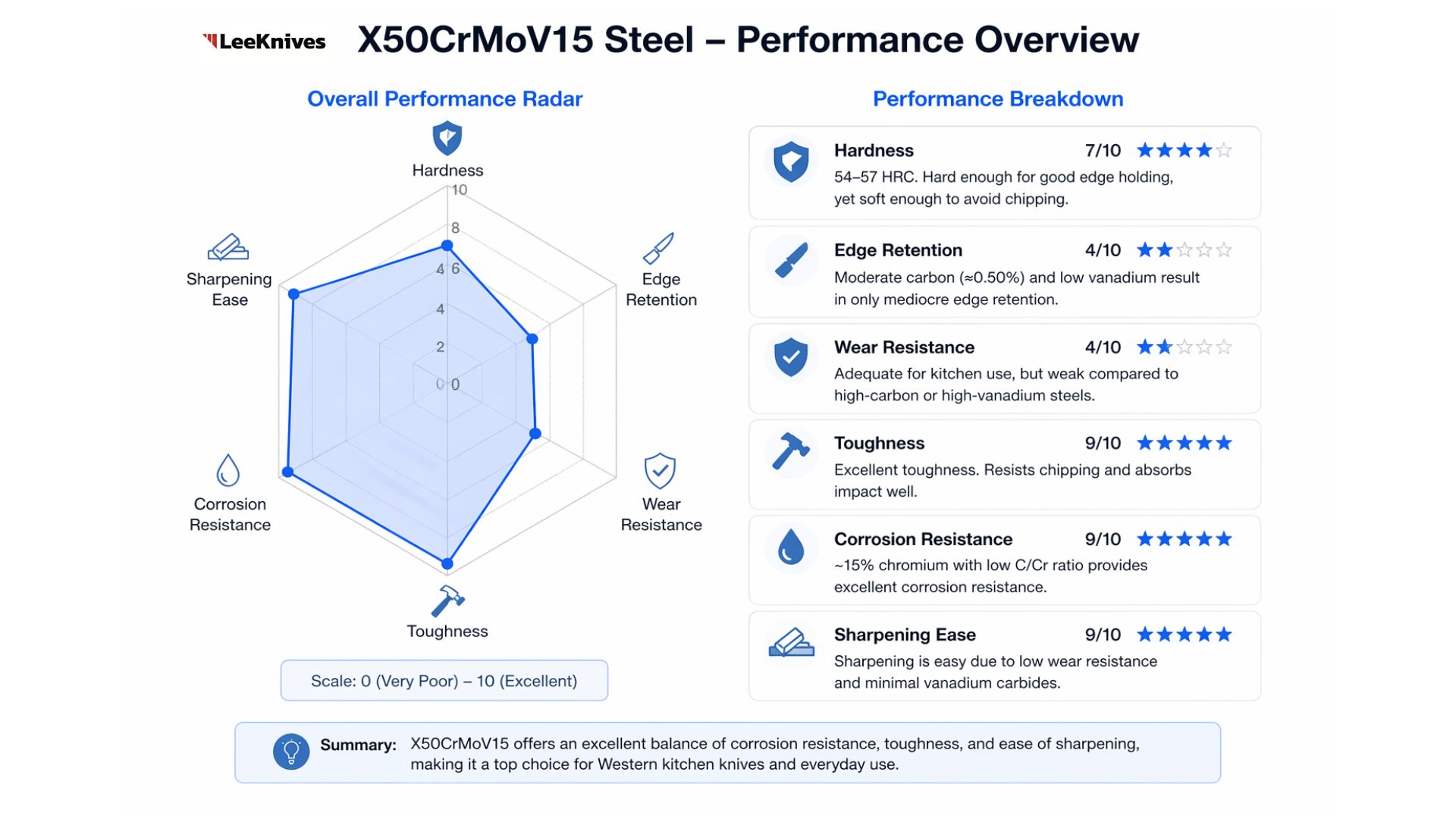
The hardness of X50CrMoV15 blades typically falls between 54 and 57 HRC. Premium German brands target the upper end — Zwilling publishes ~57 HRC, Mercer states 56–58 HRC, and Wüsthof sits around 56 HRC after their proprietary heat treatment.
Budget factories may ship as soft as 52 HRC, which is one of the most common reasons private-label customers come to us complaining their previous supplier’s blades “won’t hold an edge.”
It would be incorrect to expect X50CrMoV15 to behave like a high-carbon Japanese steel — it only contains ~0.50% carbon. But for the Western kitchen knife use case it was designed for, 54–57 HRC is the sweet spot: hard enough to take and hold a working edge, soft enough to flex rather than chip.
Edge retention
Due to its moderate carbon content, X50CrMoV15 has only mediocre edge retention compared with high-vanadium or high-carbon steels. The small vanadium addition helps, but not dramatically.
In a fast-paced commercial prep kitchen processing 50 lbs of tomatoes per shift, the cook will notice the edge dragging by end of day. In a home kitchen used 3–5 times a week, a properly sharpened X50CrMoV15 blade will hold a serviceable edge for weeks before needing more than a quick touch-up on a honing rod.
This is why manufacturers default to X50CrMoV15 for paring knives, utility knives, bread knives, and entry/mid-tier chef’s knives rather than for ultra-premium gyutos or pocket knives.
Wear resistance
Wear resistance is largely driven by hardness and carbide content. X50CrMoV15 has neither in abundance, so wear resistance is best described as “adequate for kitchen use, weak for outdoor/EDC use.” The vanadium and molybdenum carbides give it a slight edge over plain 420 stainless, but it is no match for D2, S30V, or VG-10.
In the kitchen this is rarely a problem. On a wood or HDPE cutting board, a 56 HRC X50CrMoV15 chef’s knife will give you years of service before needing a real regrind.
Toughness
Where hardness drops, toughness usually rises — and X50CrMoV15 is the textbook example. It absorbs shock without complaint. Hit a chicken bone with an X50CrMoV15 chef’s knife and the edge is far more likely to roll than chip. A rolled edge can be straightened in seconds with a honing steel; a chip requires regrinding the bevel.
Molybdenum boosts tensile strength and Manganese reduces brittleness, both contributing to a knife that bends or twists slightly under abuse rather than shattering. This is exactly why German brands have built their warranty programs around it: warranty returns for chipped edges are dramatically lower than with hard Japanese steels.
Corrosion resistance
This is X50CrMoV15’s headline strength. With ~15% chromium and a low carbon-to-chromium ratio, it forms a robust passive oxide layer that shrugs off acids, moisture, and salt.
Independent testing has shown X50CrMoV15 resisting 72+ hours of acidic exposure without pitting, and surviving 100+ dishwasher cycles with ~85% surface integrity (we still recommend hand-washing — see the Care section).
For Western and home kitchens — where citrus, tomatoes, brines, and the occasional dishwasher trip are part of daily life — this corrosion resistance is the single biggest reason German brands have stuck with this steel for over 50 years.
OEM tip: If your end-customer market is humid (Southeast Asia, coastal regions, hospitality) corrosion resistance trumps every other property. X50CrMoV15 is almost always the safe specification.
Buy Wholesale Knives and Start Scaling up with Us Today
Contact us and connect with a sales rep to get a free quote.
A steel’s wear resistance largely determines how hard it is to sharpen. Because X50CrMoV15 has modest wear resistance and minimal vanadium carbides, it sharpens beautifully — even on basic whetstones, pull-through sharpeners, or electric sharpeners. A 1000–3000 grit stone is all most users need.
This is a real selling point for the home-cook market: customers who would never buy expensive ceramic stones can still keep an X50CrMoV15 knife screaming sharp with a $20 honing rod and a $15 pull-through.
Heat treatment: Why two “identical” steels perform differently
Two factories can both cut their blanks from the same X50CrMoV15 coil and ship knives that perform completely differently. The difference is heat treatment.
A best-practice X50CrMoV15 heat-treat schedule looks like this:
- Austenitizing: 1010–1050 °C (1850–1922 °F), soak 10–20 min
- Quench: Fast oil quench (e.g. Parks 50) to below 150 °C
- Cryogenic treatment (optional but recommended): −80 °C to −195 °C for 1–2 hours — converts retained austenite to martensite, adding 1–2 HRC and improving edge stability. (This is what Zwilling markets as Friodur®.)
- Tempering: 150–200 °C for 1–2 hours, two cycles, cooling to room temp between cycles.
- Stress relieving: Optional 100–120 °C for 1 hour after final grinding.
Pros and cons of X50CrMoV15 steel kitchen knives
Pros
- Excellent corrosion resistance: X50CrMoV15 isn’t sensitive to rust. Resisting oxidation in the kitchen or humid environments is X50CrMoV15’s strongest suit.
- Good toughness: X50CrMoV15 won’t chip or break easily. The damages caused by forcefully cutting denser ingredients aren’t prevalent with X50CrMoV15 steel knives.
- Easy sharpening: Aside from quickly honing to restore the edge, sharpening X50CrMoV15 steel kitchen knives on a whetstone is straightforward. Most cooks won’t even see their whetstones dipping down after multiple sessions.
Cons
- Mediocre edge retention: X50CrMoV15 steel knives aren’t suitable for continuous use. The added vanadium and nitrogen boost edge retention but only to a small degree.
- Underperforming wear resistance: This isn’t a big issue in the kitchen. However, outdoors bring more wear and tear to knives. The underperforming wear resistance of X50CrMoV15 doesn’t make it ideal for outdoor use.
Which brands use X50CrMoV15?
Understanding who uses this steel in production is one of the strongest pieces of evidence that X50CrMoV15 is a proven, commercially reliable choice — not a marketing gimmick.
| Brand | Series / Lines using X50CrMoV15 | Published HRC |
|---|---|---|
| Wüsthof | Classic, Pro, Gourmet | ~56 HRC |
| Zwilling J.A. Henckels | Pro, Four Star, Twin Signature (Friodur® cryo-treated) | ~57 HRC |
| Henckels International | Forged Premio, Statement, Solution | 54–56 HRC |
| Mercer Culinary | Genesis, Renaissance | 56–58 HRC |
| Victorinox | Some Fibrox models (close cousin X55CrMoV14) | ~56 HRC |
| ProCook | Gourmet X50, Damascus 67 cores | 56 HRC |
| Böker | Forge / Core kitchen lines | 55–56 HRC |
| IKEA | 365+ kitchen line | 56–58 HRC |
Why this matters to OEM buyers: When a steel is used by Wüsthof, Zwilling, and Mercer, the global supply chain (mill capacity, heat-treat know-how, sharpening tooling) is mature and predictable. That translates directly into lower defect rates, faster lead times, and cheaper per-piece pricing for your OEM order.
X50CrMoV15 steel vs. other knife steels
X50CrMoV15 steel vs. other German steel
- X55CrMoV14 is similar to X50CrMoV15 but with higher carbon content. The difference in carbon amounts between the two is only minor at about 0.10%. Still, this makes it different steel with better wear resistance. Victorinox, a popular Swiss Army knife maker, uses X55CrMoV14 to manufacture their knives. If you want similar attributes to X50CrMoV15 but for pocket knife use, X55CrMoV14 is the best alternative.
- X55CrMo14 and X55CrMoV14 are the same except for the vanadium. X55CrMo14 has more carbon than X50CrMoV15. The lack of vanadium makes it easier to sharpen and gives it a finer edge. It has better wear resistance than X50CrMoV15, making it ideal for EDC knives. Nonetheless, X55CrMo14 is more prevalent in kitchen knives, just like X50CrMoV15.
- X45CrMoV15 is a tougher alternative to X50CrMoV15 and has less carbon. The same as X50CrMoV15, its main uses are in kitchen cutlery. X45CrMoV15 is somewhat a better choice for large knives like Serbian chef’s knives and cleavers that cut with more force. The higher toughness enables X45CrMoV15 to perform better in these knives.
X50CrMoV15 steel vs. Japanese steel
Japanese and German steels don’t have much in common. Both cultures have different types of cuisine. The equipment that works the best for that cuisine varies. Japanese chefs favor hardness with incredible sharpness, while German chefs favor toughness and corrosion resistance.
Take VG-10 as an example. It’s Japanese steel with good hardness and edge retention but isn’t as tough as most German steel. This makes VG-10 more susceptible to chipping, but the uses also matter. Japanese cutlery has specialized knives for many different purposes. While western chefs turn to their all-purpose knives for most tasks, Japanese chefs tend to use their specialized knives, as the edge and hardness aren’t suitable at times.
X50CrMoV15 vs. 1.4116 — Are they the same steel?
This question gets asked constantly, so let’s settle it:
- X50CrMoV15 is the DIN naming standard (German national standard).
- 1.4116 is the EN/Werkstoff number for the same steel.
- 420MoV is the rough US/AISI equivalent (close but not identical chemistry).
- “4116” by itself usually refers to Krupp 4116, ThyssenKrupp’s own variant — same family, slightly tighter tolerances and consistent heat-treat response.
For all practical OEM purposes, X50CrMoV15 = 1.4116. Confirm the Werkstoff number on your mill cert.
How to care for X50CrMoV15
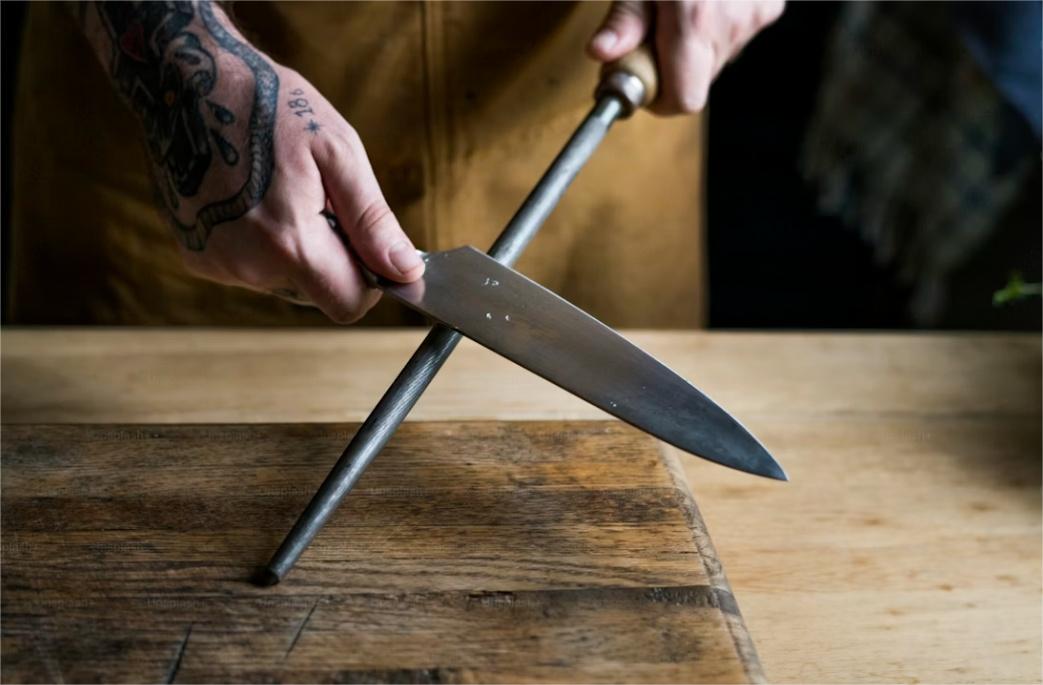
Even though X50CrMoV15 is one of the most forgiving steels on the market, a few simple habits will keep your knives performing like new for 7–10 years in a home kitchen or 18–24 months in a commercial setting.
- Hand wash and dry immediately — not because it will rust quickly, but because dishwasher detergents and high heat dull edges and damage handles.
- Use wood, HDPE, or rubber cutting boards. Never glass, granite, or ceramic.
- Hone before every cooking session with a steel or ceramic rod — 5–10 light passes per side.
- Sharpen on a 1000–3000 grit whetstone every 2–3 months for home use, or weekly for commercial.
- Sharpening angle: 17–20° per side is the sweet spot. Going below 15° is possible but reduces edge stability.
- Store in a knife block, magnetic strip, or with edge guards — never loose in a drawer.
- Light surface rust? Rare on X50CrMoV15, but if it appears: a paste of baking soda + water and a wine cork or soft sponge will remove it.
Final words
X50CrMoV15 is tough, extremely corrosion resistant, and easy to sharpen — three properties that make it the default choice for Western chef’s knives, paring knives, santokus, and bread knives across the entire mid-market. It’s the right steel for home cooks, hospitality buyers, hotel and restaurant supply, and private-label brands serving the $25–$120 retail price band.
It is not the right steel if your customer is a sushi chef, a competition-level professional doing 8-hour prep shifts, or a hard-use outdoor buyer. For those use cases, point them toward VG-10, AUS-10, S30V, or our Damascus core lines.
The chances of success selling kitchen knives made from German steel to Japanese-tradition chefs is slim — and vice versa. Match the steel to the customer, and you’ll have a product that practically sells itself.
Ready to OEM X50CrMoV15 knives with LeeKnives?
At LeeKnives we manufacture X50CrMoV15 cutlery for global brands, distributors, hospitality groups, and dropshippers. Every order ships with:
- Mill test certificate (MTC) for the steel batch
- Hardness test report (HRC tolerance ±1)
- Custom blade geometry, handle material (POM, G10, Pakkawood, Micarta, riveted wood), bolster, and edge angle
- Custom logo etching, packaging, and barcoding
Launch Your Custom Knife Line Faster with LeeKnives
Complete OEM/ODM support—from design to final shipment—so you can focus on growth.
Backed by warehouses in the U.S. for fast, reliable delivery.
Frequently asked questions
Is X50CrMoV15 a good knife steel?
Yes. X50CrMoV15 is a good-to-very-good kitchen knife steel that prioritizes corrosion resistance, toughness, and ease of sharpening over extreme edge retention. It is the established mid-range standard for German-style kitchen knives, used by Wüsthof, Zwilling, Mercer, and many others. It is not recommended for hard-use outdoor knives or pocket folders.
What does X50CrMoV15 mean?
The name follows the European DIN naming convention:
- X = high-alloy stainless steel
- 50 = ~0.50% carbon
- Cr = chromium
- Mo = molybdenum
- V = vanadium
- 15 = ~15% chromium
X50CrMoV15 vs 440C — which is better?
440C has more carbon (1.0% vs 0.5%) and slightly better edge retention. X50CrMoV15 has better corrosion resistance, better toughness, and is easier to sharpen. For kitchen knives, X50CrMoV15 is usually the smarter spec; for fixed-blade outdoor knives, 440C may be preferable.
What is the difference between 7Cr17MoV and X50CrMoV15?
7Cr17MoV is a Chinese-origin steel with higher carbon and chromium on paper, but mill quality is inconsistent — the same grade from two different suppliers can perform very differently.
X50CrMoV15 follows tighter European standards, delivering predictable 54–57 HRC hardness, better toughness, and a longer track record in professional kitchens.
For most buyers, the real difference isn’t the chemistry — it’s the consistency.
Is X50CrMoV15 good for outdoor / pocket / EDC knives?
Generally no. Its modest edge retention and wear resistance are mismatched to the cutting tasks an outdoor or EDC knife sees (rope, wood, cardboard, plastic strapping). For those use cases, look at X55CrMoV14, AUS-8, D2, S30V, or VG-10.
Can X50CrMoV15 knives go in the dishwasher?
Technically yes — the steel can withstand it. Practically no — dishwasher detergents are abrasive, the high heat damages handles, and blades knock against other items and dull. Always hand wash and dry for maximum knife life.




 EN
EN  JA
JA  DE
DE