In this article we’re talking about 10Cr15CoMoV steel. We’ll assess it as a knife steel, what goes into it, how it ranks against some other popular knife steels available today, and if it’s a good knife steel product to carry in your store.
As a knife retailer, it’s so important to know your materials so that you can discuss these with your buyer and help them make educated decisions on which products suit both their lifestyle and their budget.
What is 10Cr15CoMoV steel?
10Cr15CoMoV steel is a budget high carbon stainless steel that is produced by and exported from China. 10Cr15CoMoV steel is regarded on the market today as an analog steel (a copy) to the Japanese VG10 steel and it shares basically the same characteristics.
The Japanese VG10 steel has in the past been subject to export bans, and this motivated China to develop an equivalent steel which is 10Cr15CoMoV steel.
This is understandable as there was certainly a gap in the market for a VG10 steel duplicate, and VG10 is a highly popular knife material, so copying it makes a lot of sense, particularly if that can be done much more cheaply than the original.
A mouthful of a name: what does 10Cr15CoMoV mean?
Steel manufacturers do follow a general system of naming steel alloys, but this isn’t always adhered to strictly by different companies and manufacturers have their own designations that they like to follow.
In general, the letters and numbers of the steel’s name refer to the steel’s main alloying element, the approximate amount of that element in the steel, and the approximate carbon content expressed in hundredths of 1 percent.
In the name 10Cr15CoMoV the ‘Cr’ refers to Chromium and ‘Co’ refers to the Cobalt content. 10 indicates it has 1.0% of carbon content, 15 means the steel contains 15% of chromium.
Buy Wholesale Knives and Start Scaling up with Us Today
Contact us and connect with a sales rep to get a free quote.
The composition of 10Cr15CoMoV steel
Iron ore is the foundation component of steel and makes up most of its content. However, iron is alloyed or mixed with other elements to produce a steel alloy with various properties desired by the maker.
Let’s look at these in 10Cr15CoMoV steel.
- Chromium: The element Chromium makes up 15.50% of 10Cr15CoMoV steel and it’s what makes the steel ‘stainless’ grade. The Chromium makes the steel harder and tougher.
- Carbon: Carbon makes up 1.05% of the steel and it adds to the steel’s hardness, edge retention and resistance to pressure and wear.
- Cobalt: Cobalt is 1.50% of 10Cr15CoMoV steel. It improved the ability of the steel to be heat treated and thus made stronger. It also helps reduce retained austenite after quenching.
- Molybdenum: 1.20% of 10Cr15CoMoV steel is Molybdenum. This element makes the steel machine workable and helps it harden during manufacture.
- Manganese: Manganese is in 10Cr15CoMoV steel at 0.50%. The Manganese hardens the blade but can add brittleness too IF too much is added to the alloy.
- Vanadium: At 0.30%, the Vanadium in 10Cr15CoMoV increases the steel’s toughness and wear resistance and it also helps with resistance to corrosion.
- Phosphorus: Phosphorus makes up 0.03% of 10Cr15CoMoV and even in this tiny amount it strengthens the steel and makes it workable under heat.
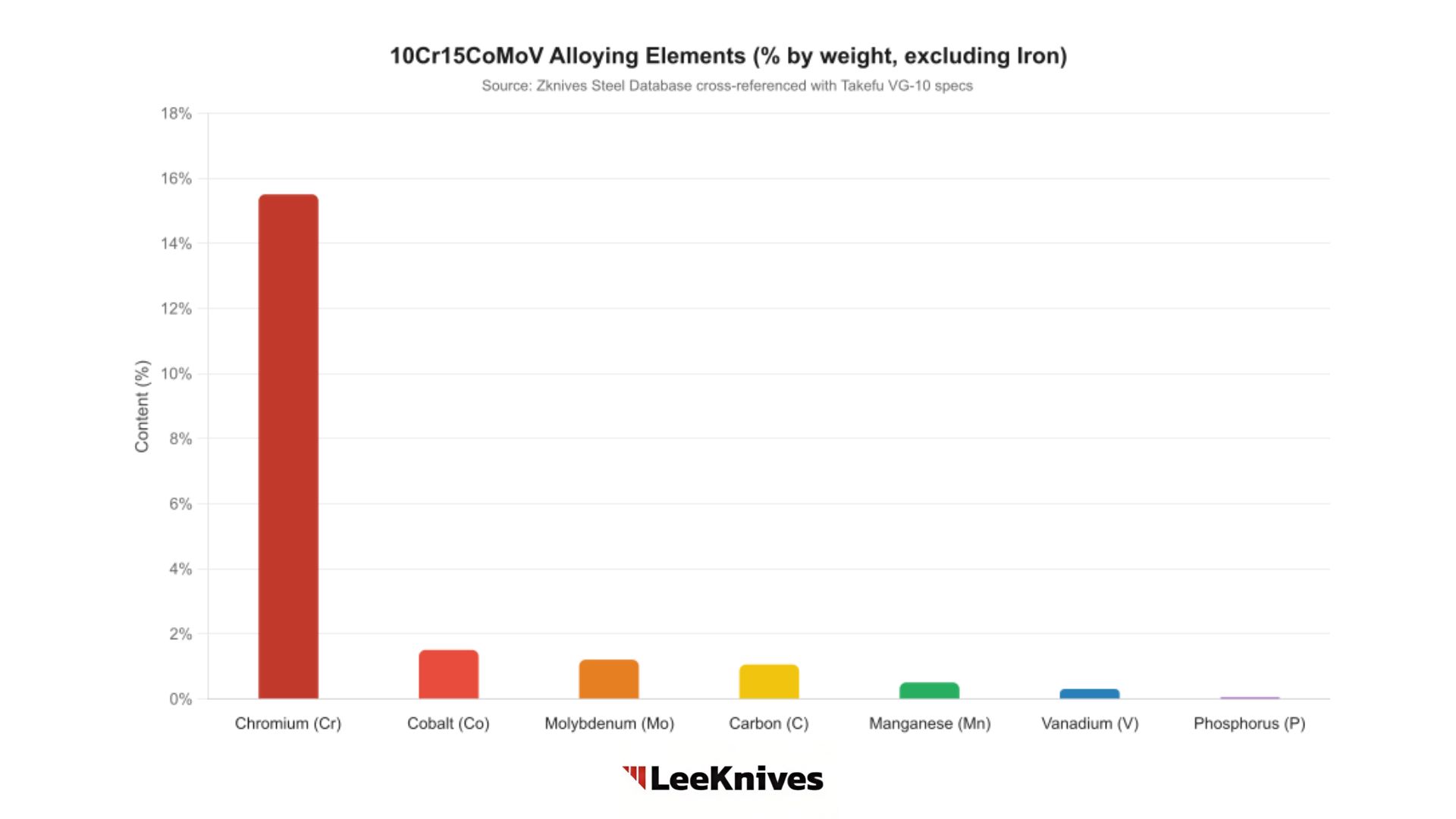
Chemical composition data sourced from Zknives Steel Database, which cross-references 10Cr15CoMoV against Takefu VG-10 specifications. No official GB standard sheet has been publicly released by Chinese manufacturers.
10Cr15CoMoV steel properties
| Feature | Description | Rating |
|---|---|---|
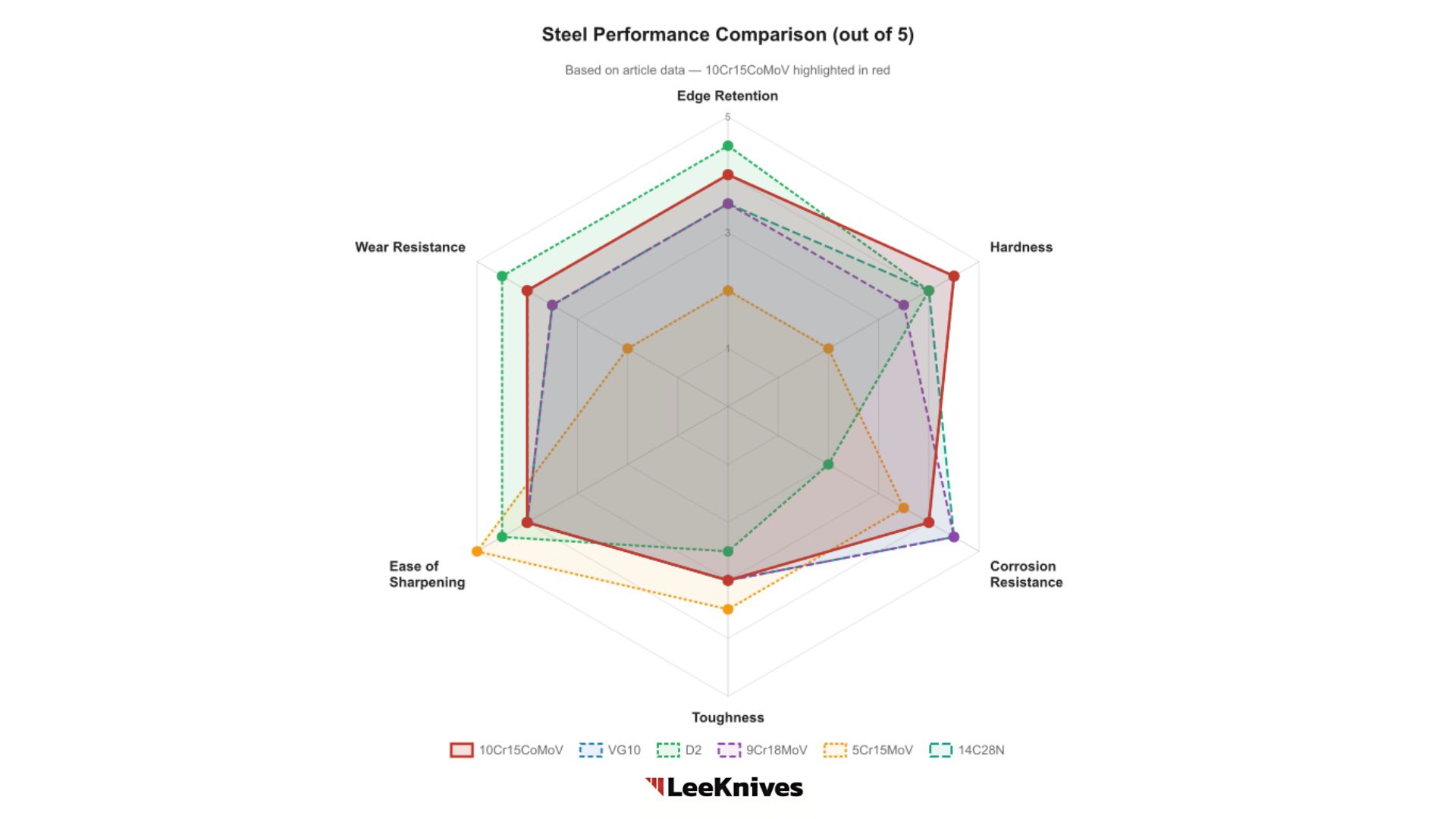
| Edge Retention | – Offers very good edge retention , – holds a sharp edge for an extended period, reducing the need for frequent sharpening | ★★★★☆ |
| Toughness | – Possesses adequate toughness for most kitchen and everyday tasks. – it may be prone to chipping with very demanding use compared to tougher steels. | ★★★☆☆ |
| Corrosion Resistance | – Excellent corrosion resistance due to its high Chromium content. – it is well-suited for humid environments like kitchens. | ★★★★☆ |
| Ease of Sharpening | – Refreshes quickly on common water stones or ceramics; no specialized abrasives required. | ★★★★☆ |
Hardness
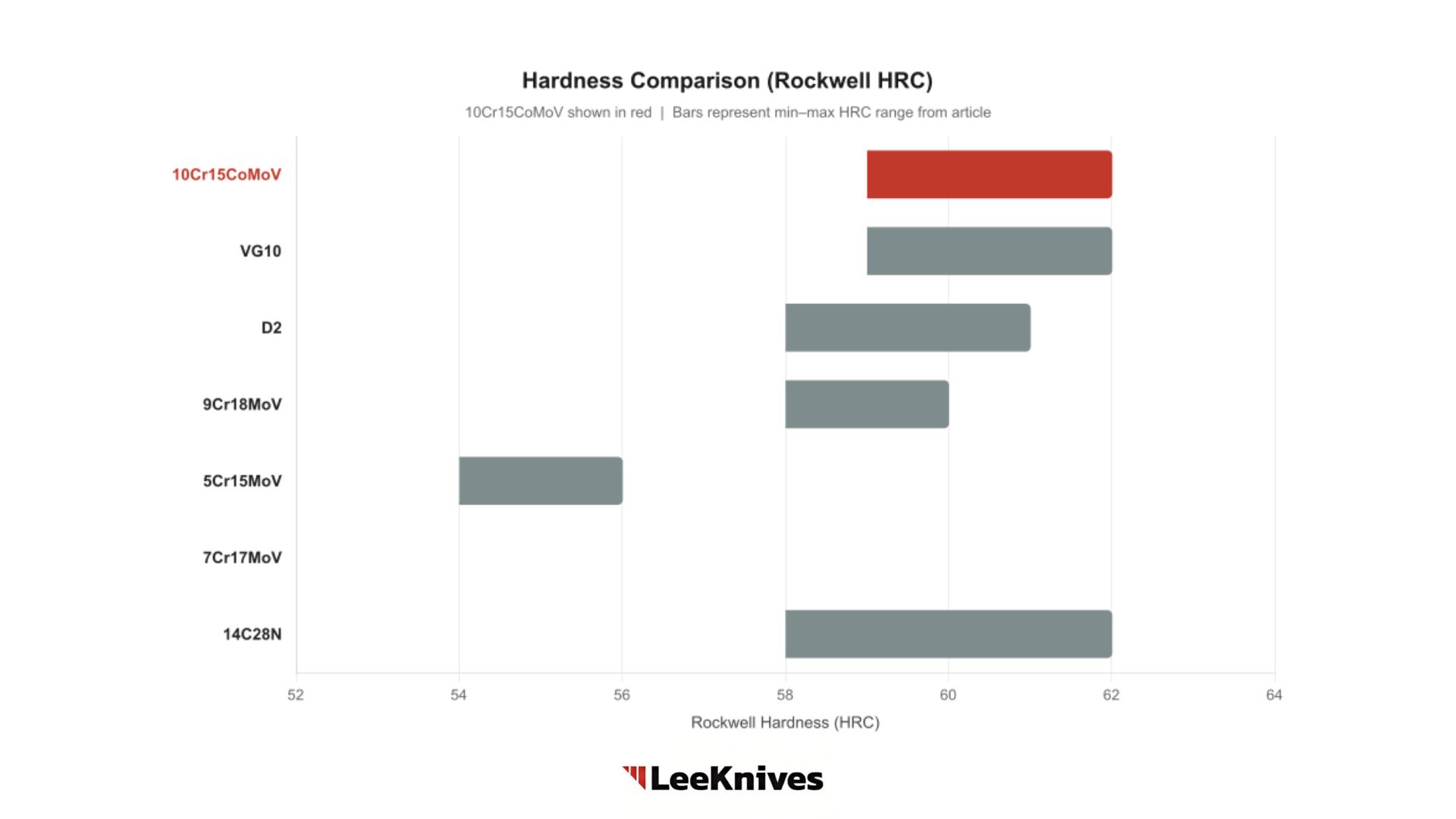
This steel has a Rockwell hardness rating of 59 – 62, based on how it’s heat treated. This is a very ‘good’ rating for a steel and means that it’s very hard and able to stand up to wear and impacts. For this reason, 10Cr15CoMoV steel is used for both outdoor and domestic (kitchen) knives.
To better understand how 10Cr15CoMoV hardness compares to other common knife steels, the table below shows typical hardness ranges across similar materials.
Toughness
As a steel gets harder, its toughness typically decreases. 10Cr15CoMoV offers adequate resistance to impact for most kitchen and general-use applications. However, care should be taken to avoid heavy chopping or prying to prevent the blade from chipping.
Corrosion resistance
10Cr15CoMoV steel is stainless due to its Chromium content, which means it resists rust. Care must be taken though like with any knife steel and knives made from 10Cr15CoMoV steel must be dried thoroughly after use and kept in dry conditions.
Edge retention
10Cr15CoMoV steel performs well in this area and holds a sharp edge for a desirable amount of time. This steel needs infrequent sharpening which suits customers that dislike sharpening or simply don’t have a lot of time for it.
Wear resistance
A key quality of any good quality steel is its ability to withstand wear and tear and because of the clever blending of elements in the 10Cr15CoMoV alloy, this steel can resist damage and abrasion very well.
Ease of sharpening
10Cr15CoMoV steel offers user friendly utility to the buyer in that it holds an edge for a lengthy time, meaning less sharpening in the first place! Also, the steel itself lends itself to being honed and sharpened so when sharpening is needed, it is not complicated or onerous.
Overall, this steel scores well across several quality assessment areas and it’s clear to see why it’s such a popular choice for the knife buyer and matches the performance levels of its equivalent steel VG10.
Heat Treatment: The Factor That Separates Good 10Cr15CoMoV from Bad
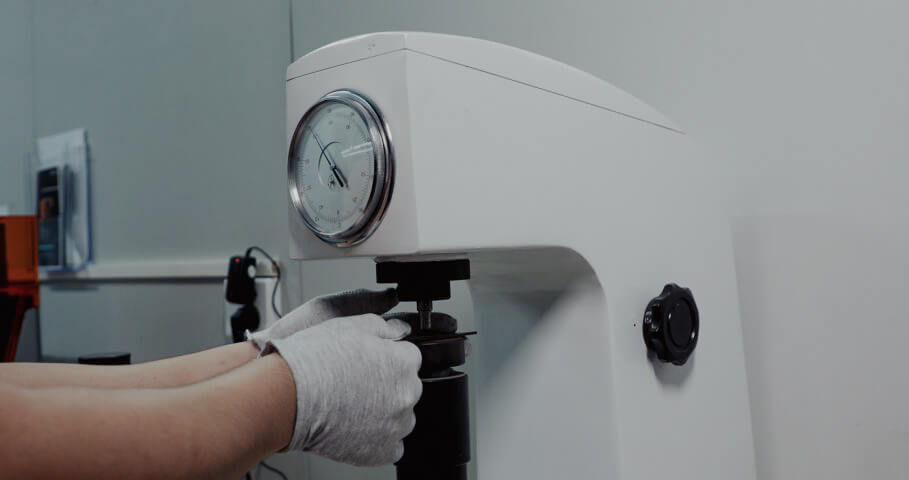
Two blades from identical 10Cr15CoMoV stock can perform completely differently depending on how they were heat treated. This is the most important variable when evaluating suppliers.
Standard process:
- Austenitizing: Heat to 1,050–1,100°C to dissolve carbides
- Quenching: Rapid cooling to form martensite (the hard phase)
- Double tempering: Two cycles at 200–250°C to relieve stress and stabilize at 59–62 HRC
Skipping or rushing double tempering is a common cost-cutting shortcut. The blade tests fine on composition but chips or rolls in use.
When sourcing, request:
- HRC certificates per batch (59–62 is the acceptable range; below 58 is a red flag)
- Heat treatment process documentation
- Sample blades for independent spot-testing before bulk order
A reputable OEM supplier provides this without hesitation.
Real-World Performance Data
Specification sheets describe what a steel can do under ideal conditions. The numbers below represent documented performance under actual use and structured testing.
| Test | Result |
|---|---|
| Hardness (HRC) | 59–62 (properly heat treated) |
| Edge retention (CATRA, sisal rope) | ~800–1,000 cuts |
| Impact toughness | 25–30 J/cm² |
| Salt spray (72h) | No surface rust; minor at grind line |
| Recommended sharpening angle | 15–18° per side |
These numbers confirm what the composition analysis predicts: 10Cr15CoMoV is a genuine high-performance steel at mid-tier pricing, not a marketing label applied to commodity stock. The key caveat — as with all performance claims — is that results depend on heat treatment quality.
An undertreated blade in the same steel may test 4–6 HRC points lower and lose its edge in half the cutting cycles.
User experience: Real-world insights on 10Cr15CoMoV steel
Knife communities on Reddit and BladeForums have accumulated years of hands-on feedback on this steel. Three consistent themes:
- Heat treatment makes or breaks it. Users from reputable brands report VG10-level performance; those from aggressively priced sources report early edge rollover. The steel is not the variable — the manufacturer’s process is.
- Easy to sharpen, better edge retention than 9Cr18MoV. Users migrating from harder steels find 10Cr15CoMoV responsive on a standard whetstone. Edge retention is rated noticeably above 9Cr18MoV by most users.
- Comparable to 440C. The BladeForums consensus places 10Cr15CoMoV alongside 440C: marginally tougher, slightly lower corrosion resistance, equivalent edge retention when both are properly hardened — at a lower price point.
For retailers: when customers ask if this is “just a budget knockoff,” the community answer is that the steel spec is legitimate. Execution varies by manufacturer. Stocking from suppliers who document their heat treatment process is how you defend that answer on the shop floor.
10Cr15CoMoV steel compared to other steels on the market
10Cr15CoMoV steel vs VG10 Steel
10Cr15CoMoV was engineered as a direct equivalent to Japan’s VG10 — same cobalt content, near-identical chromium, carbon, and vanadium levels. Both reach 59–62 HRC with proper heat treatment, and in daily kitchen use the performance difference is negligible.
The only real gap is price and supply. VG10 comes exclusively from Takefu Special Steel in Japan and has faced export restrictions. 10Cr15CoMoV is widely available from Chinese manufacturers at 20–30% lower OEM cost.
If your customer asks for “VG10 quality at a mid-range price,” 10Cr15CoMoV is the honest answer. The steel is not inferior — it is a deliberate engineering equivalent. The difference shows up in the invoice, not the cutting board.
10Cr15CoMoV steel vs D2 steel
D2 steel is a tool steel that is ‘semi – stainless’, not a true stainless steel like 10Cr15CoMoV steel, so it doesn’t have as good a resistance to rust.
10Cr15CoMoV steel is also tougher than D2 due to its alloy composition. D2’s large, unevenly distributed carbides — a result of its high carbon tool steel nature — make it more prone to micro-chipping along the edge, whereas 10Cr15CoMoV’s finer carbide structure delivers more consistent toughness in everyday use..
As a tool steel D2 is comparatively easier to sharpen than a stainless steel like 10Cr15CoMoV and it will hold an edge longer.
Both steels offer pros and cons that the buyer must assess and of course it must be factored in what the knife is to be used for. Different knife steels perform differently under different conditions, so the usage and habits of the buyer are important when matching customer to ‘best’ knife steel for THEIR lifestyle.
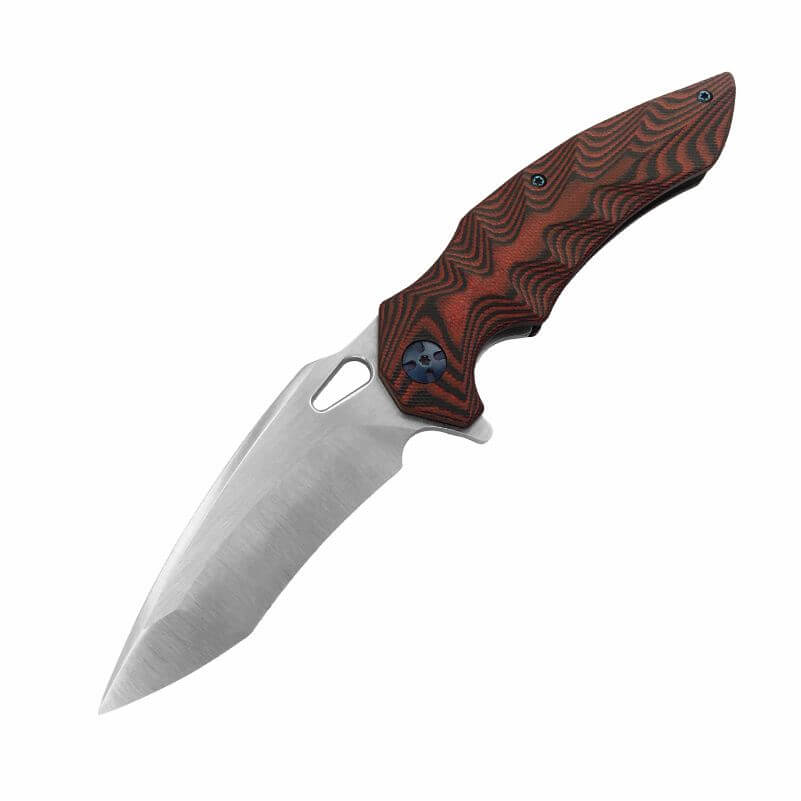
D2 G10 Folding Knife LKFDK10010
Buy Wholesale Knives and Start Scaling up with Us Today
Contact us and connect with a sales rep to get a free quote.
10Cr15CoMoV steel vs 9Cr18MoV steel
With a hardness rating (HRC) of 58 – 60, 9Cr18MoV steel isn’t as hard as 10Cr15CoMoV, but this difference is so negligible that it wouldn’t be noticeable to many buyers.
In terms of corrosion resistance, the 9Cr18MoV wins as it has a higher amount of chromium in the alloy. For this reason, it may be a better knife steel to suggest to a customer looking for a knife steel that’ll be fine if used near water a lot, outdoors or simply not maintained as much.
As 10Cr15CoMoV has a higher level of vanadium carbides in the alloy, it undoubtedly has better hardness as we’ve said and for this reason holds a sharp edge longer than 9Cr18MoV steel.
Toughness of both steels is equivalent; they score about even in this category.
10Cr15CoMoV Steel vs 5Cr15MoV Steel
10Cr15CoMoV represents a significant performance upgrade over 5Cr15MoV, primarily due to its substantially higher carbon content (1.05% vs. 0.50%). This results in 10Cr15CoMoV achieving a much higher hardness (59-62 HRC vs. 54-56 HRC) and, consequently, superior edge retention.
Additionally, 10Cr15CoMoV benefits from higher molybdenum and the presence of cobalt, which are absent in 5Cr15MoV, further enhancing its hardenability, wear resistance, and overall stability.
While 5Cr15MoV is a budget-friendly option that is easier to sharpen, 10Cr15CoMoV delivers a professional-grade cutting experience with extended sharpness and greater durability.
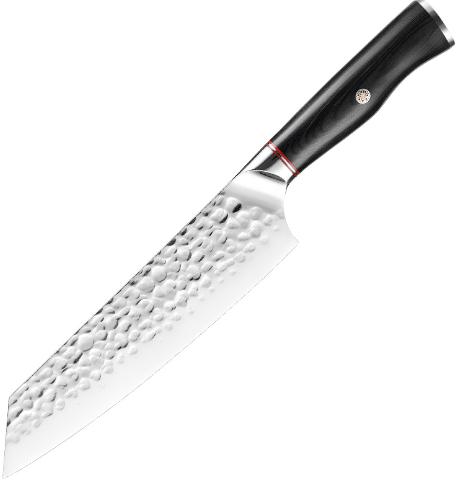
Damascus Clad 5Cr15MoV Pakkawood Gyuto 203 mm Hammered Finish KKDA0323
10Cr15CoMoV steel vs 7Cr17MoV steel
With an HRC of 60, 7Cr17MoV steel is not as hard as 10Cr15CoMoV but it is still a very hard steel for everyday usage.
As 10Cr15CoMoV has added Vanadium and carbon, it excels 7Cr17MoV steel in terms of overall toughness and edge retention.
Bear in mind these differences may not even be noticed by the average buyer as many steel alloys are so similarly composed that it would take an expert to distinguish between them.
7Cr17MoV steel is also a stainless steel with a high level of Chromium so it offers very good corrosion resistance, both steels are about equal in this respect.
10Cr15CoMoV Steel vs Sandvik 14C28N Steel
Sandvik 14C28N has gained popularity as a Swedish stainless steel often used in affordable yet high-performance knives.
With an HRC of 58-62, it matches 10Cr15CoMoV in hardness, but offers slightly better corrosion resistance due to its optimized chromium and nitrogen balance, making it ideal for wet environments like fishing or kitchen use.
However, 10Cr15CoMoV edges out in edge retention and wear resistance thanks to its vanadium and cobalt additions, holding a sharp edge longer under heavy cutting.
Toughness is comparable, but 10Cr15CoMoV’s lower cost (often 20-30% cheaper in production) makes it a stronger budget option.
Cost Structure and Supply Chain: What Retailers Need to Know
Raw material cost
10Cr15CoMoV steel strip trades at roughly $1,800–$2,500/ton from Chinese mills — about 20–30% cheaper than Japanese VG10 ($3,500–$5,000+, single-source from Takefu). But raw steel only accounts for 5–10% of a finished knife’s FOB cost. The real cost driver is heat treatment, grinding, handle material, and QC.
Finished knife FOB pricing (Yangjiang OEM, MOQ 300–1,000 pcs)
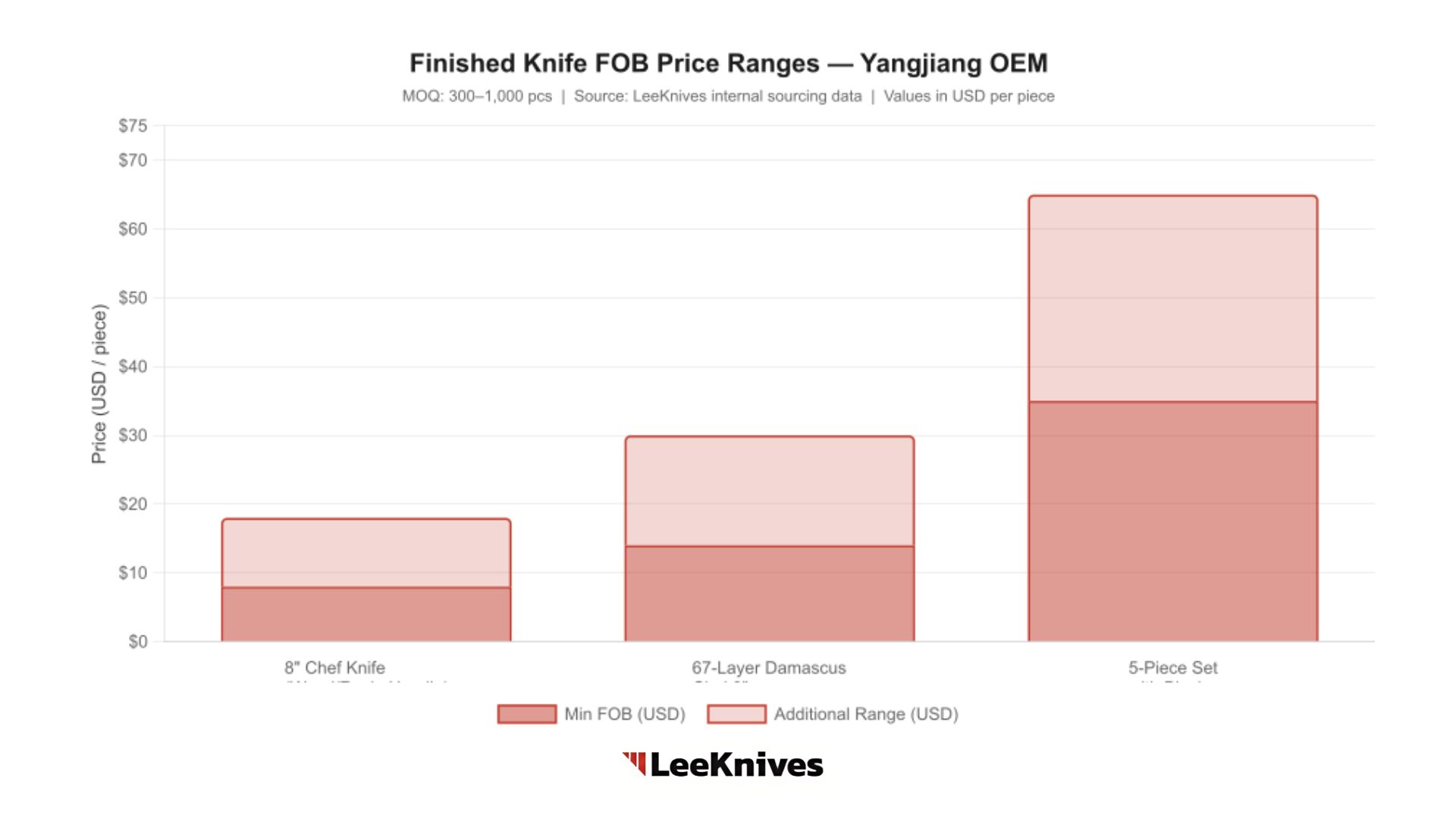
| Product | FOB/piece |
|---|---|
| 8″ chef knife, wood/resin handle | $8 – $18 |
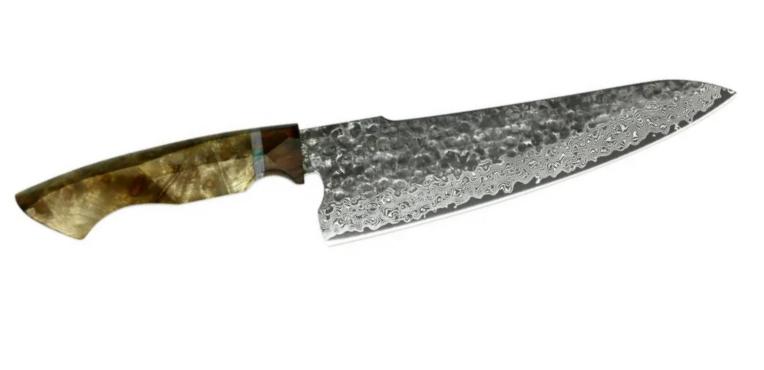
| 67-layer Damascus clad, 8″ | $14 – $30 |
| 5-piece set with block | $35 – $65 |
A $9 knife and an $18 knife often use identical steel strip. The price gap is processing quality — not the metal.
Pricing data based on LeeKnives’ internal sourcing experience and supplier negotiations.
Supply chain risks (2025–2026)
- U.S. tariffs: Section 301 + IEEPA surcharges push total duty on Chinese-made knives to 30–40%. A $15 FOB knife lands closer to $20–22 before freight.
- China steel export licenses (Jan 2026): Covers 300 steel codes; mainly raw/semi-finished products. Limited direct impact on finished knives, but could stretch lead times if your supplier’s mill deprioritizes export orders.
- Southeast Asia rerouting: Some Yangjiang OEMs are shifting production to Vietnam to dodge tariffs. Verify QC data is from the actual production site, not the China headquarters.
What to ask your supplier
- Which mill supplies the steel strip?
- HRC certificates per batch? (Accept 59–62; below 58 is a red flag)
- Heat treatment process documented? (Double temper is non-negotiable)
- Where is the actual factory producing the order?
Insights in this section are drawn from LeeKnives’ years of industry experience in knife manufacturing and OEM sourcing.
Is 10Cr15CoMoV steel a good choice for a knife store?
If you sell knives made from 10Cr15CoMoV steel, you certainly won’t be lacking for a market as this steel is used regularly for everything from kitchen knives to pocketknives to outdoorsman type knives. It appeals to a wide range of clientele which is great.
Because it’s essentially a copy of the very well regarded VG10 steel, you’re able to provide that quality in a steel blend at a very reasonable price point. This knife steel is a good meeting of quality standard and cost.
Provided that the knife is made with skill and care, a 10Cr15CoMoV should offer the buyer no problems. If looked after properly and used appropriately 10Cr15CoMoV knives do a fantastic job.
In conclusion
10Cr15CoMoV knives offer a quality knife steel at an affordable price and we hope that this article has explained its qualities more fully to you.
Thank you for visiting the LeeKnives blog and for showing interest in our exciting range of superior knives! Should you be needing an easy peasy quote, we’re always glad to assist, until we meet again, stay sharp dear friends!
Launch Your Custom Knife Line Faster with LeeKnives
Complete OEM/ODM support—from design to final shipment—so you can focus on growth.
Backed by warehouses in the U.S. for fast, reliable delivery.




 EN
EN  JA
JA  DE
DE