
In this guide, we’ve shortlisted 11 custom cookware manufacturers and sourcing partners, comparing their customization capabilities, MOQs, tooling options, sampling timelines, and certifications. Our goal is to help you find a suitable partner for your product and budget.
Key Takeaways
- There are three levels of cookware customization: branding existing products, modifying factory designs, and developing entirely new products. Your choice affects costs, MOQs, and lead times.
- You don’t always need custom molds. Manufacturers such as West Bend and Leeknives offer private-label programs using existing tooling, helping brands avoid initial mold-development costs.
- Different manufacturers specialize in different materials. Linkfair focuses on high-volume stainless steel cookware, while Tmai specializes in aluminum nonstick cookware and Debien offers cast iron.
- Low-MOQ options are available. LeeKnives offers custom cookware programs with MOQs typically ranging from 200–300 units per SKU, depending on the product and customization.
- Allow time for development. Industry estimates suggest approximately 8–12 weeks for standard private-label production and 12–24 weeks for projects requiring new tooling, although actual timelines depend on the manufacturer and specifications.
What Does Custom Cookware Mean? Three Tiers of Customization
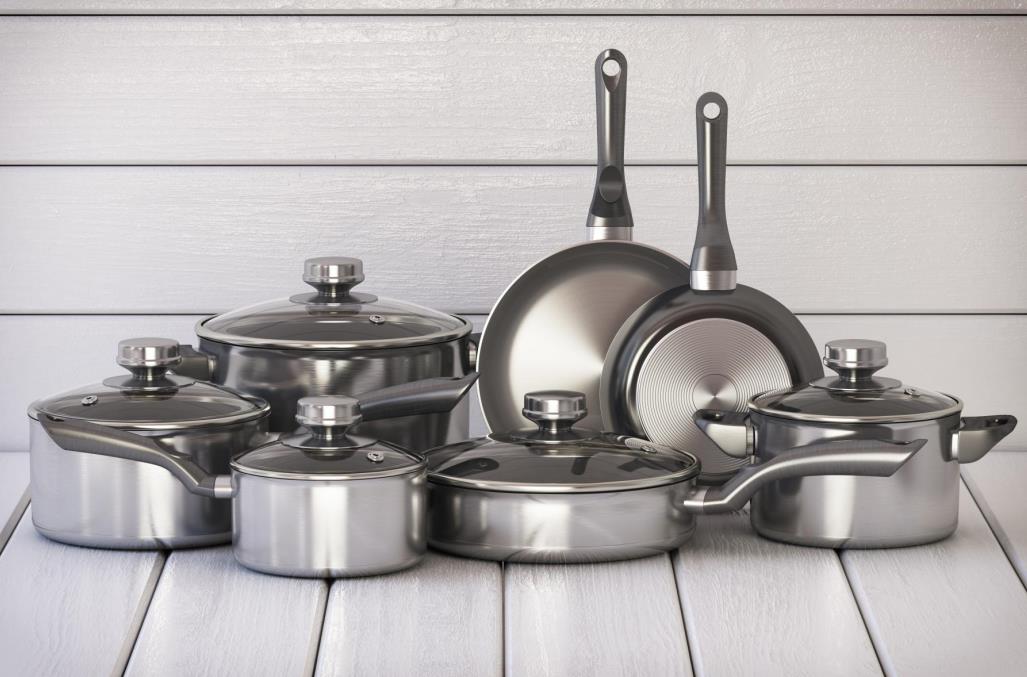
Not every custom cookware manufacturer offers the same level of customization. Some can add your logo to an existing pan, while others can modify handles, coatings, or even develop an entirely new product from scratch.
Before contacting suppliers, we recommend identifying which of the following three tiers (T1–T3) your project falls into. This will help you compare quotes, understand minimum order quantities (MOQs), and avoid paying for tooling you may not need.
| Tier | What changes | Typical MOQ impact | Tooling cost | Timeline | Best for |
| T1: Branding only | Logo engraving, exterior colors, packaging, labels | Lowest; depends on existing stock and branding method | Usually none | Days to weeks for simple changes | New brands testing products |
| T2: Existing-model modification | Coatings, handles, lids, sizes, set configurations using existing tooling | Higher; often calculated per size, color, or coating | Low to moderate; component tooling may be needed | Approximately 8–12 weeks | Brands wanting differentiated products |
| T3: New tooling from drawings | Completely new shapes, dimensions, or construction | Usually highest; factory must recover setup and development costs | Industry estimate: 10,000-50,000 | Approximately 12–24 weeks | Established brands developing original designs |
Timelines and new-tooling costs are indicative industry estimates attributed to Wonnda, rather than guaranteed supplier quotes. Actual requirements depend on product complexity and factory capabilities.
T1: Branding an Existing Cookware Product
This is generally the easiest and most affordable way to launch a private-label cookware brand. You select an existing product and customize its branding, packaging, or available finishes.
Since the manufacturer already has the required molds and production equipment, you can avoid most development costs. It’s a practical starting point if you want to test demand before investing in a completely original design.
T2: Modifying an Existing Cookware Design
At this level, you work with a manufacturer’s existing product design but change specific features to differentiate your cookware.
For example, you might choose a different nonstick coating, replace stainless steel handles with wooden ones, or introduce a new lid design. Some modifications may require additional component tooling, even when the main cookware body remains unchanged.
One detail we always recommend checking is whether the MOQ applies to each product variation. A supplier quoting 1,000 pieces per size could require 3,000 pieces if you’re ordering three different pan sizes.
T3: Developing Cookware From Your Own Drawings
This is the most advanced customization option. You provide technical drawings or detailed specifications, and the manufacturer develops the necessary tooling to produce your design.
The process typically involves engineering reviews, prototype development, mold production, testing, and revisions before mass production begins. That explains why T3 projects generally require larger budgets and longer timelines.
Mold ownership is especially important at this stage. Before paying tooling fees, confirm who legally owns the molds, whether the manufacturer can use them for other customers, and what happens if you change suppliers.
For most first-time cookware brands, we’d recommend exploring T1 or T2 before committing to T3. You can validate product demand with a smaller investment and move toward original designs once your sales volume justifies the development costs.
This guide focuses on custom cookware manufacturing, OEM/ODM services, and private-label production.
If you're still exploring suppliers, our best cookware manufacturers guide provides a broader comparison of factories and their specialties. If you simply want to purchase existing cookware in bulk without developing your own products, see our cookware wholesale distributors guide instead.
The 11 Best Custom Cookware Manufacturers in 2026
We’ve shortlisted 11 custom cookware manufacturers and sourcing partners based on their product specialization, customization capabilities, minimum order quantities, production processes, and available certifications.
Some are large factories equipped for high-volume OEM production, while others are better suited to smaller private-label launches. The comparison below will help you narrow down which suppliers are worth contacting for your project.
Custom Cookware Manufacturers Comparison Table
| Manufacturer | Location | Materials | Customization | MOQ | Sampling / Lead Time | Certifications / Verification | Best For |
| LeeKnives | Yangjiang, China | Stainless steel, cast iron, nonstick aluminum | T1–T3 | Typically 200–300 units/SKU | Inquire | Food-contact reports arranged by market | Low-MOQ custom cookware and knife bundles |
| West Bend | Wisconsin, USA | Clad stainless steel, titanium, nonstick, ceramic | T2–T3 | ~1,000 pcs/shape | 3–9 months | ISO 9001:2015 | US-made private label |
| Allinox | Belgium, China, USA | Stainless steel, aluminum, multi-ply, copper | T1–T3 | Inquire | Inquire; US stock available | Inquire | Full-service OEM and US distribution |
| Papilla | Niğde, Turkey | Nonstick aluminum | T1–T3 | Inquire | Inquire | ISO 9001/14001, BSCI, SEDEX | Non-China private-label manufacturing |
| Linkfair | Yunfu, China | Stainless steel, nonstick aluminum, bakeware | T2–T3 | 500–2,000 sets | Inquire | ISO 9001/14001, NSF, TÜV | High-volume stainless steel OEM |
| Shanghai Guanhua | Shanghai, China | Stainless steel | T2–T3 | 1,000 pcs; 500 trial | Samples: 7–15 days; production: 45–55 days | BSCI, ISO 9001 | European-brand-grade OEM |
| Potobelo (Zoombo) | Jieyang, China | Stainless steel cookware, kettles, pressure cookers | T1–T3 | Per model | Samples: 7–10 days; production: 30–50 working days | ISO 9001/14001, BSCI | Fast-sampling stainless steel OEM |
| Tmai | Jinhua, China | Aluminum nonstick | T2–T3 | Varies | Inquire | BSCI, ISO 9001, LFGB/FDA product documentation | Die-cast aluminum OEM |
| Zhejiang Lechu | Wuyi, China | Aluminum nonstick, tri-ply | T2 | Inquire | Inquire | Inquire | Mid-size aluminum customization |
| Debien | Shijiazhuang, China | Cast iron, enameled cast iron | T2 | 50–200 pcs | Inquire | SGS on-site verification | Low-MOQ cast iron |
| Sancong | Wuyi, China | Enameled cast iron, tri-clad | T1–T2 | Low/no MOQ claimed | Inquire | ISO 9001, BSCI (supplier-claimed) | Enameled cast iron branding |
MOQ and lead-time figures reflect supplier-published or marketplace-stated information in the supplied research dated October 2026, rather than independently confirmed quotations. T1 = branding, T2 = existing-model modification, T3 = new-tooling development. “Inquire” indicates that reliable public figures were unavailable.
1. LeeKnives (That’s Us): Best for Low-MOQ Custom Cookware and Knife Bundles
We’ll start with ourselves, with a clear disclosure: LeeKnives is our company. We’re a kitchen knife manufacturer based in Yangjiang, China, and we also coordinate custom cookware manufacturing through partner factories specializing in different materials and production processes.
Our cookware programs cover stainless steel, nonstick aluminum, and cast iron, including enameled products. You can explore our cookware range or learn about our cast iron cookware manufacturing services.
We support all three customization tiers, from adding a logo and custom packaging to modifying existing designs or coordinating new tooling with an appropriate manufacturing partner.
Our MOQ typically ranges from 200 to 300 units per SKU, depending on the product and customization requirements. More complex projects may need higher quantities. Sampling and production timelines are quoted individually, and we can arrange FDA, LFGB, or California Proposition 65-related food-contact testing documentation as required by the destination market.
One advantage of working with us is the ability to coordinate cookware and kitchen knives through a single sourcing partner. This is especially useful for brands developing matching kitchen collections or retailers expanding into multiple product categories.
- Pros: Low MOQs, flexible customization, multiple cookware materials, combined knife and cookware sourcing.
- Cons: Manufacturing is coordinated across partner factories, so timelines and production capabilities depend on the selected supplier. Large-volume commodity orders may be more competitive with dedicated high-capacity factories.
- Ideal for: Startups, growing kitchenware brands, and retailers seeking private-label cookware alongside custom knives.
US & Western Custom Cookware Programs
These manufacturers offer established private-label or OEM programs with production or commercial operations in the United States, Europe, and Turkey.
2. West Bend: Best for US-Made Private Label Using Existing Tooling
West Bend is an established American cookware manufacturer with manufacturing operations in Wisconsin dating back to 1911.
Its private-label program is particularly attractive for brands that want US-made cookware without developing entirely new molds. West Bend maintains an existing tooling library covering three-ply and five-ply clad stainless steel, titanium, PTFE nonstick, and ceramic-coated cookware.
By selecting existing shapes, buyers can avoid new tooling costs while customizing their product offering. The company also has in-house tooling design capabilities for projects requiring new cookware shapes.
West Bend publishes relatively clear commercial requirements: approximately 1,000 pieces per shape, with production and delivery timelines ranging from three to nine months.
The company holds ISO 9001:2015 certification. Its published pricing guidance indicates unit costs approximately 10–20% higher than offshore alternatives, making domestic manufacturing and product positioning important considerations.
- Pros: US manufacturing, existing tooling options, no new mold costs for compatible designs, published MOQ and timeline guidance.
- Cons: Higher manufacturing costs than many offshore alternatives, relatively long lead times, and a substantial minimum order requirement.
- Ideal for: Established US brands, premium cookware retailers, and businesses prioritizing domestic manufacturing.
3. Allinox: Best for Full-Service OEM Manufacturing With US Distribution
Allinox is a cookware group with Belgian roots, manufacturing operations in China, and distribution capabilities in the United States.
The group has operated a joint-venture factory in Xinxing, Guangdong, since 1996 and also has copper cookware production in France. It is associated with cookware brands including Alva and Beka and holds the exclusive worldwide Brabantia cookware license.
What makes Allinox interesting for custom cookware buyers is the breadth of its services. Its OEM program extends from product development and tooling to quality inspections and distribution.
With stated annual capacity exceeding 12 million pieces, the group supports substantial manufacturing programs across stainless steel, aluminum, multi-ply, and copper cookware.
For American buyers, its Atlanta warehouse and US sales presence can simplify inventory coordination and replenishment when suitable stock arrangements are available.
Allinox does not publish a standard MOQ or comprehensive sampling timeline in the supplied research, so buyers should request project-specific terms. Relevant certifications and test reports should also be confirmed before contracting.
- Pros: End-to-end OEM development, multiple cookware materials, established manufacturing operations, US distribution infrastructure.
- Cons: Unpublished minimum order requirements; smaller projects may be less attractive to a manufacturer operating at this scale.
- Ideal for: Established cookware brands and retailers seeking one partner for development, manufacturing, quality control, and US distribution.
4. Papilla: Best Non-China Custom Cookware Manufacturer for EU and Middle Eastern Markets
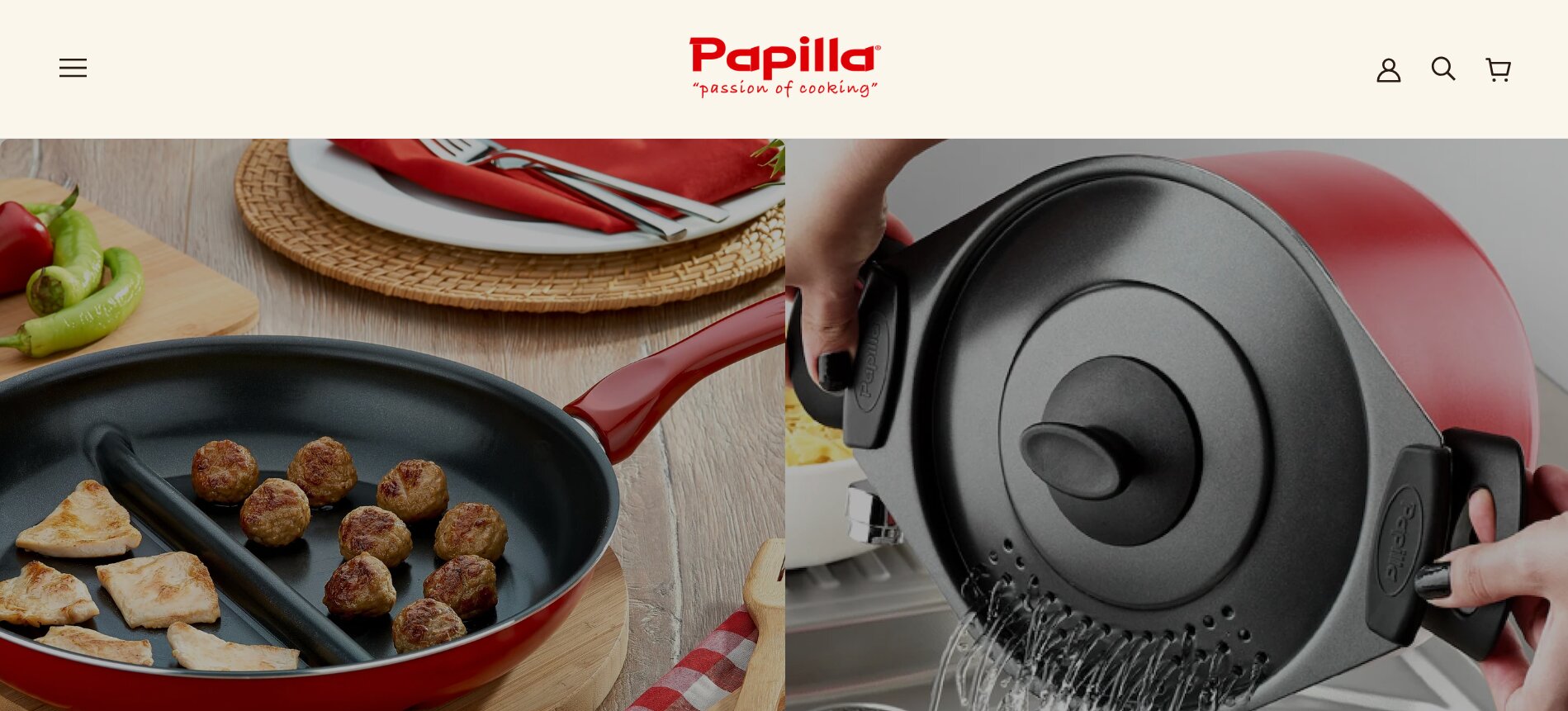
Papilla is a Turkish cookware manufacturer established in 1999, specializing in aluminum nonstick cookware.
The company operates a reported 40,000-square-meter facility in Niğde, Turkey, with robotic production equipment and multiple coating processes, including roller, curtain, and spray coating.
Its extensive mold library and access to aluminum disc production through a sister company give buyers several options for customizing existing cookware designs or developing new products.
Private-label manufacturing is an established part of Papilla’s business, with exports reportedly reaching more than 85 countries.
Papilla’s documented certifications and audits include ISO 9001, ISO 14001, BSCI, SEDEX, and ICS. Buyers should request current documentation relevant to their products and destination markets.
For European, UK, and Middle Eastern importers, Turkey can offer favorable shipping routes and an alternative to China-based sourcing. Actual landed costs and tariff treatment still depend on the destination and product classification.
- Pros: Specialized nonstick production, multiple coating technologies, established export operations, documented quality and social-audit credentials.
- Cons: Limited material diversity compared with multi-material cookware manufacturers; MOQ and lead times require direct inquiry.
- Ideal for: European and Middle Eastern retailers seeking private-label nonstick aluminum cookware outside China.
China-Based Custom Cookware Factories
China remains an important sourcing destination for custom cookware because manufacturers offer different production specialties, including stainless steel fabrication, aluminum die-casting, nonstick coating, and cast iron foundry work.
The following factories are worth comparing based on the material and degree of customization your project requires.
5. Linkfair: Best for High-Volume Stainless Steel Cookware Engineering
Linkfair is the export brand associated with Guangdong’s Lingfeng Group, founded in 1993 in Xinxing, Yunfu.
The group is one of the larger stainless steel cookware producers in China, with seven factories, approximately 400,000 square meters of manufacturing space, and reported production capacity reaching five million pieces per month.
Its biggest strength for custom cookware buyers is vertical integration.
Linkfair has internal capabilities for producing cookware components such as handles and glass lids, alongside impact bonding and finishing processes. This gives the manufacturer greater control over modifications that might otherwise require several independent suppliers.
The group also owns German cookware brands Carl Schmidt Sohn and CS-Kochsysteme.
Export listings indicate MOQs of approximately 500–2,000 sets, while documented certifications include ISO 9001, ISO 14001, NSF, TÜV, and UL-related approvals. Buyers should verify which credentials apply to their intended products.
- Pros: Large manufacturing capacity, extensive stainless steel engineering capabilities, in-house component production, multiple certification programs.
- Cons: Volume-oriented operation, with minimum order requirements that may be unsuitable for small launches.
- Ideal for: Established cookware brands, importers, and retail chains developing large-volume stainless steel product lines.
6. Shanghai Guanhua: Best for European-Brand-Grade OEM Production
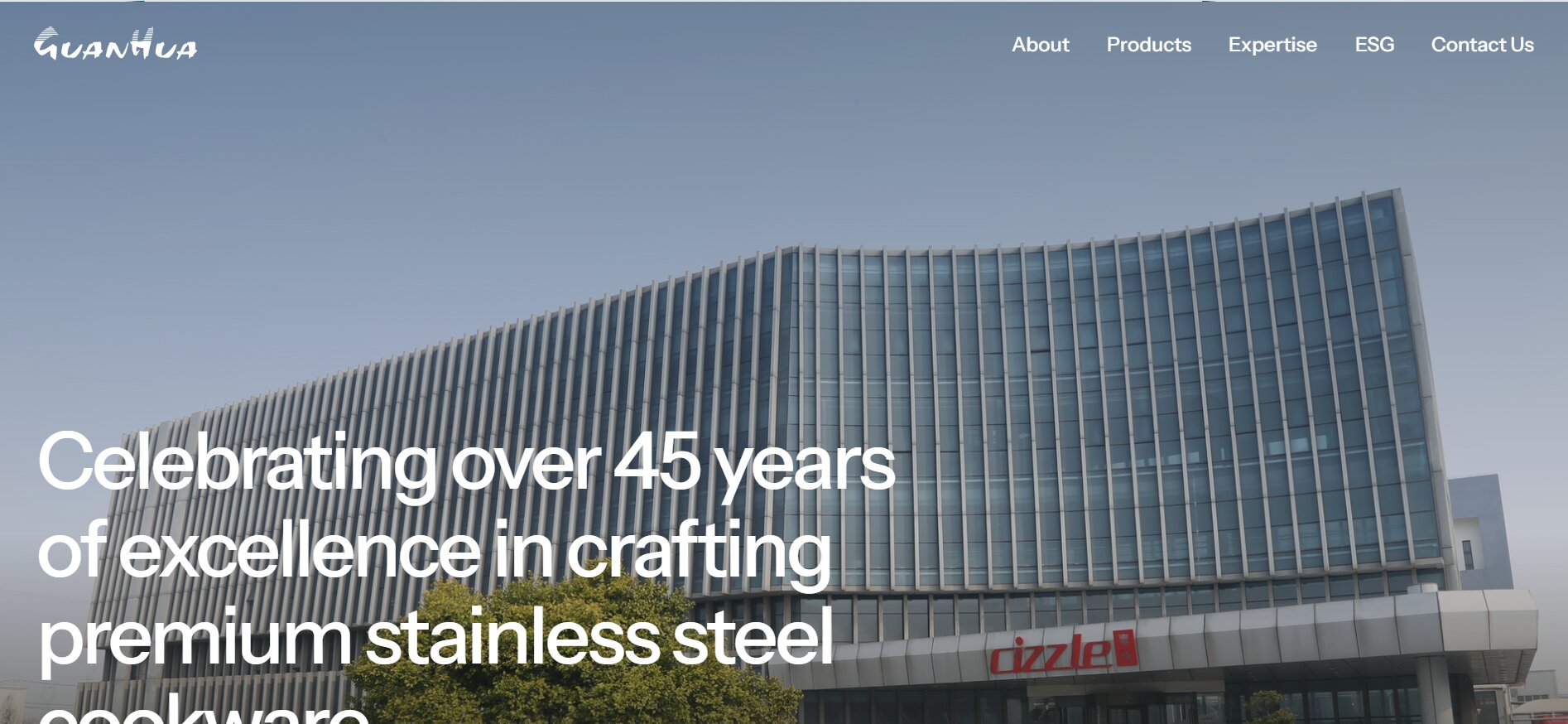
Shanghai Guanhua is an established stainless steel cookware manufacturer whose operations date back to the late 1970s.
The company has been associated with OEM production for international names including WMF, IKEA, Rösle, Fissler, Kuhn Rikon, and Lidl. Its supplier research also identifies US import records documenting shipments connected to IKEA.
For buyers, this background is relevant because supplying major international retailers generally requires structured production, inspection, and product documentation processes.
Guanhua’s customization capabilities cover existing-model modifications and more advanced OEM development, supported by BSCI and ISO 9001 credentials.
The company also publishes useful purchasing terms. Its standard MOQ is approximately 1,000 pieces per size, although 500-piece trial orders are accepted.
Sampling typically takes 7–15 days, with published production lead times of 45–55 days.
- Pros: Established international OEM relationships, documented manufacturing experience, published production timelines, trial-order flexibility.
- Cons: Standard MOQs may be too high for very small brands; product development and premium quality requirements can increase costs.
- Ideal for: Cookware brands targeting European markets and importers prioritizing established OEM manufacturing processes.
7. Potobelo (Zoombo): Best for Fast Stainless Steel Cookware Sampling
Potobelo is the international brand of Guangdong Zhongbao Kitchenware, also known as Zoombo.
Founded in 2002, the manufacturer operates a reported 66,000-square-meter production facility in Jieyang, Guangdong, with more than 70 production lines.
Its product range includes stainless steel cookware sets, kettles, pressure cookers, and steamers.
Potobelo offers customization ranging from branding on existing models to more involved OEM development with tooling support.
One reason it stands out is its relatively transparent verification information. The company publishes certificate numbers for ISO 9001 and ISO 14001, BSCI audit details, third-party testing references, and information about six Chinese design patents.
It also appears in the Messe Frankfurt exhibitor directory for Ambiente 2027.
Published sampling times are approximately 7–10 days, with mass production taking 30–50 working days. Minimum order requirements vary by model and should be confirmed directly.
- Pros: Fast published sampling timelines, detailed verification credentials, broad stainless steel product range, OEM tooling capabilities.
- Cons: Limited suitability for buyers seeking cast iron or aluminum-focused manufacturing; MOQs are not publicly standardized.
- Ideal for: Stainless steel cookware brands seeking faster product development and independently checkable supplier credentials.
8. Tmai: Best for Custom Die-Cast Aluminum and Nonstick Cookware
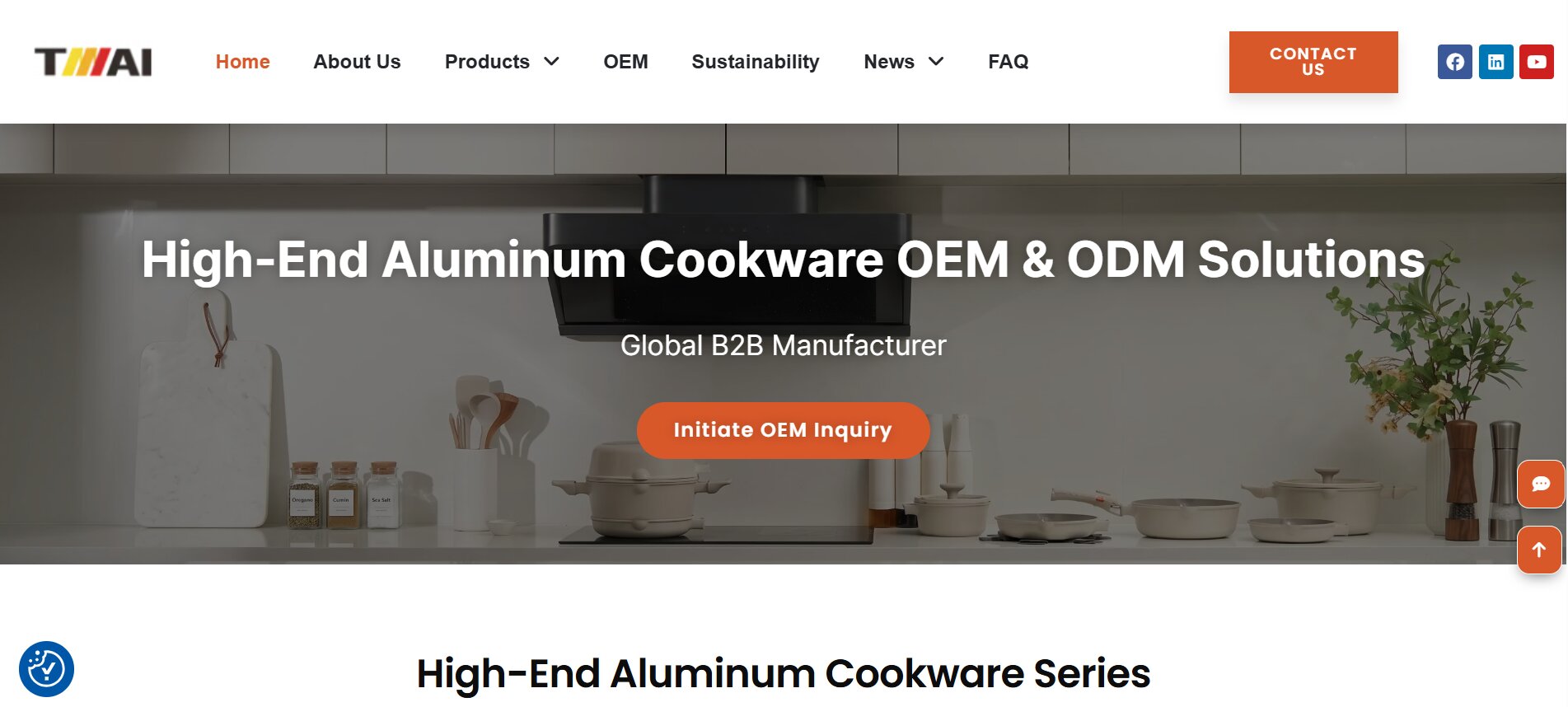
Tmai Holding is a Chinese cookware manufacturer incorporated in 2012 and based in Jinhua, Zhejiang.
The company operates a reported 90,000-square-meter aluminum cookware manufacturing facility equipped with 20 die-casting machines and four automatic coating lines.
Its specialization makes it particularly relevant for brands developing die-cast aluminum frying pans, casseroles, griddles, and related nonstick cookware.
Tmai offers multiple coating and appearance options, including traditional nonstick, ceramic, and granite-style finishes. Custom packaging is also available.
Because the company has die-casting equipment, it can support projects involving custom aluminum body molds alongside modifications to existing products.
Its documented credentials include BSCI, ISO 9001, and LFGB/FDA-related product documentation. Buyers should confirm the specific coating and finished-product reports required for their target markets.
- Pros: In-house die-casting capabilities, multiple coating options, large production facility, established international export activity.
- Cons: Primarily aluminum-focused; minimum order requirements and lead times depend on the project.
- Ideal for: Brands developing custom aluminum cookware collections with differentiated coatings, shapes, or finishes.
9. Zhejiang Lechu: Best for Mid-Size Aluminum Cookware Customization
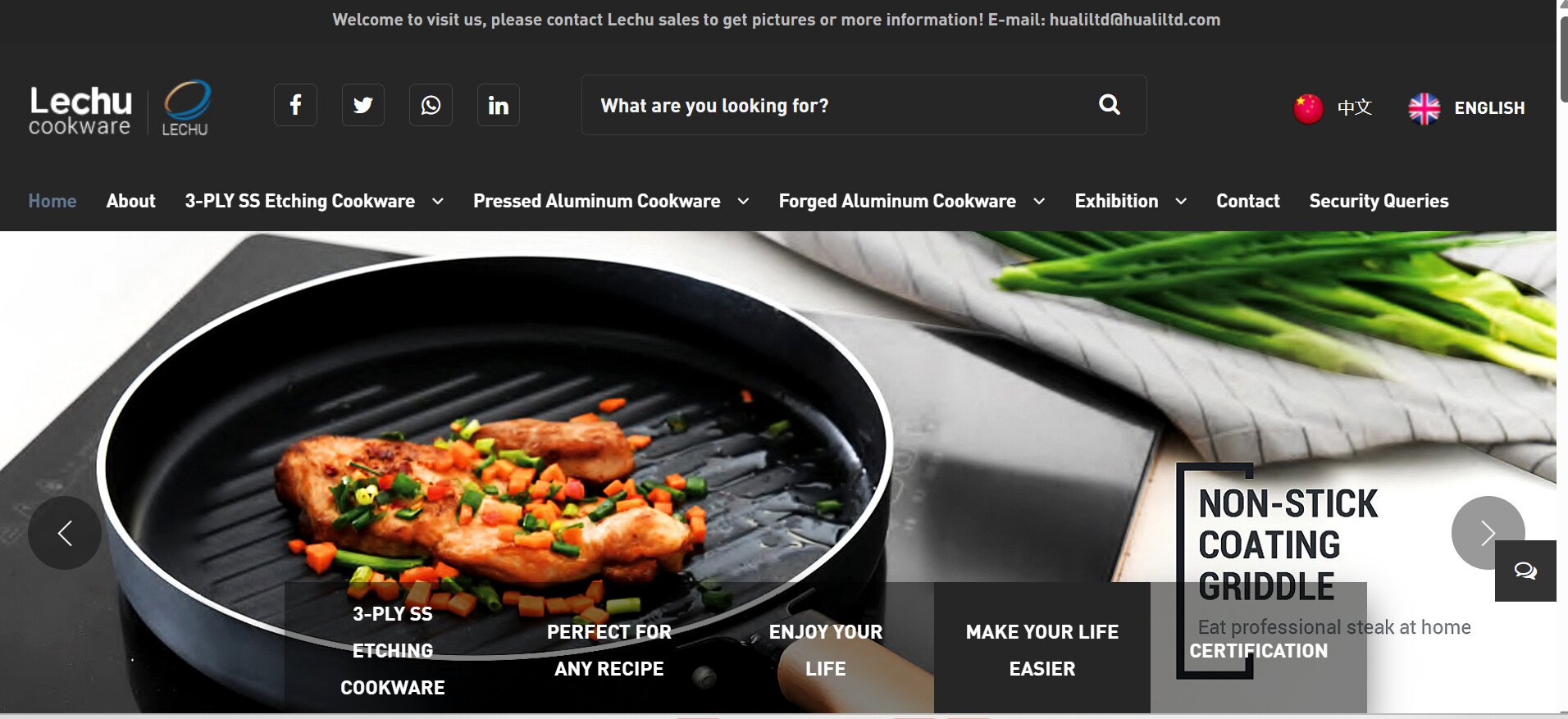
Zhejiang Lechu Industry & Trade is a cookware manufacturer based in Wuyi, Jinhua, with operations dating to approximately 2003.
Although its company name includes “Industry & Trade,” the supplier research identifies a registered manufacturing business with export rights and documented US shipments.
Lechu specializes in pressed and forged aluminum nonstick cookware, alongside tri-ply products.
Its customization options include product sizes, coatings, exterior colors, laser-applied logos, handles, lids, packaging, and product manuals.
This makes it a practical option for T2 customization, particularly when buyers want to differentiate an existing cookware design without commissioning a completely new product shape.
With a reported workforce of approximately 100–200 employees, Lechu may appeal to mid-size buyers seeking a manufacturer with an established export record.
However, public MOQ and production timeline information is limited. Buyers should also request current quality certifications and food-contact testing documentation.
- Pros: Registered manufacturing business, documented US export activity, broad component-level customization options.
- Cons: Limited public information about MOQs, lead times, and certifications; full new-tooling capabilities need confirmation.
- Ideal for: Mid-size importers and private-label brands developing aluminum nonstick cookware with modified handles, coatings, and packaging.
10. Debien: Best for Low-MOQ Custom Cast Iron Cookware
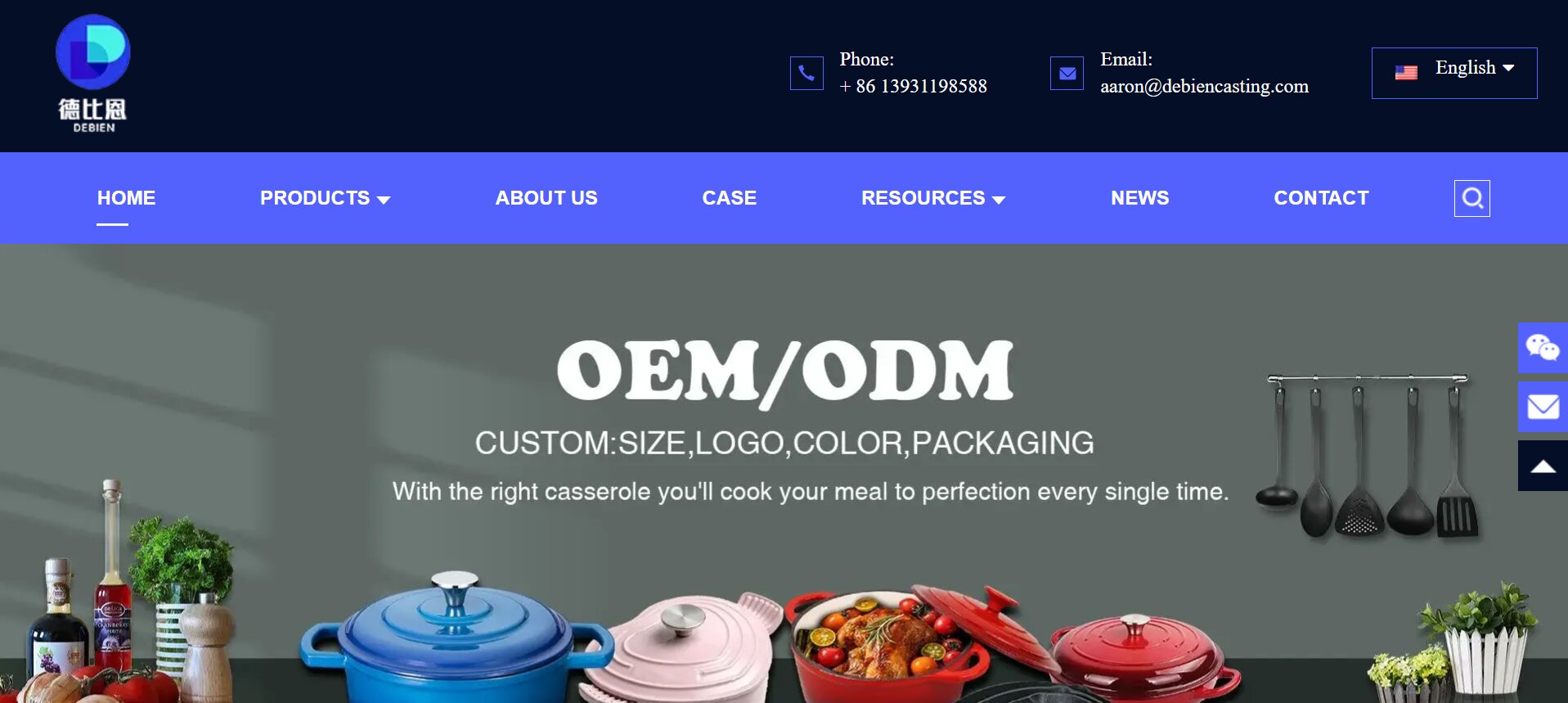
Debien, operating under Hebei Debien Technology, is a cast iron cookware manufacturer located in Shijiazhuang, China.
Unlike suppliers that outsource cast iron production, Debien has documented foundry equipment, including an automatic vertical parting molding line, a sand-processing system, and cupola and induction furnaces.
Its product range covers seasoned cast iron skillets, enameled Dutch ovens, casseroles, griddles, woks, and outdoor cooking sets.
One of its biggest advantages is its accessible order volume. Product listings show MOQs ranging from 50 to 200 pieces per item, making it an option for smaller cast iron product launches.
Debien also has an SGS on-site verified Alibaba storefront with transaction activity.
For customization, buyers can explore modifications to existing cast iron products, including branding, finishes, and packaging. Any project requiring completely new cast iron patterns should be discussed separately because it may introduce tooling costs and higher minimums.
- Pros: Low published MOQs, documented foundry equipment, broad cast iron selection, SGS on-site verification.
- Cons: Smaller operation compared with large industrial foundries; production capacity for major reorders and conflicting public founding-year information should be checked.
- Ideal for: New cookware brands, boutique retailers, and businesses introducing cast iron products without committing to large initial orders.
Another option worth exploring is M-Cooker (Baichu), also based in Shijiazhuang, which lists some enameled cast iron sets with minimum orders starting around 100 pieces.
11. Sancong: Best for Custom-Branded Enameled Cast Iron Cookware
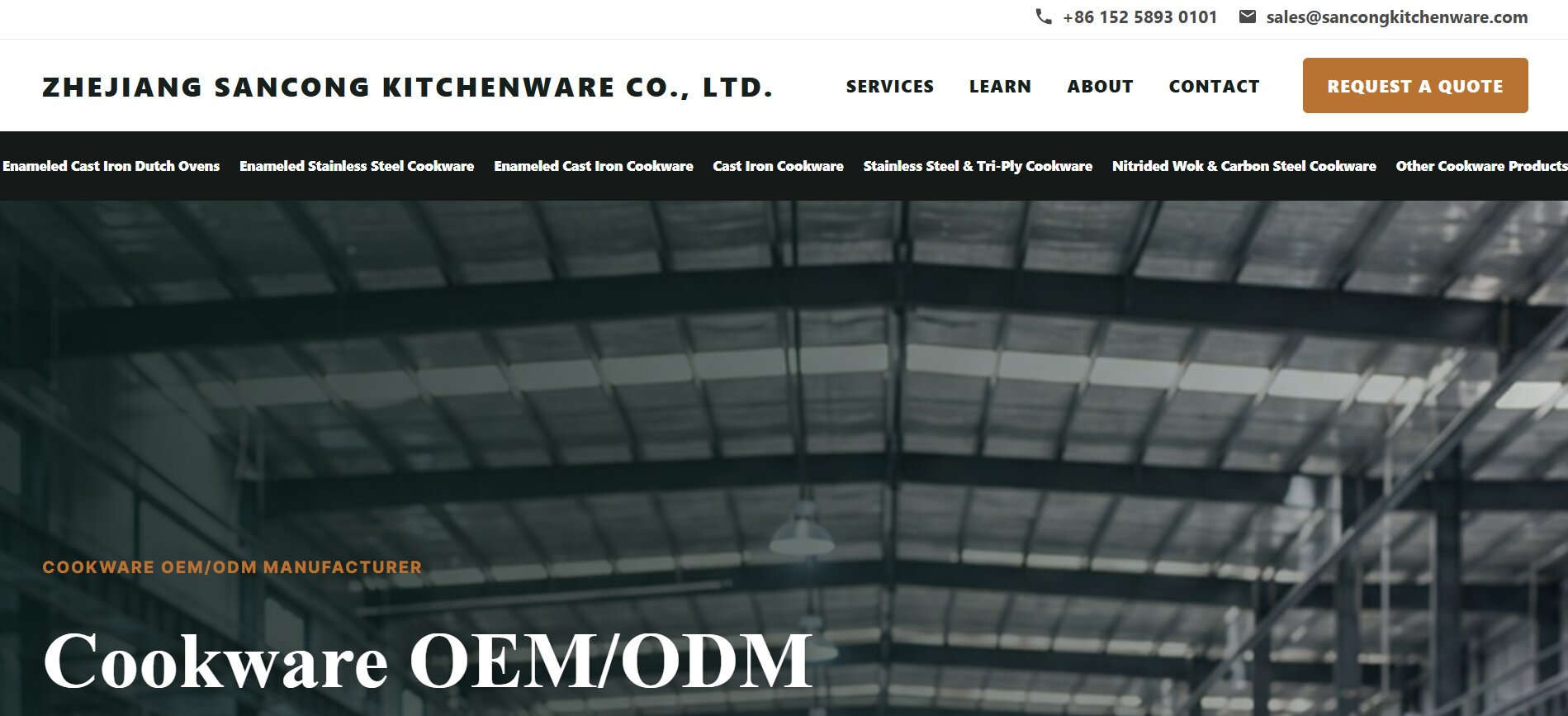
Sancong is a cookware manufacturer established in 2004 and based in Wuyi, Zhejiang, China.
The company specializes in enameled cast iron cookware, particularly Dutch ovens and casseroles, and also lists tri-clad cookware products.
Its documented customization services focus on logos, exterior colors, retail packaging, and product manuals.
Sancong also advertises ready-stock options with low or potentially no strict minimum order threshold, although buyers should verify these terms for their chosen products.
There is an important distinction to make regarding its OEM capabilities. While branding and existing-model customization are documented, public evidence of full new-pattern development is limited.
We would therefore treat Sancong primarily as a T1–T2 supplier until it confirms its ability to manufacture entirely new cast iron shapes.
The company claims ISO 9001 and BSCI credentials, but the supplied research contains limited independent verification. Request current certificates, business registration details, and product samples before committing to production.
- Pros: Enameled cast iron specialization, custom colors and packaging, potentially accessible ready-stock order quantities.
- Cons: Limited third-party verification, unpublished production timelines, and unconfirmed new-pattern tooling capabilities.
- Ideal for: Brands launching private-label enameled Dutch ovens and cookware collections using existing product shapes.
Not Factories, but Real Custom Cookware Program Partners
Not every company offering custom cookware owns a manufacturing facility. Some businesses specialize in product development, factory coordination, private-label sourcing, and distribution.
Two US companies worth considering are:
Clipper Corporation: Custom Cookware Program Management
Based in Carson, California, Clipper develops custom and control-label cookware programs through manufacturing partners. Established in 1994, it is the exclusive Viking cookware licensee and has worked on programs for Burger King, Subway, and Denny’s.
Its services include in-house design and 3D prototyping, making it suitable for foodservice chains and larger retail programs.
HIC Harold Import: Private-Label Sourcing and Fulfillment
HIC is a US kitchenware importer with origins dating to approximately 1957. The company offers private-label sourcing and fulfillment services, with particular strength in kitchen tools and gadgets.
It is worth considering if you prefer working with a US-based sourcing partner rather than managing overseas factory relationships directly.
Both companies can help buyers manage custom product programs, but they should be evaluated as sourcing and program-management partners rather than direct cookware factories.
How Does Custom Cookware Development Work?
Custom cookware manufacturing typically involves six stages, from defining your product specifications to inspecting the finished order. The process is relatively straightforward for private-label cookware, but developing an original design requires additional tooling, testing, and approvals.
Here’s how we recommend approaching each stage.
1. Prepare a Detailed Product Specification Sheet
Start by documenting exactly what you want the manufacturer to produce. Your specification sheet should include the cookware material and grade, thickness, dimensions, construction method, coating, handles, lids, and packaging requirements.
Also specify whether the cookware must work with induction, gas, or electric cooktops.
The more detailed your specifications, the easier it becomes for manufacturers to provide accurate quotations and identify potential production challenges.
2. Request Quotes From Multiple Manufacturers
Send the same specification sheet to at least three suitable manufacturers and request a quotation (RFQ).
Ask each supplier to break down its MOQ, tooling costs, sampling charges, production lead time, packaging costs, and applicable Incoterms.
This makes quotations easier to compare. Otherwise, one manufacturer might quote a thinner stainless steel body or a different coating system, making its price appear more competitive.
3. Evaluate Samples and Approve a Golden Sample
Before placing a bulk order, request a physical sample and evaluate it against measurable quality requirements.
We recommend checking:
- Dimensions and weight: Confirm thickness, diameter, capacity, and weight against your specifications.
- Coating quality: Check surface consistency, adhesion, and relevant test results.
- Handles and lids: Inspect alignment, fastening, fit, and overall stability.
- Base flatness: Check whether the cookware sits properly on the intended cooking surface.
- Heat-source compatibility: Verify induction compatibility and other claimed cooktop suitability.
- Food-contact documentation: Request relevant test reports for the materials, coatings, and components.
Once you’re satisfied, approve a golden sample: a signed, documented reference product that both parties retain or can reliably identify.
This sample becomes the quality benchmark for mass production and helps resolve disputes if the delivered cookware differs from what you approved.
4. Develop and Approve Tooling (For T3 Projects)
If you’re developing an entirely new cookware shape, the manufacturer may need to create molds, dies, or other production tooling.
This stage includes reviewing technical drawings, producing prototypes, making adjustments, and approving the final tooling before mass production.
Before paying, confirm who owns the molds and whether the manufacturer can reuse them for other customers. Tooling ownership and usage rights should be documented in your manufacturing agreement.
5. Complete Compliance Testing for Your Destination Market
Cookware intended for food contact must meet the applicable requirements of the market where you’ll sell it.
For example, products sold in the United States may require documentation demonstrating compliance with applicable FDA food-contact requirements, while cookware entering European markets may need testing against relevant EU and national rules, including applicable LFGB requirements in Germany.
California Proposition 65 obligations may also need consideration when selling in California.
Request test reports covering your actual finished product, including relevant materials and coatings, rather than relying on certificates issued for unrelated cookware models.
6. Begin Mass Production and Arrange a Pre-Shipment Inspection
After approving the sample, tooling, and required documentation, the manufacturer can proceed with bulk production.
Before releasing the final payment, arrange a pre-shipment inspection using your approved specifications and golden sample as references.
An inspection should cover product dimensions, cosmetic defects, coating consistency, handle assembly, packaging, labeling, and order quantities. Where appropriate, use an agreed Acceptance Quality Limit (AQL) sampling plan.
This final check helps identify defects while the goods are still at the factory, when corrective action is generally easier to arrange.
How Long Does the Entire Process Take?
As indicative industry benchmarks cited by Wonnda, standard private-label cookware production typically takes 8–12 weeks, while projects requiring new tooling can take 12–24 weeks.
These are planning estimates, not guaranteed factory timelines. Sampling revisions, tooling complexity, testing requirements, and production schedules can extend the process.
Our recommendation is to establish written approval milestones for samples, tooling, compliance, and final inspection before paying for full-scale production.
MOQ and Tooling: How Much Should You Budget for Custom Cookware?
Your minimum order quantity (MOQ) and tooling costs depend largely on how much you want to customize the cookware. Adding a logo to an existing pan is generally more affordable than developing a completely new shape that requires dedicated molds.
One detail we always recommend checking is whether the MOQ applies per product variation or to your entire order.
For example, if a manufacturer requires 1,000 pieces per size and you want three different frying pan sizes, your total order could reach 3,000 pieces. Different colors or coatings may also have separate minimums.
What Are the Typical MOQs for Custom Cookware?
Here are some published MOQ examples from the manufacturers we’ve covered:
| Manufacturer | Published MOQ | Customization considerations |
| Debien | 50–200 pieces | Low-volume cast iron products |
| LeeKnives | 100–500 pieces | Branding, existing-model modifications, and custom development |
| Shanghai Guanhua | 500-piece trials; 1,000 standard | Stainless steel OEM programs |
| West Bend | Approximately 1,000 pieces per shape | Private label using existing tooling |
| Linkfair | 500–2,000 sets | Larger-volume custom cookware programs |
These figures are supplier-stated starting points, not guaranteed minimums for every design. More complex coatings, components, or tooling requirements can change the order quantity.
How Much Does Custom Cookware Tooling Cost?
If you choose an existing design from a manufacturer’s mold library, you may avoid new tooling expenses entirely. West Bend, for example, offers private-label production using existing dies without charging for new molds.
For T3 projects involving completely new shapes, industry tooling estimates range from approximately $10,000 to $50,000, according to Wonnda. Actual costs depend on the material, manufacturing process, mold complexity, and number of components.
Before approving tooling expenses, ask the manufacturer who will own the molds, whether they can be used for other customers, and whether you can transfer them to another factory.
Also, remember that tooling is only one part of your development budget. You’ll need to account for sampling, revisions, product testing, packaging, inspections, and freight.
For new cookware brands, we’d generally recommend starting with an existing design and investing in custom tooling once demand justifies the additional expense. This lets you test your product with a smaller upfront commitment while keeping future customization options open.
How to Protect Your Cookware Design and Tooling Ownership
If you’re developing custom cookware from your own drawings, protecting your intellectual property (IP) should be part of the manufacturing agreement from the beginning.
This is particularly important for T3 projects, where you’ve invested in original designs, molds, and product development. Without clear contractual protections, you could face disputes over who owns the tooling or whether the manufacturer can use your designs for other customers.
Use an NNN Agreement When Manufacturing in China
For China-based manufacturing, we recommend discussing a China-enforceable NNN agreement (Non-Disclosure, Non-Use, and Non-Circumvention) with a qualified legal professional.
Unlike a basic confidentiality agreement, an NNN agreement addresses three separate risks:
- Non-disclosure: The manufacturer cannot disclose your confidential designs or technical information without authorization.
- Non-use: The manufacturer cannot use your protected designs for unauthorized production.
- Non-circumvention: The manufacturer cannot bypass agreed commercial restrictions, such as using your confidential business information to circumvent your relationship.
A standard Western NDA may not adequately address these issues or be drafted for enforcement in China. The agreement should be tailored to Chinese law, the correct contracting entity, and your specific manufacturing arrangement.
Clarify Who Owns the Molds
Paying for custom tooling doesn’t automatically settle every question about ownership and usage rights.
Before approving mold development, make sure your manufacturing contract specifies:
| Contract provision | What to clarify |
| Tooling ownership | Who legally owns the molds after payment? |
| Permitted use | Can the factory use the tooling only for your orders? |
| Third-party production | Is the factory prohibited from making your design for other customers? |
| Storage and maintenance | Who pays for repairs, maintenance, and storage? |
| Transfer or destruction | Can you retrieve, transfer, or request destruction of the molds when the agreement ends? |
| Breach remedies | What happens if the manufacturer violates the agreement? |
We also recommend keeping detailed records of your drawings, tooling payments, revisions, and final mold approvals. These documents can help establish what was developed and what the parties agreed to.
Register Your Designs and Trademarks Early
China generally follows a first-to-file system for trademarks and patents, making early registration important if you’re developing an original cookware product.
Consider registering your brand name and logo as trademarks, along with eligible product designs through the China National Intellectual Property Administration (CNIPA). Registration in your home country doesn’t automatically provide equivalent protection in China.
For example, Potobelo (Zoombo) publicly lists six CNIPA design patents covering cookware products such as pressure cookers, teapots, and woks. These illustrate how manufacturers can document design protection, although buyers should independently check patent status and ownership.
For more information about protecting product designs when sourcing from China, see our custom product IP protection service.
Ultimately, we recommend finalizing your IP, tooling ownership, and confidentiality arrangements before sharing detailed technical drawings or paying for mold development. A qualified Chinese IP lawyer can help ensure your agreements are appropriate and enforceable.
How to Verify a Custom Cookware Manufacturer
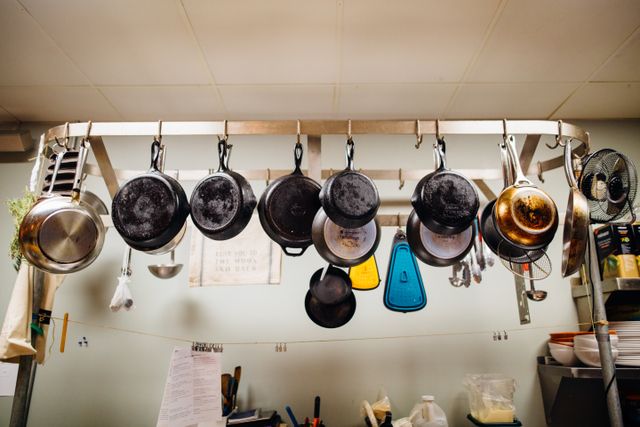
Before placing a custom cookware order, we recommend verifying that the supplier can actually produce your design. A manufacturer offering logo engraving or custom packaging may not have the equipment or engineering capabilities needed for a completely new product.
Here are five checks worth making before committing to production:
1. Confirm tooling capabilities in writing. If you need T3 customization, ask for evidence of previous mold-development projects, available equipment, and engineering capabilities. Don’t assume a supplier can create new shapes simply because it advertises OEM services.
2. Verify the relevant production processes. For nonstick cookware, check coating lines and curing equipment. For cast iron, verify foundry and casting capabilities. For stainless steel, examine forming, bonding, and finishing processes. Request a factory audit or video walkthrough where possible.
3. Match the legal entity with the payment details. Verify the manufacturer’s registered business name and compare it with the company signing your contract and receiving payment. If the bank beneficiary differs, request a documented explanation before transferring funds.
4. Check product-specific certifications and test reports. Ask for current food-contact documentation relevant to your cookware materials and destination market. A factory’s ISO certification alone doesn’t establish that your finished product meets applicable food-contact requirements.
5. Approve a golden sample before production. Inspect the sample against your specifications, including dimensions, weight, coating, handle attachment, and packaging. Document your approval and require the manufacturer to use it as the reference for bulk production and final inspection.
We’d also recommend requesting references or examples of similar custom projects, particularly when developing an original design. A manufacturer’s experience with your specific cookware material and production method matters more than a broad claim of offering OEM/ODM services.
Why Some Custom Cookware Manufacturers Aren’t on This List
When researching custom cookware manufacturers, you’ll likely encounter suppliers frequently mentioned in recommendations. However, appearing on these lists doesn’t necessarily mean a company operates a verified factory or offers genuine OEM manufacturing services.
We excluded several names because we couldn’t establish sufficient evidence of their manufacturing capabilities, business identity, or suitability for custom cookware projects.
| Company | Why we didn’t include it |
| SG Cookware | Claims a history dating to 1978 and operations across multiple countries, but our research couldn’t establish a verifiable registered business entity or specific manufacturing facility. |
| Foshan Eartha | We couldn’t independently verify its company registration or substantiate its advertised manufacturing capabilities and advanced coating claims. |
| Swishi | Provides limited company-identification information, with contact details relying on a free email service rather than a clearly documented corporate identity. |
| SUERMA | A newer company established in 2024. Its documented customization options focus on logos, colors, and packaging, making it more suitable for T1 branding than advanced OEM development. |
| Bonray | Associated websites contain inconsistent founding dates and overlapping marketing information, making it difficult to establish a reliable company history. |
| LongTeng | We couldn’t establish sufficient independent evidence of its manufacturing operations. Related websites also publish supplier rankings that don’t provide independent verification. |
| KOBACH | An established Chinese cookware brand, but we couldn’t verify a publicly available OEM manufacturing program for external brands. |
| Aramco Imports | A legitimate US cookware importer that sources products for its own brands. It doesn’t appear to offer custom manufacturing services to outside buyers. |
| Finex | A premium cast iron cookware brand acquired by Lodge in 2019. It’s not an independent OEM manufacturer, and MOQ figures circulating in some recommendations may be outdated. |
These exclusions don’t necessarily mean the companies are illegitimate or incapable of fulfilling orders. They mean we couldn’t verify enough relevant information to recommend them confidently for the specific needs of custom cookware buyers.
Start Your Custom Cookware Project With LeeKnives
Whether you’re launching your first private-label cookware collection or developing an entirely new product, we can help you find the right manufacturing solution.
At LeeKnives, we support all three customization tiers (T1–T3), from simple logo branding and packaging to modifying existing cookware designs and developing new products with custom tooling.
Our custom cookware programs offer:
- Low MOQs: Starting from 100–500 pieces, depending on material and customization requirements.
- Flexible customization: Stainless steel, cast iron, and nonstick aluminum cookware with options for custom finishes, handles, lids, and packaging.
- Quality and compliance support: Food-contact testing documentation arranged according to your destination market’s requirements.
- Combined sourcing: Custom cookware and kitchen knives coordinated through one partner, ideal for building complete kitchenware collections.
We work with specialized cookware manufacturing partners, allowing us to match your product requirements with suitable production capabilities.
Request a free custom cookware quote with your product specifications, estimated order quantity, and target market.
Still deciding which customization approach suits your business? Contact our team to discuss your options, or request a quote to get started.
Frequently Asked Questions About Custom Cookware Manufacturing
What is the difference between OEM, ODM, and private label cookware?
OEM cookware is manufactured according to your product designs or technical specifications. ODM cookware uses designs developed by the manufacturer, which you can customize and sell under your brand. Private labels generally involve adding your branding to an existing product.
If your project requires new molds or tooling, make sure the manufacturing agreement clearly establishes ownership and usage rights.
What is the typical MOQ for custom cookware?
Minimum order quantities depend on the customization level. Branding-only programs (T1) can start around 100–500 pieces, while existing-model modifications (T2) often require 500–1,000 pieces. Fully custom designs (T3) may require larger commitments to justify tooling costs.
Remember that manufacturers often calculate MOQs per size, color, or coating, rather than across your entire order. Always confirm whether the quoted minimum applies to individual pieces or complete cookware sets.
How long does custom cookware manufacturing take?
According to industry estimates cited by Wonnda, standard private-label cookware production generally takes 8–12 weeks, while projects requiring new tooling can take 12–24 weeks.
Sampling timelines also vary. For example, Potobelo publishes sampling times of 7–10 days, while Shanghai Guanhua quotes 7–15 days. Design revisions, product testing, and shipping can extend the overall timeline.
Can you custom-manufacture cast iron cookware?
Yes. Cast iron cookware can be customized with logos, enamel colors, seasoning finishes, and packaging. However, creating a completely new shape generally requires developing a new foundry pattern or mold.
For smaller projects, Debien lists MOQs of 50–200 pieces, while Sancong advertises low or no strict minimums for certain ready-stock products. Sancong’s claims should be confirmed directly, particularly for custom designs.
Explore our guides to enameled cast iron vs. cast iron and cast iron cookware manufacturers for more information.
How much does it cost to develop a custom cookware product?
Development costs depend on your design, materials, tooling requirements, testing, and minimum order quantity.
Using existing factory molds can eliminate new tooling expenses, while developing entirely new molds may cost approximately 10,000-50,000, based on industry estimates attributed to Wonnda.
You’ll also need to budget for prototypes, compliance testing, packaging, and inspections. Larger production runs can spread these fixed development expenses across more units, reducing their contribution to the cost of each product.
Where can I get personalized cookware as gifts?
If you’re looking for a personalized cookware gift, retailers offering engraving or monogramming services are usually the better option.
For example, Smithey offers personalization on selected cast iron cookware products. These services are intended for individual purchases rather than businesses developing their own cookware lines.
The manufacturers in this guide primarily serve B2B buyers seeking private-label products, custom designs, or bulk orders.
Which cookware material is easiest to customize?
The biggest factor is whether the manufacturer can use existing tooling. Branding or modifying an existing cookware design is generally simpler than developing a new shape, regardless of material.
For new designs, pressed or spun aluminum and stainless steel can offer relatively straightforward shape development, depending on construction. Multi-ply cookware may require additional bonding considerations, while cast iron needs dedicated foundry patterns.
Material choice should also reflect cooking performance and your target customers. See our guides to the best cookware materials for gas stoves and best nonstick pan materials to compare your options.






 EN
 JA
 DE