
Curved and straight boning knives serve different purposes in professional kitchens. A curved blade follows joints and contours with a natural sweeping motion, reducing repositioning and waste. A straight blade delivers controlled, precise cuts on beef, pork, and larger roasts with better leverage.
Your customers—whether butchers, chefs, or fishmongers—need the right shape for their protein type and cutting style. This guide compares both designs across maneuverability, sharpening, maintenance, and commercial use so you can stock blades that actually sell.
Key Takeaways
- Curved blades excel at poultry, fish, and small joints where following bone contours boosts yield.
- Straight blades dominate beef and pork processing with stronger tips, easier sharpening, and broader buyer appeal.
- Maintenance matters: Straight edges sharpen quickly on standard whetstones; curved edges demand section-by-section technique and higher service costs.
- Inventory strategy: Straight boning knives turn faster in general retail; curved blades command higher margins in seafood and poultry niche markets.
- Best practice for wholesalers: Stock both shapes—straight blades for volume, curved blades for specialty commercial buyers.
What Is a Curved Boning Knife?
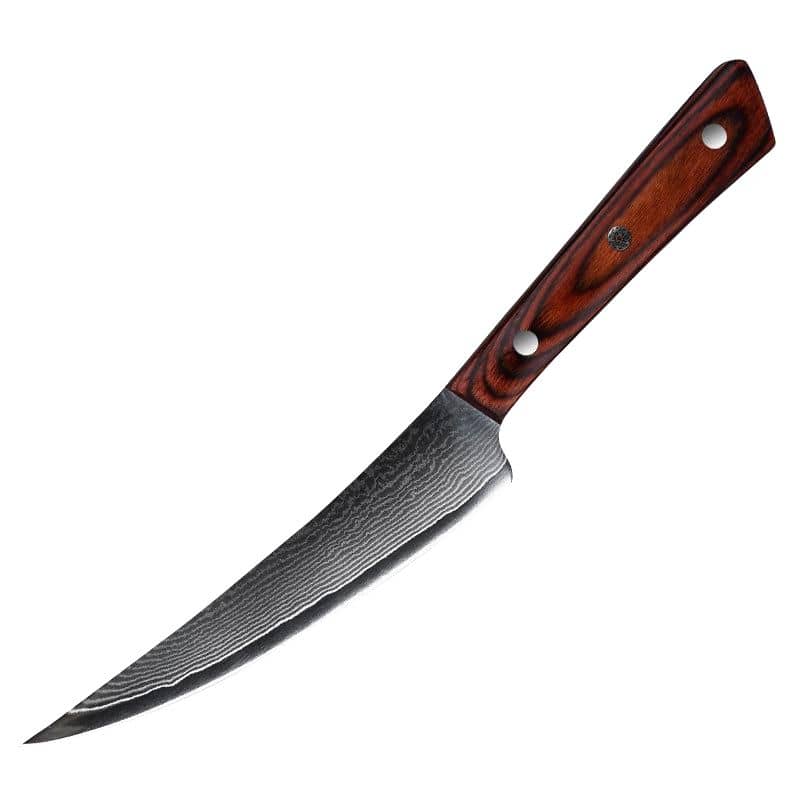
Damascus Clad 10Cr15CoMoV Pakkawood Bonning Knife 140 mm KKDA0370
A curved boning knife features a blade with a pronounced arc from heel to tip. The edge curves inward toward the spine, creating a concave profile designed to hug bone surfaces during use.
Key Features:
- Blade shape: Pronounced arc with a concave cutting path
- Typical length: 12–15 cm (5–6 inches)
- Tip style: Fine, flexible point
- Best known for: Following bone contours and reducing repositioning
What Is a Straight Boning Knife?
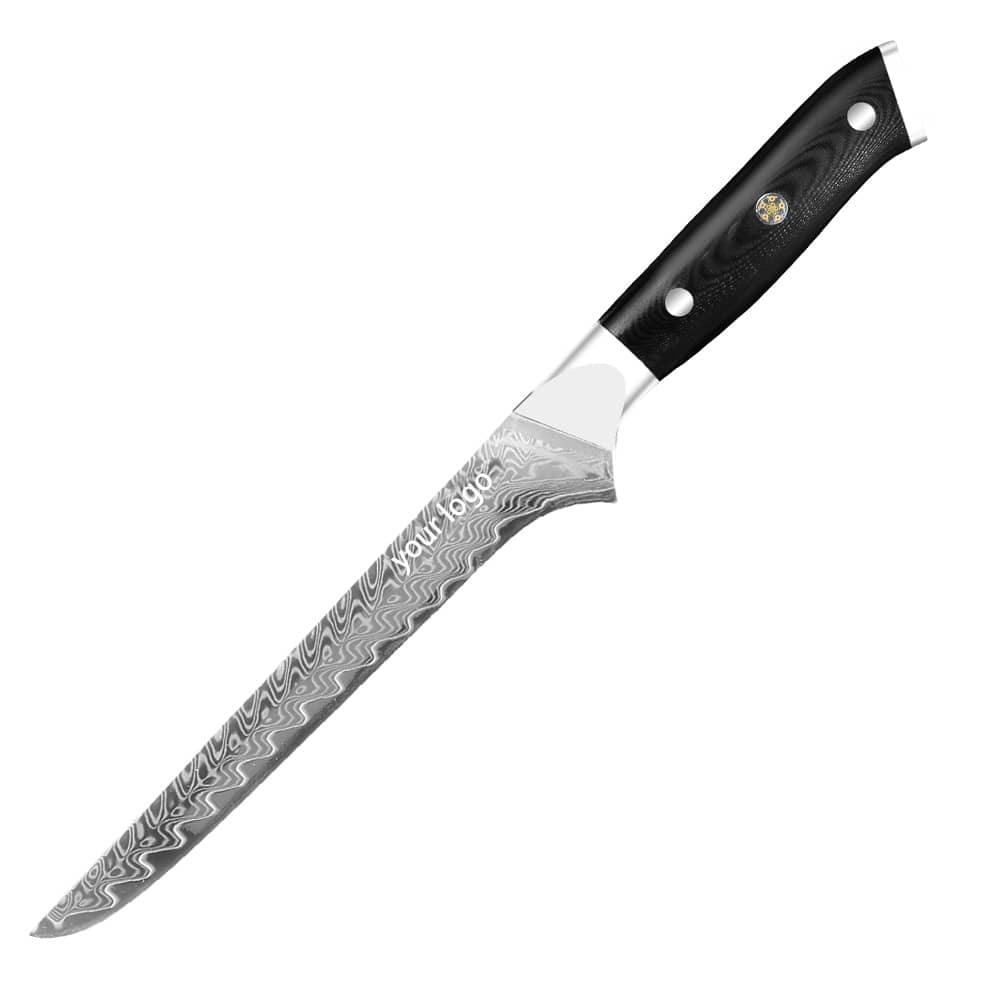
Damascus Clad 10Cr15CoMoV G10 Handle Boning Knife 140 mm KKDA0441
A straight boning knife has a flat or nearly flat edge that runs directly from heel to tip. The linear blade geometry provides a stronger, more rigid tip and a predictable cutting path.
Key Features:
- Blade shape: Flat or nearly flat linear edge
- Typical length: 15–18 cm (6–7 inches)
- Tip style: Stronger, reinforced point
- Best known for: Controlled, uniform cuts and easier maintenance
Curved vs Straight Boning Knife: Key Differences
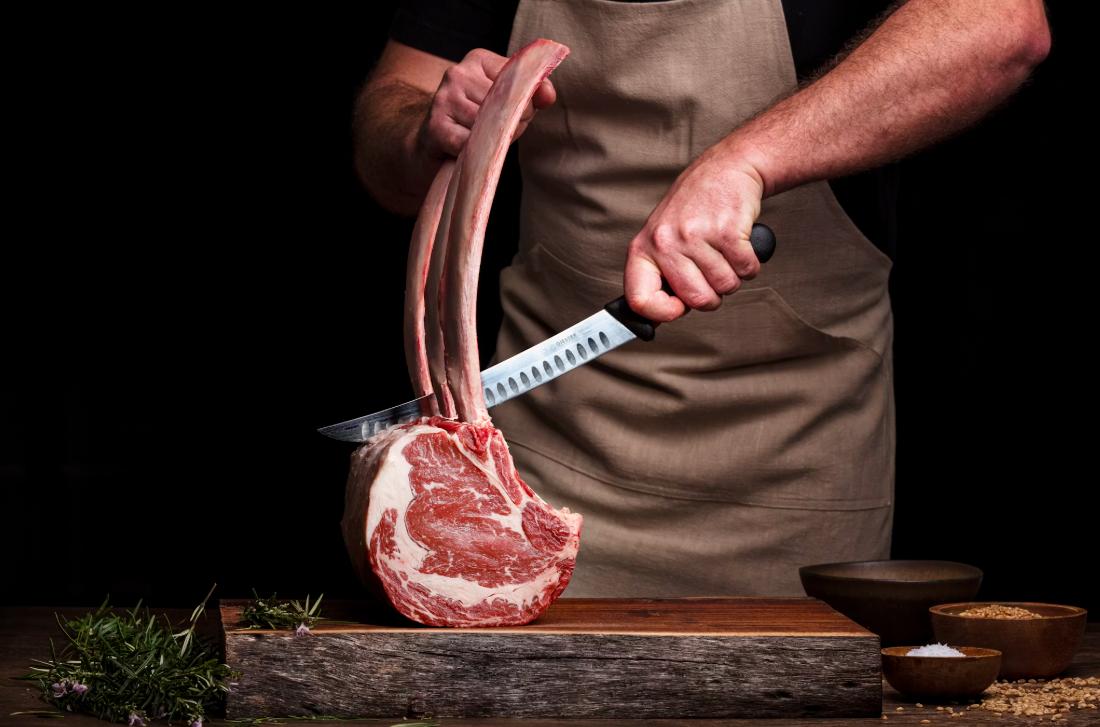
In the comparison table below, you’ll find the key differences between curved and straight boning knives to help you guide your customers.
| Curved Boning Knife | Straight Boning Knife | |
| Blade Design | Arced edge, fine tapered tip | Flat edge, stronger tip |
| Best For | Poultry, fish, ribs, joints | Beef, pork, large roasts |
| Key Advantage | Follows bone contours in one pass | Controlled straight cuts, more leverage |
| Limitation | Harder to sharpen, less versatile | Requires more repositioning around joints |
| Sharpening | Section-by-section technique | Standard whetstone method |
| Typical Length | 12–15 cm / 5–6 inches | 15–18 cm / 6–7 inches |
Blade Design and Geometry
The fundamental distinction lies in the blade profile. A curved boning knife uses an inward arc that creates a concave cutting path. This shape excels at scooping meat away from rounded bones in a single motion. The tip is typically thinner and more flexible, allowing the blade to bend slightly around tight joints.
A straight boning knife employs a linear edge with a thicker, reinforced tip. The flat geometry maximizes contact length against large, flat surfaces like beef ribs or pork loins. The rigid spine prevents flex under pressure, delivering cleaner cuts through dense connective tissue.
Cutting Technique and Efficiency
Curved blades reduce hand fatigue with a sweeping motion, while straight blades increase throughput with predictable push-pull cuts. A curved knife glides along the bone in a continuous arc, making repetitive poultry work less tiring over long shifts.
A straight blade slices through meat in uniform passes, ideal for trimming fat or breaking down large muscle groups. In high-volume butcher shops, the straight edge’s consistent action allows faster processing on standard cuts.
Straight boning knives are significantly easier to maintain. The flat edge rests evenly on a whetstone or honing steel, allowing consistent angle control from heel to tip. Most sharpeners can maintain a straight blade without specialized training.
Curved blades demand a section-by-section approach. The sharpener must rock the blade across the stone in segments to address the changing curve. This adds time and skill to the maintenance process. For your B2B customers, straight blades mean lower sharpening service costs and less downtime.
Tip Strength and Durability
The straight boning knife wins on tip durability. The reinforced point can pierce tough cartilage and ligaments without risk of bending or breaking. This makes it the default choice for breaking down large animals.
The curved boning knife’s fine tip is more delicate. While excellent for precision work, it can snap if used to pry or lever against heavy bone. Retailers should advise customers to match tip strength to application: straight for force, curved for finesse.
Which Boning Knife Is Better for Different Commercial Applications?
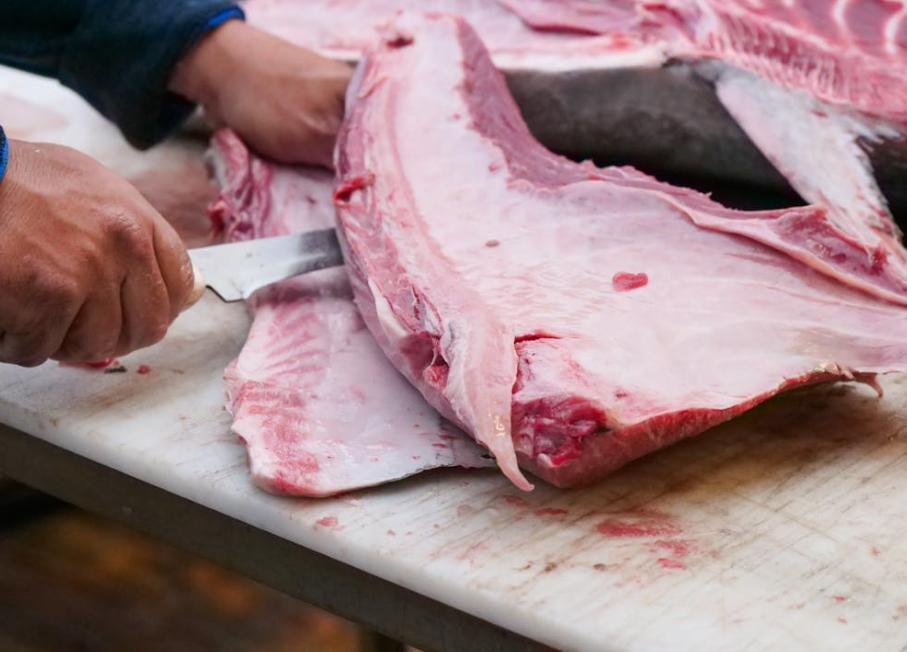
The right blade shape depends on what your customers process daily. Below is a breakdown of which boning knife works best for each commercial environment.
| Application | Best Shape | Key Reason |
| Poultry and fish processing | Curved | Follows bone contours, higher yield |
| Beef and pork processing | Straight | Stronger tip, faster throughput |
| Mixed-protein restaurants | Both | Full prep coverage, upsell potential |
| Home cooking retail | Straight | Easier to use and maintain |
Poultry and Fish Processing
Curved boning knives are the better choice for poultry and fish operations because the arc follows natural bone contours with minimal waste. The sweeping blade glides around rib cages and spine joints without tearing delicate meat.
Fishmongers and poultry processors achieve higher yield because the curved edge stays close to the bone through the entire cut. For wholesalers, this means curved blades command strong demand in seafood and poultry markets.
Beef and Pork Processing
Straight boning knives outperform curved blades in beef and pork processing due to stronger tip durability and predictable cutting action. The rigid spine and flat edge transfer more force into dense muscle and connective tissue.
Butchers can trim fat and separate large primal cuts in uniform passes without blade flex. Straight blades also withstand heavier daily use, making them the default choice for high-volume meat operations.
Mixed-Protein Restaurants
Restaurants handling multiple proteins need both blade shapes to cover their full prep range efficiently. A curved blade handles morning fish prep and afternoon poultry breakdown, while a straight blade takes over for evening beef and pork portions.
Offering both shapes to restaurant clients creates upsell opportunities through combo sets. Many commercial kitchens explicitly request paired inventory to keep workflow smooth across stations.
Home Cooking Retail
Straight boning knives are the safer retail bet for home cooks because they are easier to control and maintain. The flat edge sharpens quickly on a standard whetstone, and the predictable action reduces the learning curve for casual users.
Curved blades, while excellent for specialists, can frustrate beginners who lack proper technique. Retailers moving high volumes through home goods channels should prioritize straight boning knives in their core assortment.
How to Choose the Right Boning Knife for Your Business
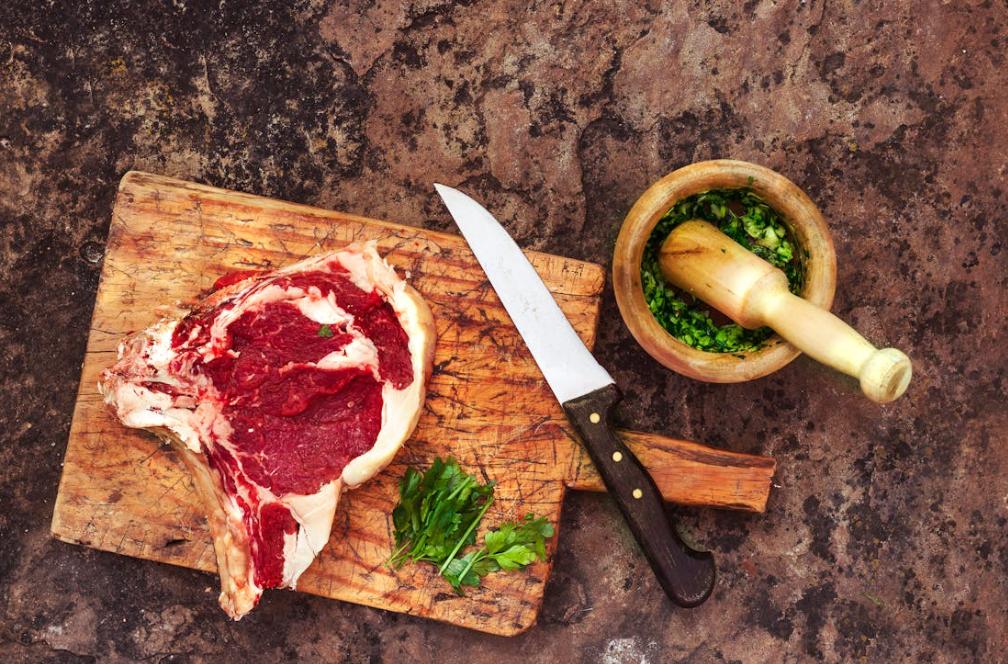
When adding boning knives to your product line, choosing the right specifications is key to your profit margins. Use the following guides to help you decide which options fit your market best.
1. Choosing the Right Steel for Your Price Point
The blade steel determines both the quality and the retail price. Matching the steel to your customer’s needs is the first step in sourcing.
| Quality Level | Steel Grade | Best For | Selling Point |
| Budget | 3Cr13 / 5Cr15MoV | Home kitchens, large gift sets | Great value, easy to sharpen |
| Standard | German 1.4116 | Butcher shops, restaurant supply | Rust-resistant, professional feel |
| High-End | 7Cr17MoV | Gourmet cooking, specialty stores | Long-lasting sharpness |
| Premium | Japanese AUS-10 | Professional chefs, luxury brands | Best edge life, high-end status |
2. Custom Options for Your Brand
If you are building your own knife brand, you can customize several features to stand out from the competition:
- Blade Flex: You can request stiff blades for heavy meat, or flexible blades for delicate fish prep.
- Handle Choice: Rubber/TPE handles are best for safety and grip in wet kitchens. G10 or Wood handles are better for premium retail looks.
- Logo & Packing: Most manufacturers can apply your logo via laser or stamping and provide custom boxes so the product is “retail-ready.”
3. Safety & Quality Standards
Professional buyers (like hotels and meat plants) often look for specific safety features:
- Easy to Clean: Look for “seamless” designs where the handle and blade meet. This prevents food from getting stuck and keeps the knife hygienic.
- Food Safety: Ensure the handle materials are BPA-free and heat-resistant so they can be cleaned in commercial dishwashers.
4. How Much to Stock?
To avoid “dead stock,” it helps to know which knife types sell faster in different markets. Here is a suggested stocking ratio based on your target customer:
| Your Target Market | Curved Knives | Straight Knives | Why? |
| Butcher Shops | 30% | 70% | Butchers need the strength of straight blades. |
| Seafood/Fish Markets | 80% | 20% | Curved blades are better for precision fish prep. |
| Home Cook Retail | 40% | 60% | Beginners find straight blades easier to use. |
| Professional Chef Kits | 50% | 50% | Chefs usually want one of each for versatility. |
Conclusion: The Right Tool for the Right Cut
Choosing between curved and straight boning knives isn’t about finding a superior blade—it’s about matching the tool to the specific operational needs of your clients.
For poultry and seafood specialists, the curved blade is a high-yield necessity that reduces waste and labor fatigue. For heavy-duty meat processing and high-volume butcher shops, the straight blade offers the durability and speed required to maintain a fast-paced production line.
As a wholesaler, your competitive edge lies in offering a diverse assortment that addresses these nuances. By stocking both geometries, you not only provide full prep coverage but also unlock significant upsell opportunities through professional combo sets.
How LeeKnives Helps Wholesalers Source Better Boning Knives
LeeKnives is a knife manufacturer based in Yangjiang City with over 30 years of experience crafting blades. We supply countless North American knife stores and wholesalers with boning knives, kitchen knives, and cutting boards. Through our affordable pricing and consistent quality, we help businesses scale their inventory without sacrificing margins.
We provide end-to-end services, offering both OEM and ODM options with global shipping and fulfillment centers in the US and China. Whether your customers need curved blades for poultry processing or stiff straight blades for beef operations, we customize blade shapes, handle materials, and steel grades to match their exact requirements.
Ready to expand your boning knife line? Request a free quote today and connect with our sales team to discuss your wholesale needs.
Launch Your Custom Knife Line Faster with LeeKnives
Complete OEM/ODM support—from design to final shipment—so you can focus on growth.
Backed by warehouses in the U.S. for fast, reliable delivery.
Frequently Asked Questions
How to use a curved boning knife?
Hold the curved boning knife at a shallow angle and use a smooth sweeping motion along the bone. The arc allows single-pass separation in many cases, reducing waste and prep time. For your commercial customers, this translates to better yield and faster service during peak hours.
What are the disadvantages of curved blades?
Curved blades are harder to sharpen uniformly due to their arc and less versatile for straight slicing tasks. Overly flexible curved versions can also slip under heavy pressure. Retailers should note that curved knives may require more maintenance support for their customers.
Should a boning curve in or out?
Most curved boning knives curve inward toward the spine. This concave design hugs the bone surface and pulls meat away cleanly. Outward curves are rare in boning knives and more common in skinning blades. When sourcing inventory, verify the curve direction matches standard butcher expectations.
Do I really need a boning knife?
For commercial kitchens and butcher shops, a dedicated boning knife is essential for yield efficiency and worker safety. Home cooks may use a chef’s knife as a substitute, but professionals rely on boning knives to minimize waste. Stocking boning knives targets the high-value professional market.
What is the Japanese version of a boning knife?
The Japanese equivalent is the honesuki, a triangular-bladed poultry boning knife. Unlike Western curved boning knives, the honesuki has a stiff spine and pointed tip designed for breaking down chicken and duck. It appeals to chefs seeking precision and is a strong niche product for specialty knife retailers.




 EN
EN  JA
JA  DE
DE