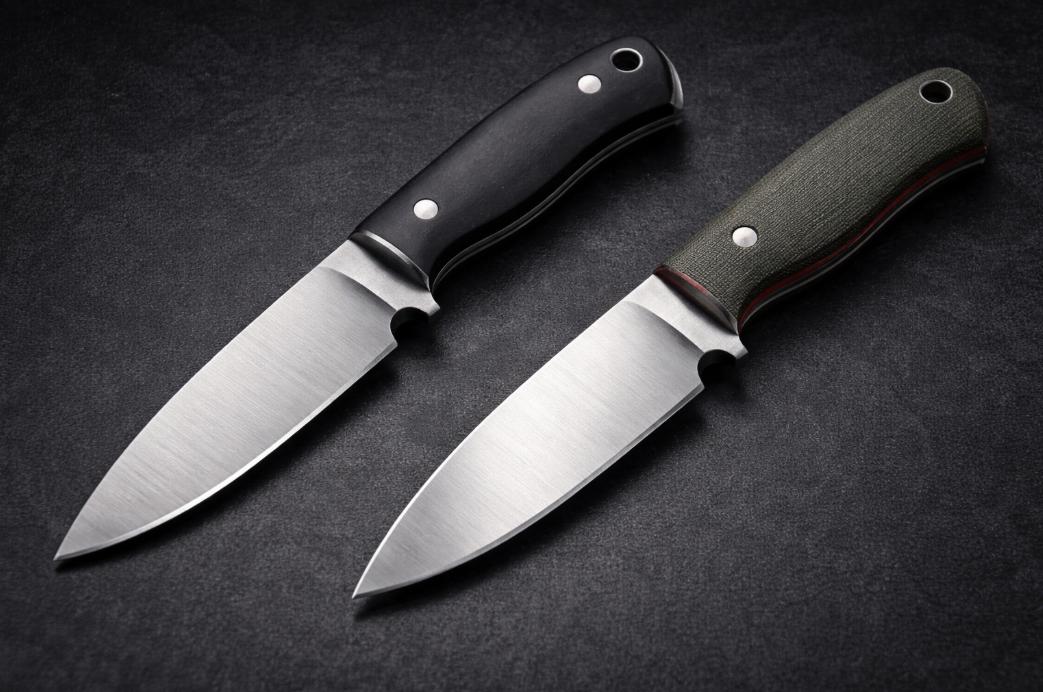
RWL34 vs ELMAX is a common comparison among knife makers looking for reliable premium steels. Both RWL34 and ELMAX are high-performance stainless steels known for strong edge retention, corrosion resistance, and consistent quality in professional knife production.
However, each steel offers different advantages depending on the application. ELMAX is widely recognized for its excellent wear resistance and balanced performance, while RWL34 is often selected for its fine grain structure and reliable toughness. In this guide, we compare RWL34 vs ELMAX in terms of composition, performance, cost, and practical use to help you choose the right steel.
Key Differences at a Glance
Before diving into detailed analysis, here are the most critical differences between RWL34 and ELMAX that knife makers need to know:
- Production Method: RWL34 uses rapid solidified powder (RSP) metallurgy, while ELMAX employs Uddeholm’s advanced powder metallurgy process — both are PM steels, but with different production techniques and alloy designs
- Hardness Range: RWL34 achieves 60-62 HRc (higher), compared to ELMAX’s 58-62 HRc (moderate)
- Corrosion Resistance: ELMAX excels with 18% chromium content, outperforming RWL34’s 14% chromium
- Toughness: ELMAX demonstrates superior impact resistance, while RWL34 offers moderate toughness
- Edge Retention: Both steels deliver excellent edge retention through different mechanisms (hardness vs. carbide structure)
- Best Application: RWL34 targets premium kitchen knives; ELMAX suits EDC, tactical, and outdoor knives
- Price Point: Both command high premiums, with ELMAX typically priced higher due to powder metallurgy costs
What Is RWL34 Steel?
RWL34 is a premium martensitic stainless steel developed by Damasteel, a Swedish steel manufacturer known for its innovative powder metallurgy technology. Originally designed as an upgrade to the popular ATS-34 steel, RWL34 utilizes rapid solidified powder (RSP) production to achieve superior cleanliness and consistency.
This steel is particularly favored by custom knife makers and premium kitchen knife manufacturers who require high hardness and excellent edge retention. The powder metallurgy process ensures uniform carbide distribution, resulting in blades that can be ground to very thin edge geometries without compromising structural integrity.
For wholesale knife manufacturers, RWL34 offers a reliable balance of corrosion resistance and cutting performance, making it suitable for chef knives, santoku blades, and other culinary tools where sustained sharpness is essential.
What Is ELMAX Steel?
ELMAX is a high-performance corrosion-resistant tool steel manufactured by Uddeholm using advanced powder metallurgy technology. It belongs to the “SuperClean” steel family, which is engineered for applications requiring excellent wear resistance, good corrosion resistance, and high toughness.
What sets ELMAX apart is its unique combination of high chromium (18%) and vanadium (3%) content, which delivers exceptional all-around performance. This makes it a popular choice among EDC enthusiasts, tactical knife users, and outdoor professionals who demand reliability in demanding environments.
For OEM manufacturers, ELMAX’s powder metallurgy structure provides design flexibility, allowing for more aggressive blade geometries and thinner profiles without sacrificing durability.
If you’re evaluating ELMAX for your product line, our complete guide to ELMAX steel covers its full property breakdown and investment considerations.
RWL34 vs ELMAX: Chemical Composition
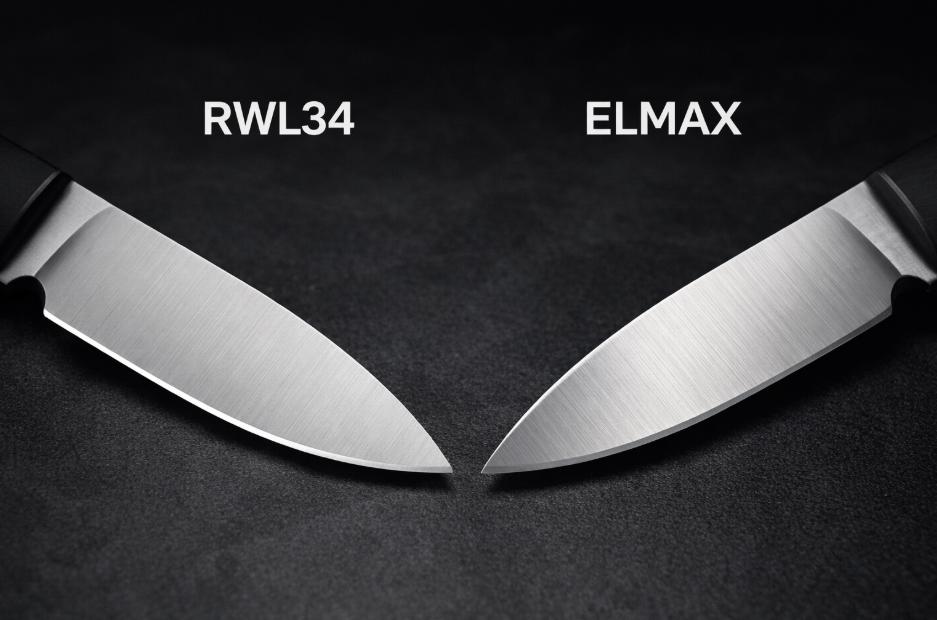
Understanding the chemical composition is essential when selecting steel for your knife production. The elemental makeup directly influences performance characteristics that your customers will care about.
| Element | RWL34 | ELMAX | Function |
|---|---|---|---|
| Carbon | 1.05% | 1.70% | Increases hardness and edge retention. |
| Chromium | 14.00% | 18.00% | Provides corrosion resistance. |
| Vanadium | 0.20% | 3.00% | Enhances wear resistance and toughness. |
| Molybdenum | 4.00% | 1.00% | Improves strength and heat resistance. |
| Manganese | 0.50% | 0.30% | Supports hardenability during heat treatment. |
| Silicon | 0.50% | 0.80% | Increases strength and oxidation resistance. |
RWL34 composition data: Damasteel RWL34 Data Sheet (Damasteel, 2023)
ELMAX composition data: Uddeholm ELMAX Technical Data Sheet (Uddeholm, 2024)
Summary: ELMAX features higher carbon and chromium content for enhanced edge retention and corrosion resistance, while RWL34 offers higher molybdenum for improved toughness and heat resistance.
RWL34 vs ELMAX: Performance Comparison
Understanding how these steels perform across key metrics is essential for selecting the right material for your knife production line.
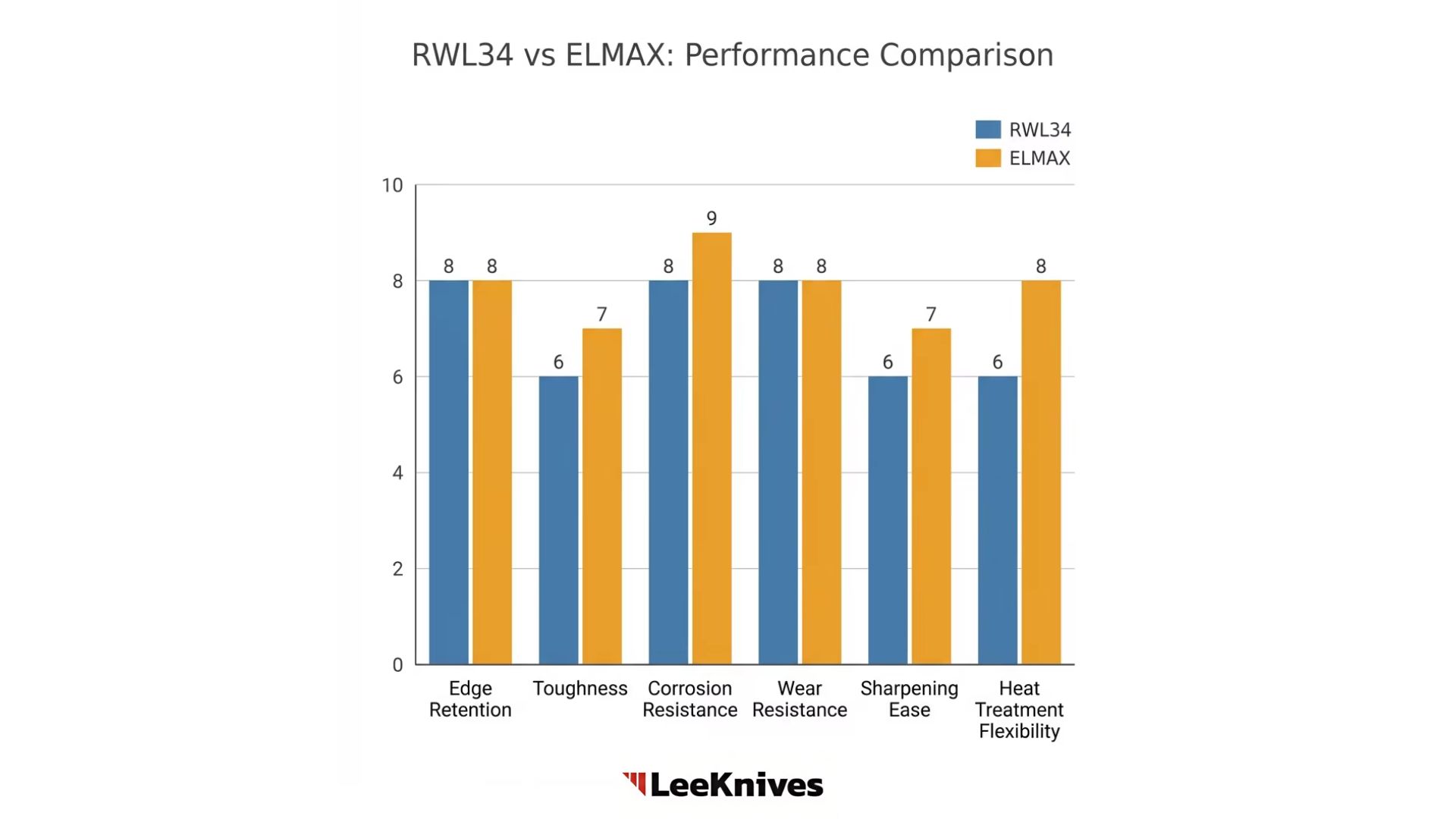
The table below provides a detailed performance comparison across the most critical attributes for knife manufacturers:
| Performance Metric | RWL34 | ELMAX | Winner |
|---|---|---|---|
| Hardness (HRC) | 60 – 62 | 58 – 62 | RWL34 |
| Edge Retention | 8/10 | 8/10 | Tie |
| Toughness | 6/10 | 7/10 | ELMAX |
| Corrosion Resistance | 8/10 | 9/10 | ELMAX |
| Wear Resistance | 8/10 | 8/10 | Tie |
| Sharpening Ease | 6/10 | 7/10 | ELMAX |
| Heat Treatment Flexibility | Moderate | High | ELMAX |
| Best For | Thin edge geometries | Aggressive blade designs | Context-dependent |
Hardness
RWL34 typically achieves a hardness range of 60-62 HRc after proper heat treatment, while ELMAX reaches 58-62 HRc depending on treatment protocols.
RWL34’s higher maximum hardness gives it a slight edge in applications requiring exceptional cutting performance, such as premium chef knives. However, ELMAX’s moderate hardness range provides more flexibility for manufacturers to optimize for specific use cases.
For knife makers, RWL34’s hardness makes it ideal for thin edge geometries, while ELMAX’s range allows for both flexible fillet knives and rigid hunting blades.
Corrosion Resistance
ELMAX excels in corrosion resistance thanks to its 18% chromium content and advanced powder metallurgy production. This makes it one of the most corrosion-resistant tool steels available for knife manufacturing.
RWL34, with 14% chromium, delivers solid corrosion resistance for a martensitic stainless steel. While not as corrosion-resistant as ELMAX, it performs adequately for most kitchen and outdoor applications.
For knife store owners, this means ELMAX blades require less maintenance guidance and generate fewer warranty claims in humid or coastal environments.
Edge Retention
Both steels offer excellent edge retention, though through different mechanisms. RWL34 achieves this through higher hardness and fine carbide structure, while ELMAX relies on its high vanadium content (3.0%) that creates fine, hard carbides.
In practical use, the difference is minimal for most applications. RWL34 knives can maintain sharpness through extended use, making them suitable for chef knives where sustained cutting performance is critical.
ELMAX’s edge performance is equally impressive, particularly for EDC knives and tactical blades where long-lasting sharpness is a key selling point.
Toughness
ELMAX demonstrates superior toughness compared to many high-hardness steels. The powder metallurgy process ensures uniform carbide distribution, reducing the risk of chipping or cracking under stress.
RWL34 offers moderate toughness that balances well with its hardness. While not as impact-resistant as ELMAX, it provides adequate durability for normal knife applications when properly heat treated.
For OEM manufacturers, this means ELMAX can handle more aggressive blade geometries without compromising durability, offering design flexibility for custom knife lines. Wholesale buyers should note that RWL34 requires careful blade geometry and heat treatment to maximize toughness.
What Knife Makers Say: RWL34 vs ELMAX

Beyond technical specs, real-world feedback from the knife-making community offers valuable perspective on how these steels perform in practice.
On BladeForums, experienced makers consistently describe ELMAX as a “great all-around steel” that is “surprisingly tough” for its hardness level. One Gold Member with over 4,000 posts noted: “You have to look pretty hard to find a better, more well-balanced steel than Elmax.” Several makers also emphasized that blade geometry plays a decisive role — a slightly thicker edge behind the apex significantly improves ELMAX’s impact resistance in hard use.
RWL34 is widely respected for its mirror finish capability and fine grain structure, with users on BushcraftUK noting it performs comparably to CPM-154 and suits applications where thin, precise edge geometry is the priority. A recurring observation: in real-world use, most users cannot tell the two steels apart — the difference comes down to heat treatment quality more than steel grade alone.
Key takeaway from the community: Heat treatment execution matters more than the steel choice itself. Both steels reward proper technique and punish shortcuts — an important consideration when evaluating OEM suppliers.
Best Uses: When to Choose RWL34 or Elmax

Selecting the right steel starts with understanding your end customer and the knife’s intended use. Here’s how to match each steel to your product line.
RWL34 excels in:
- Premium kitchen knives (chef knives, santoku, paring knives)
- Custom and handmade knife collections
- Applications requiring high hardness and fine edge geometry
- OEM production where consistent heat treatment is prioritized
RWL34’s 60-62 HRc hardness and fine carbide structure make it the preferred choice for culinary applications where sustained sharpness is a primary selling point. Its straightforward heat treatment also reduces production variability, making it well-suited for high-volume OEM runs targeting the kitchen knife segment.
ELMAX excels in:
- High-end EDC and pocket knives
- Hunting and outdoor knives
- Tactical and survival blades
- Applications requiring maximum corrosion resistance
ELMAX’s superior toughness and 18% chromium content make it the stronger choice for knives that face demanding field conditions — moisture, impact, and extended use without maintenance.
For retailers targeting outdoor enthusiasts or tactical users, ELMAX’s all-around performance justifies the premium price point and reduces after-sale maintenance complaints.
Not sure which to stock? If your customer base spans both kitchen and outdoor segments, RWL34 covers the culinary side while ELMAX handles EDC and field use — the two steels complement rather than compete with each other in a well-rounded product lineup.
Commercial Value Analysis: RWL34 vs ELMAX
Both RWL34 and ELMAX fall into the premium price category, but their cost structures differ across raw materials, manufacturing, and supply chain. Understanding these differences helps wholesale buyers make informed sourcing decisions and protect margins.
Raw Material Cost
Based on our sourcing experience across multiple production cycles, ELMAX carries a 15–25% higher raw material cost than RWL34 at comparable bar stock dimensions. This premium reflects Uddeholm’s advanced powder metallurgy process and tighter quality tolerances.
| Cost Factor | RWL34 | ELMAX |
|---|---|---|
| Raw material premium vs. standard stainless | ~2–3x | ~3–4x |
| Relative cost index | 1.0 | 1.15–1.25 |
| Typical finished blade upcharge to buyer | $8–15 | $15–25 |
Based on LeeKnives internal procurement data across OEM production runs.
Manufacturing Cost
ELMAX’s powder metallurgy structure demands more controlled grinding and heat treatment cycles compared to RWL34. In our production experience, this translates to:
- Heat treatment: ELMAX requires tighter temperature windows (±5°C vs. ±10°C for RWL34), increasing furnace cycle time by approximately 10–15%
- Grinding & finishing: ELMAX’s higher vanadium carbide content increases abrasive wear on tooling, adding marginal but measurable cost per unit at scale
- Defect rate: ELMAX’s consistent PM structure results in a lower defect rate (~1–2% vs. ~3–4% for RWL34 in high-volume runs), partially offsetting higher processing costs
For OEM buyers, the net manufacturing cost difference between an RWL34 and ELMAX blade of the same geometry is typically $3–8 per unit at mid-volume (500–2,000 pcs/run).
Supply Chain & Risk
| Factor | RWL34 | ELMAX |
|---|---|---|
| Primary supplier | Damasteel (Sweden) | Uddeholm (Sweden/Austria) |
| Global distributor network | Moderate | Broad |
| Lead time (typical) | 4–8 weeks | 3–6 weeks |
| Supply disruption risk | Moderate — single-source manufacturer | Lower — wider distributor coverage |
| Counterfeit/substitution risk | Low | Low–Moderate (verify mill cert) |
RWL34’s single-source nature (Damasteel is the sole producer) creates more supply concentration risk. ELMAX benefits from Uddeholm’s global distribution under the Voestalpine group, providing more sourcing flexibility.
For high-volume OEM orders, we recommend requesting mill certificates for both steels to verify composition and avoid substitution.
Margin Implication for Buyers
At retail, ELMAX knives typically command a $20–40 higher price point than equivalent RWL34 models in the EDC and outdoor segments — more than enough to absorb the material and manufacturing premium.
RWL34 kitchen knives hold strong margins in the culinary segment where brand positioning and blade geometry matter more than steel grade alone.
All cost ranges reflect LeeKnives internal OEM production data and may vary by order volume, blade geometry, and market conditions.
Conclusion: Which Steel Should You Choose?
Choosing between RWL34 and ELMAX ultimately depends on your target market and production requirements. Both steels offer exceptional performance for premium knife manufacturing, but they excel in different areas.
Choose RWL34 if:
- You’re producing high-end kitchen knives requiring maximum hardness
- Your manufacturing setup is optimized for RSP powder metallurgy steels with standard heat treatment protocols
- You need consistent quality with straightforward heat treatment protocols
- Your customers prioritize edge sharpness over extreme corrosion resistance
Choose ELMAX if:
- You’re targeting the EDC, tactical, or outdoor knife markets
- Maximum corrosion resistance is a key selling point for your customers
- You want superior toughness for aggressive blade geometries
- You’re willing to invest in premium materials for higher profit margins
For knife wholesalers and retailers, both steels represent solid investments in the premium segment. The key is matching the steel’s strengths to your customers’ specific needs and usage patterns.
Ready to explore OEM knife manufacturing options with these premium steels? Request a quote from our team to discuss your production requirements and get competitive pricing for RWL34 or ELMAX knife production.
Launch Your Custom Knife Line Faster with LeeKnives
Complete OEM/ODM support—from design to final shipment—so you can focus on growth.
Backed by warehouses in the U.S. for fast, reliable delivery.
Frequently Asked Questions
Is RWL34 steel good for kitchen knives?
Yes, RWL34 is an excellent choice for kitchen knives. Its high hardness (60-62 HRc) and fine carbide structure provide superior edge retention, making it ideal for chef knives and santoku blades that require sustained sharpness.
Can ELMAX rust?
While ELMAX offers excellent corrosion resistance due to its 18% chromium content, it is not completely rust-proof. Proper storage and occasional maintenance will prevent surface oxidation, especially in humid environments.
What is RWL34 steel equivalent to?
RWL34 is most closely comparable to:
- ATS-34: RWL34 is essentially the RSP upgrade of ATS-34, offering better consistency and cleanliness through powder metallurgy
- 154CM / CPM-154: Nearly identical composition to RWL34; CPM-154 is the powder metallurgy version, making it the closest direct equivalent
- VG-10: Popular in Japanese kitchen knives, but RWL34 achieves higher hardness and offers more consistent carbide distribution
For OEM buyers, RWL34 is often the preferred upgrade path from 154CM when customers demand better consistency and a Swedish provenance story.
What is ELMAX steel equivalent to?
ELMAX is most closely comparable to:
- M390 / Bohler M390: The most direct equivalent — similar powder metallurgy construction, though ELMAX offers slightly better toughness
- CPM-20CV: Nearly identical performance profile; ELMAX has a marginal edge in corrosion resistance
- S30V: ELMAX outperforms S30V in wear resistance and corrosion resistance but comes at a higher price point
For OEM buyers, ELMAX and M390 are often interchangeable in product specs, but ELMAX’s Uddeholm backing gives it stronger brand recognition in the European and premium EDC markets.




 EN
EN  JA
JA  DE
DE