S35VN vs MagnaCut is the defining steel debate for knife wholesalers and OEM buyers planning their 2026 product lines. S35VN remains the proven workhorse with factory-friendly grinding, forgiving heat treatment, and a mature supply chain ideal for mid-range lines.
MagnaCut delivers a breakthrough combination of superior toughness and exceptional corrosion resistance through its chromium carbide-free microstructure, achieving over 62 HRC without sacrificing durability.
This comparison examines hardness, edge retention, production costs, heat treatment requirements, and supply chain stability to help you select the right steel for your catalog, satisfy your customers, and maximize your margins in a competitive market.
Key differences at a glance
- MagnaCut is ~40% tougher than S35VN at comparable hardness, making it the better choice for thin-edged and hard-use blades
- MagnaCut’s corrosion resistance significantly exceeds S35VN—and even outperforms M390 and 20CV—despite lower nominal chromium, because none of it is locked in carbides
- S35VN is easier to produce—forgiving heat treatment, mature supply chain, and 15+ years of factory process data
- MagnaCut requires cryogenic processing—skipping it measurably reduces performance
- Best used together: S35VN for mid-range lines ($80–$150), MagnaCut for flagship editions ($150+)
What is CPM S35VN?
CPM S35VN is a martensitic stainless steel developed by Crucible Industries in collaboration with knifemaker Chris Reeve. Released as a direct evolution of CPM S30V, it was designed to address two production complaints: microchipping under lateral stress and inconsistent grinding behavior.
The key change was the addition of 0.5% niobium, which refines grain structure and improves toughness without sacrificing wear resistance. Since its release, S35VN has become one of the most widely adopted premium knife steels in both custom and production manufacturing.
What is CPM MagnaCut?
CPM MagnaCut was developed by metallurgist Dr. Larrin Thomas of Knife Steel Nerds and produced via powder metallurgy, now manufactured by Erasteel. It represents a fundamental rethink of stainless knife steel design rather than an incremental upgrade.
Its defining innovation is a precisely balanced chemistry that eliminates chromium carbides entirely—a structural limitation present in most conventional stainless steels including S35VN. This single change unlocks a combination of toughness, corrosion resistance, and hardness that prior stainless steels could not achieve simultaneously.
S35VN vs MagnaCut: Steel composition
Understanding the compositional differences explains why these two steels behave so differently in production and performance testing.
| Element | CPM S35VN | CPM MagnaCut | Why It Matters |
|---|---|---|---|
| Carbon (C) | 1.38–1.40% | 1.15–1.21% | MagnaCut’s lower C prevents chromium carbide formation |
| Chromium (Cr) | 14.00% | 10.70% | MagnaCut’s Cr stays fully in solution; S35VN’s is partially locked in carbides |
| Vanadium (V) | 3.00% | 4.00% | Higher V in MagnaCut drives finer carbide structure and toughness |
| Molybdenum (Mo) | 2.00% | 2.00% | Equal contribution to hardenability in both steels |
| Niobium (Nb) | 0.50% | 0.55% | Grain refinement and toughness in both; slightly higher in MagnaCut |
| Nitrogen (N) | — | Trace | Boosts MagnaCut’s corrosion resistance and carbide refinement |
| Manganese (Mn) | 0.50% | — | Standard hardenability aid in S35VN |
| Silicon (Si) | 0.50% | — | Deoxidizer in S35VN melt process |
Sources: Niagara Specialty Metals CPM MagnaCut Datasheet; Knife Steel Nerds— S35VN Properties
The key compositional insight: MagnaCut does not simply add more of everything. It is a precision-engineered balance where lower chromium and carbon work together to eliminate an entire carbide type, unlocking corrosion resistance and toughness gains that higher-chromium steels cannot achieve through brute force alloying.
S35VN vs MagnaCut: Performance & production comparison table
In the comparison table below, you will find the key performance metrics, production characteristics, and commercial considerations for CPM S35VN and CPM MagnaCut.
| Property | CPM S35VN | CPM MagnaCut |
|---|---|---|
| Hardness (HRC) | 58–61 | 60–64+ |
| Edge Retention | High | High (comparable to S35VN) |
| Toughness | Medium-High | High (~40% tougher than S35VN) |
| Corrosion Resistance | High | Very High (exceeds 20CV/M390) |
| Sharpening Ease | Medium | Medium (deburrs cleanly) |
| Production Grinding | Factory friendly | Surprisingly easy (fine microstructure) |
| Heat Treatment | Standard vacuum + temper | High-temp vacuum + cryo required |
| Raw Material Cost | Moderate | Premium (higher than S35VN) |
| Supply Stability | Excellent (mature supply chain) | Good (transitioned to Erasteel) |
| Best For | Mid-range premium lines ($80–$150 MSRP) | High-end & hard-use lines ($150+ MSRP) |
Performance ratings based on CATRA edge retention testing, Charpy V-notch toughness data, and salt-spray corrosion trials published by Knife Steel Nerds.
S35VN vs MagnaCut: Property-by-property breakdown
Hardness and heat treatment response
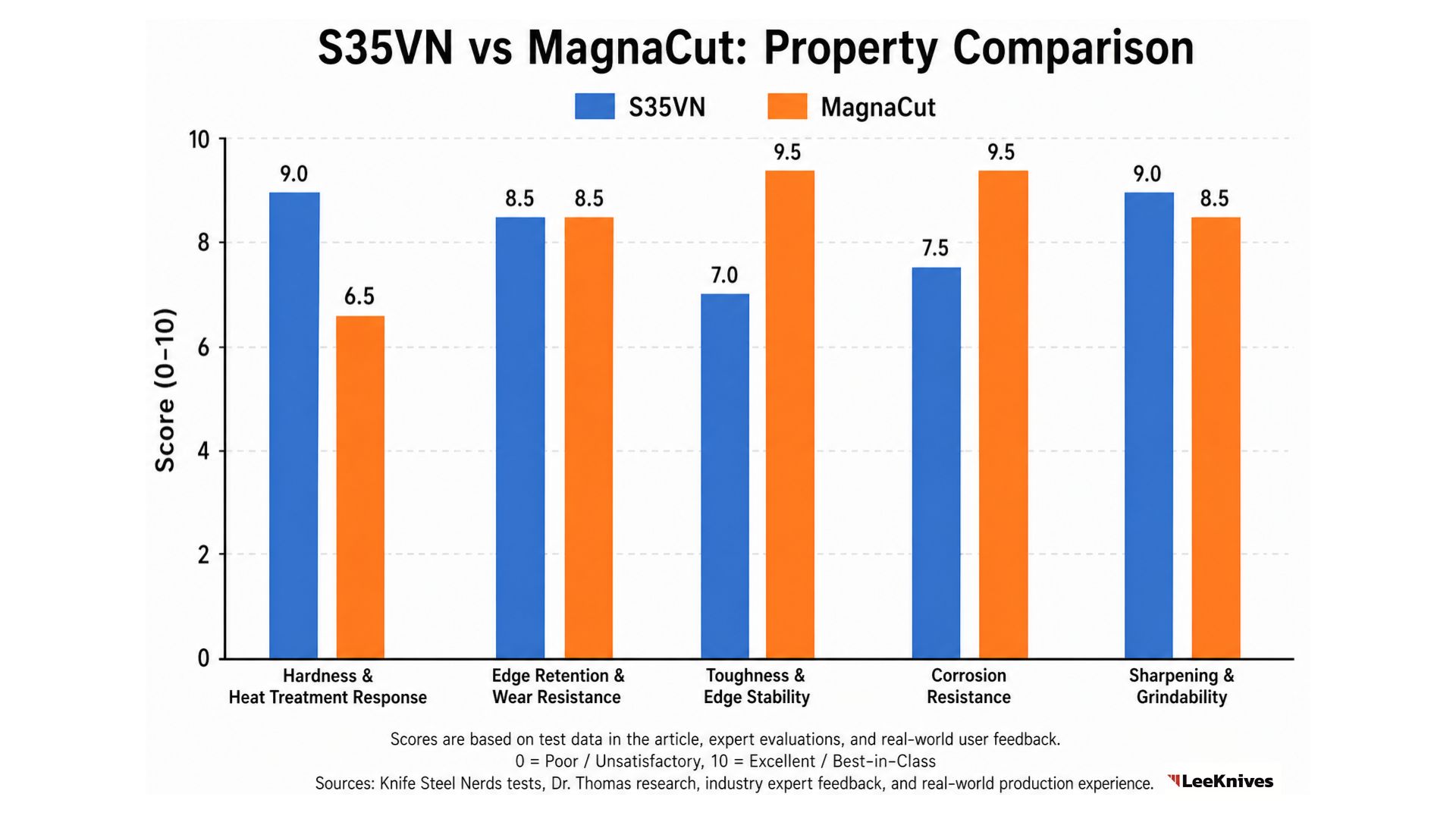
S35VN achieves a stable 58–61 HRC through conventional vacuum heat treatment, with a forgiving process window that has been refined over 15 years of OEM production. The result is low scrap rates and strong lot-to-lot consistency.
MagnaCut requires a more precise protocol—austenitizing at 2050°F, followed by quenching, cryogenic treatment, and tempering at 350°F—to reach its potential of 62–64 HRC. Skipping cryo or using suboptimal temperatures meaningfully reduces performance. For OEM buyers, this makes vetting your heat treat partner essential.
Manufacturer’s Note: If your current heat treat vendor lacks experience with high-temp austenitizing and cryogenic cycles, S35VN offers a lower-risk path to consistent results. If you have access to a qualified PM steel heat treater, MagnaCut’s property ceiling is significantly higher.
Edge retention and wear resistance
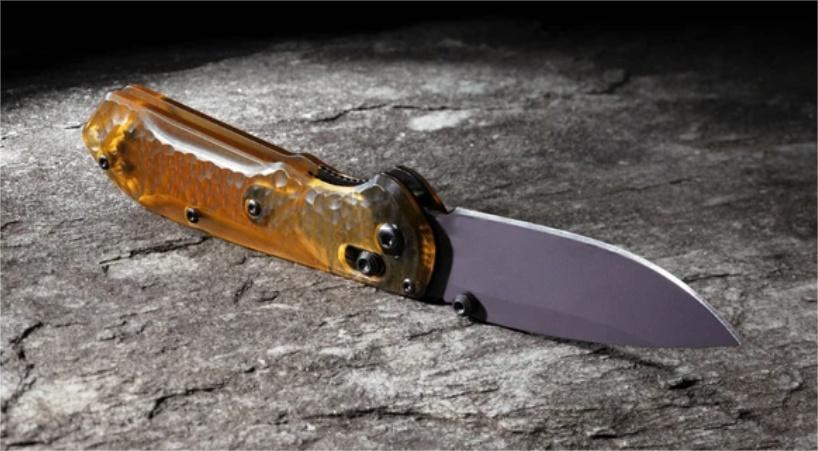
In controlled CATRA and rope-cutting tests, MagnaCut’s edge retention is broadly comparable to S35VN—the difference in everyday slicing life is small enough that most end users won’t notice. S35VN’s 3% vanadium carbide content provides reliable wear resistance across abrasive materials like cardboard and rope.
Where MagnaCut pulls ahead is edge stability across multiple dulling mechanisms. Edges dull through deformation, chipping, wear, and corrosion.
MagnaCut’s superior toughness and corrosion resistance suppress two of these four mechanisms, giving it a practical durability advantage in wet or high-impact environments even when raw wear rates are similar.
Toughness and edge stability
This is MagnaCut’s clearest advantage. At 62 HRC, MagnaCut registers approximately 20–22 ft-lb on Charpy V-notch testing—roughly 40% tougher than S35VN at comparable hardness. Its carbide-free microstructure allows the edge to absorb impact rather than fracture, making it well suited to thin-ground folders, chef knives, and hard-use outdoor blades where chipping risk is highest.
S35VN is not brittle—it outperforms M390 and S90V in toughness—but MagnaCut provides a safety margin that S35VN cannot match for demanding edge geometries and high-impact applications. For manufacturers, this translates directly to lower warranty risk.
Corrosion resistance
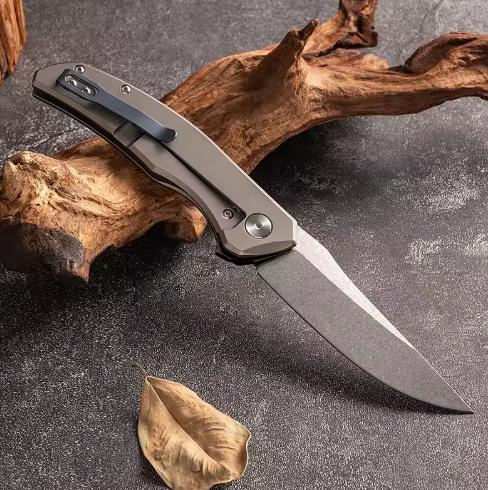
MagnaCut outperforms S35VN, 20CV, S45VN, and M390 in standardized corrosion testing. In a 72-hour 1% saltwater spray test, MagnaCut showed zero visible corrosion while 20CV developed rust spots and most other stainless grades fared worse.
The reason is structural: MagnaCut contains no chromium carbides, so all 10.7% of its chromium remains in solid solution, maximizing the passive oxide layer that blocks rust. In S35VN, a portion of chromium is locked into carbides and unavailable for corrosion protection.
For B2B buyers, this opens clear product positioning opportunities—kitchen knives, marine tools, and humid-climate EDC all benefit, and the “saltwater safe” angle is a credible, test-backed marketing claim that can reduce corrosion-related returns.
Both steels require diamond or CBN abrasives for efficient sharpening. MagnaCut deburrs cleanly and, unusually for a high-vanadium steel, responds well to aluminum oxide stones—a practical advantage for end users without specialized equipment.
On the production floor, MagnaCut’s fine microstructure makes coarse-belt grinding noticeably faster, with multiple professional knifemakers reporting easier material removal than comparable steels at similar hardness. Final finishing beyond 240 grit requires slightly more attention as vanadium carbides become visible at the surface.
S35VN remains the benchmark for factory-friendly premium steel—predictable grinding, clean polishing, and 15 years of accumulated process knowledge. Shops transitioning to MagnaCut will need some adjustment time, but overall grinding workload is not necessarily greater.
Wholesale and OEM considerations
| Factor | CPM S35VN | CPM MagnaCut |
|---|---|---|
| Production Cost Predictability | Stable heat treatment workflow with predictable tooling life and low scrap variability. | Higher processing sensitivity; tighter heat treatment control required. |
| Machining & Grinding Impact | Well-understood machining behavior across most OEM factories. | Fine microstructure may shorten coarse grinding time in some setups. |
| Typical Product Tier Fit | Mid-range premium lines ($80–$150 MSRP) with strong cost-performance balance. | Premium and professional lines ($150+ MSRP) where durability offsets cost. |
| Supply Chain Maturity | Long production history with broad inventory availability. | Newer ecosystem with tighter distribution channels. |
| Supplier Verification Risk | Lower verification burden due to established sourcing pathways. | Recommended to confirm current-generation production source and mill certification. |
Production cost and machinability
For a knife manufacturer, steel cost is only one line item in the total production equation. Machining time, abrasive consumption, heat treatment complexity, and scrap rates all factor into the final landed cost.
S35VN offers a proven cost structure. Factories have mastered its heat treatment, grinding belts last predictable lifetimes, and scrap rates are low. For mid-range production lines targeting an $80–$150 MSRP, S35VN delivers premium performance without premium production headaches.
MagnaCut carries a higher raw material cost and demands stricter heat treatment protocols. The high-temperature austenitizing and cryogenic cycles add steps and energy costs. However, the finer microstructure can reduce grinding time on coarse belts, partially offsetting the heat treat premium.
For high-end boutique lines ($150+ MSRP) or hard-use professional tools where warranty costs matter, MagnaCut’s performance advantage justifies the investment.
Supply chain stability
Here is a factor many competitors overlook: Crucible Industries, the original producer of both S35VN and MagnaCut, filed for Chapter 11 bankruptcy in late 2024 and ceased operations in early 2025. According to Knife Steel Nerds reporting, Niagara Specialty Metals has secured supply agreements with Erasteel (Sweden) to continue producing both steels under the CPM trademarks.
S35VN benefits from mature, multi-source availability. Because the steel has been in production since 2009, inventory exists throughout the supply chain, and multiple rolling mills can process it.
MagnaCut, being newer (commercially available since 2021), has a tighter supply chain. The transition from Crucible to Erasteel production required careful calibration to match composition and performance.
Independent testing in 2026 confirmed that Erasteel MagnaCut actually exceeds the toughness of original Crucible material, but buyers should verify their supplier is sourcing from the new Erasteel heats rather than aging Crucible inventory.
For wholesale buyers placing large orders, we recommend confirming with your steel supplier whether they are delivering Erasteel-produced MagnaCut and requesting mill test reports for composition verification.
Conclusion: Which steel is right for your knife line?
The toughness, corrosion resistance, and hardness ceiling of MagnaCut make it objectively superior to S35VN on a pure performance basis. However, S35VN remains an exceptionally capable steel with a lower risk profile, mature supply chain, and broader factory compatibility.
For most brands, the smartest strategy is not choosing one over the other—but using both strategically.
Choose CPM S35VN if:
- You are scaling a mid-range premium line ($80–$150 retail)
- You want maximum supply chain stability and lowest production risk
- Your heat treat vendor specializes in standard PM stainless protocols
- Your customers prioritize proven performance over cutting-edge specs
Choose CPM MagnaCut if:
- You are targeting the high-end or hard-use market ($150+ retail)
- Your product line includes thin-edged kitchen knives or heavy-duty outdoor blades
- You have access to qualified high-temp vacuum heat treatment with cryo capability
- Your customers value corrosion resistance and toughness above all else
Many successful knife brands carry both—S35VN for workhorse models, MagnaCut for flagship editions. This tiered approach captures multiple market segments while keeping your supply chain manageable.
Build your product line with confidence using industry-trusted steels like S35VN and MagnaCut. At LeeKnives, we combine OEM/ODM manufacturing expertise with a stable, proven supply chain—working directly with certified heat treatment partners and established material sources to ensure every batch meets strict performance standards.
From prototyping to mass production, we help brands reduce sourcing risk, control cost structure, and maintain consistent quality across every order.
Whether you’re launching a new knife series or scaling an existing catalog, our team provides end-to-end support—from material selection and engineering optimization to production and logistics.
Scale smarter. Source better. Build with LeeKnives.
Request a free quote today.
Launch Your Custom Knife Line Faster with LeeKnives
Complete OEM/ODM support—from design to final shipment—so you can focus on growth.
Backed by warehouses in the U.S. for fast, reliable delivery.
Frequently asked questions
Is MagnaCut better than S35VN?
On a pure performance basis, yes. MagnaCut exceeds S35VN in toughness, corrosion resistance, and maximum achievable hardness while delivering comparable edge retention. However, “better” depends on your business context.
S35VN offers lower production risk, broader heat treat compatibility, and a more mature supply chain. For mid-range lines, S35VN remains the smarter commercial choice. For high-end and hard-use lines, MagnaCut is objectively superior.
Is MagnaCut the best overall knife steel?
For pure performance, MagnaCut is the strongest all-around contender currently available—combining toughness, corrosion resistance, and hardness better than any previous stainless steel. However, “best” depends on context. For high-volume production, S35VN’s process maturity still makes it the more practical choice.
What’s better than S35VN?
MagnaCut outperforms S35VN in toughness, corrosion resistance, and hardness ceiling. Other steels like M390 and 20CV offer higher wear resistance, but at the cost of toughness. The right upgrade depends on what your product line demands.
What is the closest steel to MagnaCut?
In terms of the toughness-corrosion-hardness balance, no current stainless steel closely replicates MagnaCut. CPM-4V is comparable in toughness but lacks corrosion resistance. S45VN is the closest in the stainless category but falls short on toughness and corrosion resistance.
Yes. S35VN sits firmly in the premium tier, offering a well-balanced combination of toughness, wear resistance, and corrosion resistance. It is widely used by respected production knife brands as a benchmark mid-to-high-end steel.




 EN
EN  JA
JA  DE
DE