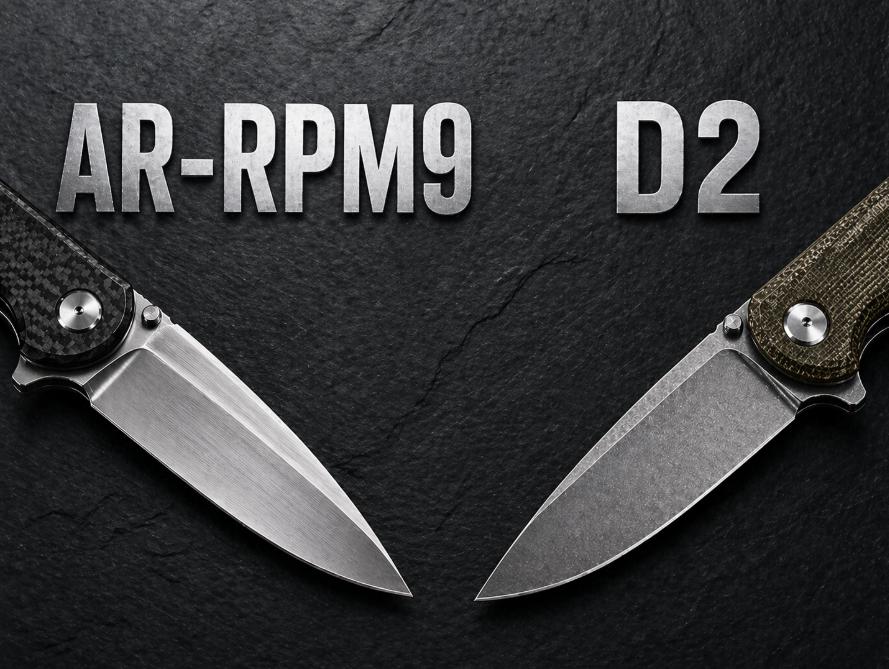
Choosing between AR-RPM9 vs D2 is one of the most frequent steel-spec decisions we see across OEM and wholesale knife programs in 2026. Both target the $25–$80 retail band, both promise “premium” performance at budget pricing, and both can win or lose your margin depending on the channel you’re selling into.
This guide cuts through the consumer-review noise and compares AR-RPM9 vs D2 the way a brand owner, distributor, or private-label buyer actually needs to see it: chemistry, hardness, edge retention, toughness, corrosion, sharpening, heat-treat windows, machining cost, supply-chain risk, and channel fit.
TL;DR for buyers in a hurry
- D2 is a high-carbon, high-chromium tool steel — proven, wear-resistant, semi-stainless. Best for value-driven SKUs sold into dry climates and customers who accept light maintenance.
- AR-RPM9 is Artisan Cutlery’s spray-formed, high-chromium stainless steel positioned as a budget upgrade. Better corrosion resistance and finer grain than D2, but lower edge retention and limited to the Artisan/CJRB supply chain.
- For most OEM/wholesale programs in 2026, the choice comes down to: D2 = max wear-per-dollar in dry markets; AR-RPM9 = lower warranty/return risk in humid markets and easier resharpening for end users.
What are AR-RPM9 and D2? A quick overview
D2: the legacy high-carbon tool steel
D2 is a high-carbon, high-chromium cold-work tool steel that has been a staple in the knife industry for decades.
With around 1.5% carbon and 12% chromium, it sits just below the conventional “stainless” threshold — tough enough for demanding cutting tasks, hard enough to hold a serious edge, and widely available from mills around the world. It’s not stainless, but it’s proven.
AR-RPM9: Artisan Cutlery’s spray-formed budget stainless
AR-RPM9 is a proprietary steel developed by Artisan Cutlery. It uses a spray-forming process to produce a finer-grained microstructure compared to conventional cast steels like 9Cr18MoV. With approximately 18% chromium, it clears the stainless threshold comfortably, making it noticeably more corrosion-resistant than D2.
It’s positioned as a budget-friendly upgrade to standard stainless steels — easier to resharpen and more rust-resistant, though it trades off some edge retention in the process.
In short: D2 is the workhorse with a long track record; AR-RPM9 is the newer, more corrosion-resistant alternative aimed at everyday carry and humid-environment use cases.
AR-RPM9 vs D2 steel: Chemistry & metallurgy
Chemical composition table
| Element | AR-RPM9 | D2 |
|---|---|---|
| Carbon (C) | ~0.90% | 1.50 – 1.60% |
| Chromium (Cr) | ~18.0% | 11.5 – 12.0% |
| Molybdenum (Mo) | ~1.0% | 0.7 – 1.0% |
| Vanadium (V) | ~0.10% | 0.8 – 1.1% |
| Cobalt (Co) | ~0.30% | — |
| Nickel (Ni) | ~0.30% | — |
| Manganese (Mn) | ~0.45% | ~0.40% |
| Silicon (Si) | 0.2 – 0.8% | ~0.30% |
AR-RPM9 vs D2 — Chemical Composition
Values in weight percent (%). Hover or tap bars for exact values.
Sources: ZKnives, Knife Steel Nerds, Böhler K110 datasheet. D2 values shown as midpoint where a range is given.
Sources: Böhler K110 (D2) datasheet; ZKnives steel database — AR-RPM9
What the numbers actually mean
- Cr ≥ ~13% is the conventional threshold for “stainless.” AR-RPM9 sits well above it (≈18%). D2 sits below it (≈12%) and is correctly described as semi-stainless — it resists rust better than carbon steel but will still spot in humid conditions.
- Carbon and vanadium drive carbide volume, which drives wear resistance. D2 has nearly double the carbon and 8–10× the vanadium of AR-RPM9. That’s why D2 holds an edge longer.
- Manufacturing route is the real story. D2 is a conventional ingot-cast tool steel — large primary carbides, the classic “D2 chunky grain.” AR-RPM9 is spray-formed, which produces a finer and more uniform microstructure than ingot-cast steels but is not a true powder-metallurgy (PM) steel like CPM-D2 or S30V.
AR-RPM9 vs D2 Steel: Performance comparison
Performance Comparison: AR-RPM9 vs D2
Ratings out of 10 where applicable. Winner highlighted per category.
| Property | AR-RPM9 | D2 | Winner |
|---|
Rated Properties (0–10)
CATRA-based ratings are approximate industry benchmarks. Toughness ratings are estimated from microstructure data.
Hardness
Both steels operate in a similar hardness range — AR-RPM9 at 59–61 HRC, D2 at 58–62 HRC (typically spec’d at 60–62 HRC in production knives). On paper this looks like a tie, but D2 has more headroom at the top end when heat treatment is dialed in correctly with cryo.
AR-RPM9’s finer grain means hardness is more consistent across a batch, while D2 shows greater scatter without proper cryo treatment.
Edge retention
This is where D2 pulls clearly ahead. D2’s higher carbon (1.5–1.6%) and vanadium content (0.9%) produce a denser carbide structure that holds an edge significantly longer under real cutting loads. CATRA-based testing rates D2 around 5/10 versus AR-RPM9’s 3/10.
In practical terms, a D2 blade will out-cut an AR-RPM9 blade by roughly 50–70% on standardized rope or cardboard tests. If edge retention is your primary selling point, AR-RPM9 cannot compete with D2 at this price tier.
Toughness
AR-RPM9 has the advantage here. Its spray-formed microstructure produces a finer, more uniform grain than D2’s ingot-cast carbide structure, which translates to better resistance to chipping and lateral stress.
D2 is notoriously brittle compared to its tool steel peers — a known weakness that shows up in tip breakage on thin grinds. AR-RPM9’s estimated toughness rating sits around 4–4.5/10 versus D2’s 3/10.
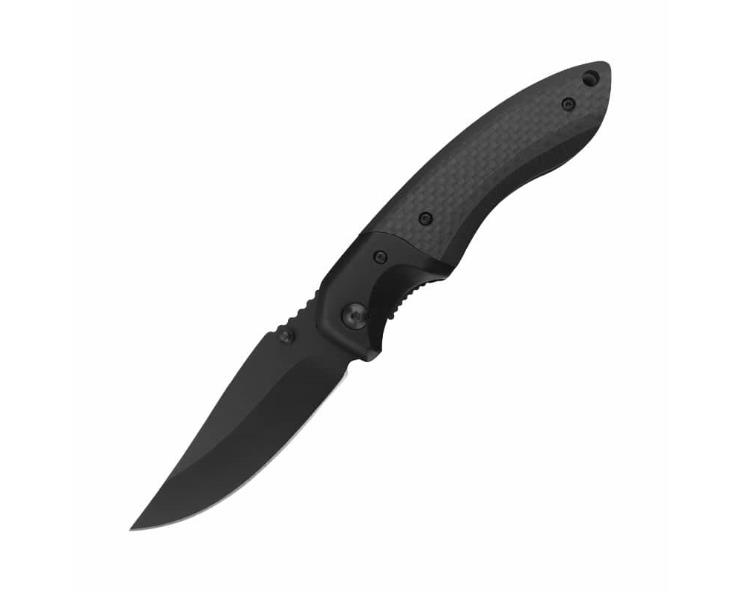
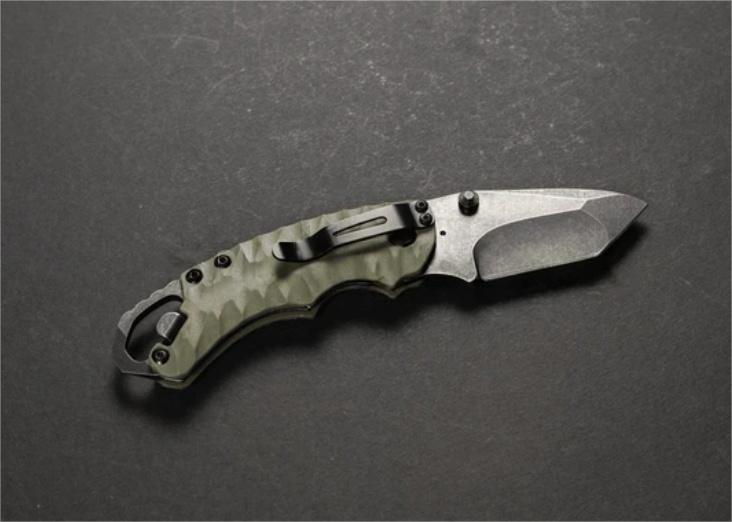
D2 G10 with Steel Bolster Folding Knife LKFDK10018
Corrosion resistance
No contest — AR-RPM9 wins decisively. At ~18% chromium it sits well above the stainless threshold, while D2 at ~12% chromium is correctly classified as semi-stainless. D2 will develop rust spots in humid storage, coastal environments, or even a sweaty pocket within weeks.
AR-RPM9 handles these conditions without issue. For any channel where end users are unlikely to wipe and oil their blade regularly, this difference will show up directly in your return and warranty data.
AR-RPM9 is meaningfully easier to resharpen. Its low vanadium content means standard ceramic or aluminum-oxide stones cut it efficiently — most end users can touch it up with basic equipment.
D2’s chromium and vanadium carbides are harder and more abrasion-resistant, requiring diamond or CBN stones for efficient sharpening. For consumer-facing SKUs where the buyer is not an experienced sharpener, this matters: a blade that’s easy to maintain gets better long-term reviews.
An honest note on AR-RPM9’s marketing
Artisan has at times marketed AR-RPM9 with “powder material” language. Independent metallurgist Dr. Larrin Thomas (Knife Steel Nerds) has shown via micrographs that AR-RPM9’s microstructure is closer to a refined conventional 9Cr18MoV than to true PM steels. Performance testing puts its edge retention near 440C / 9Cr18MoV, not anywhere near CPM-S30V or CPM-154.
For B2B buyers this matters in two ways:
- Don’t oversell it on your listing copy. “Stainless powder steel” claims invite chargebacks and Amazon listing complaints.
- Position it correctly: AR-RPM9 is a better budget stainless — finer grain than 9Cr18MoV, more rust-resistant than D2 — not a premium super steel.
What this looks like in the real world: A D2 EDC knife will out-cut an AR-RPM9 knife on rope or cardboard tests by roughly 50–70%. An AR-RPM9 knife left in a humid pocket or a coastal warehouse will still look new while the D2 will show rust freckles within weeks.
The OEM/factory view: heat treatment, machining, and yield
Heat-treatment window
| Aspect | AR-RPM9 | D2 |
|---|---|---|
| Austenitizing range | ~1050–1080 °C (vacuum, plate-quench) | ~1010–1040 °C (vacuum, plate-quench) |
| Cryo treatment | Optional, modest gain | Recommended for full HRC and dimensional stability |
| Tempering | 180–220 °C, 2× cycles | 180–210 °C for working hardness; secondary-hardening peak around 510 °C is rarely used in knives |
| HRC consistency across batch | High (fine grain forgives small deviations) | Sensitive — under-tempered D2 chips, over-tempered drops below 58 HRC |
| Risk of retained austenite | Lower | Higher without cryo — causes dimensional drift on PVD pre-heat |
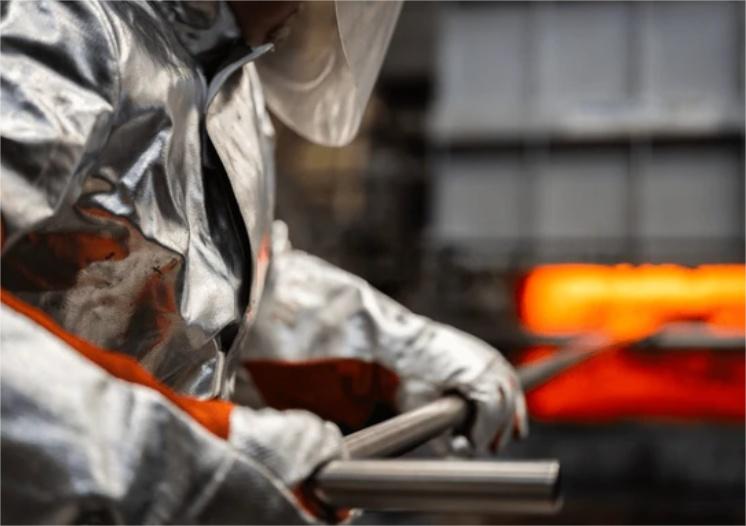
OEM takeaway: AR-RPM9 is more forgiving in a high-mix, multi-customer factory environment. D2 demands a tighter HT discipline and ideally cryo treatment between quench and temper. If your supplier doesn’t run cryo for D2, expect HRC scatter of ±1.5 across a 1,000-unit batch.
Grinding, machining, and finishing cost
Profile cutting shows no meaningful cost difference between the two steels. The gap opens at bevel grinding — D2’s chromium carbides consume roughly 1.4–1.6× more abrasive belts than AR-RPM9 per batch.
Hand finishing takes longer on D2 as well; carbide pull-out causes micro-scratches that require extra passes on mirror or satin finishes. Stonewash, blast, PVD and DLC coating both handle well on either steel.
Across a typical 2,000–5,000 unit OEM order, D2 adds roughly $0.30–$0.80 per blade in belt and labor cost versus AR-RPM9, depending on bevel geometry and finish spec.
Supply chain and pricing reality
| Factor | AR-RPM9 | D2 |
|---|---|---|
| Supplier base | Single-source via Artisan / CJRB ecosystem | Open market — Crucible (US), Böhler (AT), domestic CN mills, IN/KR mills |
| MOQ flexibility | Limited; tied to Artisan partnerships | Excellent — bar stock available in any common thickness |
| Lead time for raw bar | 6–12 weeks | 1–4 weeks (China-stocked) |
| Bar stock price (2026 indicative) | Premium; not openly quoted | $3.5–$6.0 / kg depending on form and origin |
| IP / brand risk | Using “AR-RPM9” branding outside Artisan ecosystem may invite trademark issues | None — D2 is a generic AISI designation |
Bottom line: If you’re a brand wanting to spec AR-RPM9 on a private-label SKU, you generally need to source through Artisan/CJRB or a partnered factory. D2 can be sourced and certified by virtually any reputable knife factory worldwide. For LeeKnives OEM customers, this is one of the most common decision points in the first sourcing call.
Which steel for which SKU? Channel & target-market matrix
| End market | Recommended steel | Reasoning |
|---|---|---|
| Amazon EDC folder, US dry climates | D2 | Wins the “sharp out of the box / holds an edge” Amazon review pattern at $25–$45 retail. |
| Amazon / Shopify EDC, EU + humid Asia | AR-RPM9 | Cuts rust-related 1-star reviews; easier customer resharpening = better long-tail rating. |
| Outdoor / bushcraft fixed blades | D2 (60–62 HRC) | Edge retention and wear matter more than rust on a serviced tool. |
| Marine / fishing / dive | AR-RPM9 (or step up to LC200N) | D2 will spot within a single trip. |
| Tactical / LE / military distributors | D2 with PVD/Cerakote | Coating mitigates D2’s corrosion weakness; carbide content liked by spec writers. |
| Kitchen / chef knives | Neither — use a true stainless cutlery steel (e.g. VG-10, 14C28N, AUS-10) | Both are sub-optimal vs. dedicated kitchen steels. |
| Premium gift / collector | Neither | Move to S35VN, M390, or Magnacut. AR-RPM9 cannot carry a premium price tag credibly post-Knife Steel Nerds coverage. |
| Promotional / private-label budget line | D2 | Lowest landed cost per “perceived premium” steel. |
The bottom line
AR-RPM9 and D2 are both capable steels at the budget-to-mid tier, but they serve different purposes.
- D2 — the proven workhorse. Hard, wear-resistant, freely available from mills worldwide. Best where edge retention matters and end users accept basic maintenance.
- AR-RPM9 — the more user-friendly option. Stainless, consistent, easier to maintain. Best for humid environments and consumer-facing SKUs where after-sales friction needs to stay low.
For B2B buyers, the decision rarely comes down to which steel is “better” — it comes down to channel fit: who is buying the knife, where they’re using it, and how much warranty exposure you’re willing to carry.
Get that right, and either steel can anchor a successful SKU. When neither fits cleanly, that’s usually the signal to step up to a premium PM steel like S35VN or MagnaCut.
Source your next program with LeeKnives
LeeKnives is a Yangjiang-based OEM and wholesale knife manufacturer. We help brands, distributors, and private-label sellers spec the right steel for the right channel — and run the heat treatment, grinding, finishing, and QC to get a consistent product into your warehouse.
- OEM & private-label knives — start at low MOQs, scale to container loads
- Wholesale catalog — D2, 9Cr18MoV, 14C28N, VG-10, S35VN, M390 and more
- Talk to an engineer about your AR-RPM9, D2, or alternative steel program
Have an existing AR-RPM9 or D2 SKU you’d like benchmarked against an alternative steel? Send us the spec sheet and we’ll return a side-by-side cost, lead-time, and performance estimate within 2 business days.
Contact us to get started.
Launch Your Custom Knife Line Faster with LeeKnives
Complete OEM/ODM support—from design to final shipment—so you can focus on growth.
Backed by warehouses in the U.S. for fast, reliable delivery.
Frequently asked questions
Is AR-RPM9 better than D2?
Neither is categorically better. AR-RPM9 wins on corrosion resistance, toughness, and sharpening ease. D2 wins on edge retention and supply-chain flexibility.
For humid environments or low-maintenance consumers, AR-RPM9 is the safer choice. For dry-climate markets or edge-retention-focused channels, D2 delivers more performance per dollar.
What are the disadvantages of D2 steel?
Three main weaknesses matter for B2B buyers. First, corrosion resistance — at ~12% chromium, D2 is semi-stainless at best and will spot in humid storage or coastal environments without regular maintenance.
Second, toughness — D2’s large carbide structure makes it more brittle than most tool steels at the same hardness, with tip chipping a known failure mode on thin grinds.
Third, sharpening difficulty — D2’s hard chromium and vanadium carbides require diamond or CBN abrasives to sharpen efficiently, which is a friction point for end users who don’t own the right equipment.
Is AR-RPM9 a good steel?
It depends on what you need it for. AR-RPM9 is a solid budget stainless — better corrosion resistance than D2, easier to sharpen than most tool steels, and more consistent in heat treatment than 9Cr18MoV.
Where it falls short is edge retention, which independent testing puts closer to 440C than to premium PM steels like S30V or CPM-154. It’s a good fit for humid-environment EDC and consumer-facing SKUs where ease of maintenance matters. It’s not the right choice if edge retention is your primary selling point.
Is D2 a cheap steel?
Relative to premium PM steels like M390 or S35VN, yes — D2 is one of the most cost-effective tool steels available, with bar stock widely sourced from mills in the US, Austria, China, India, and Korea.
However, “cheap” doesn’t mean low cost across the board. D2’s higher belt consumption during grinding and the additional labor required for finishing adds $0.30–$0.80 per blade versus softer stainless steels.
Factor in cryo treatment requirements and the total production cost is higher than its raw material price suggests.




 EN
EN  JA
JA  DE
DE