SKD11 was designed to stamp and shear metal all day in industrial dies. The same steel also ends up in Japanese kitchen knives hardened past 60 HRC.
If you source knives from Asia, “SKD11” will appear in supplier quotes sooner or later—sometimes honestly, sometimes as a label for cheaper material. This review gives you the spec sheet, quantified comparisons against D2, VG-10, and the Chinese grades, and the one sourcing check that protects your margin.
What Is SKD11 Steel?
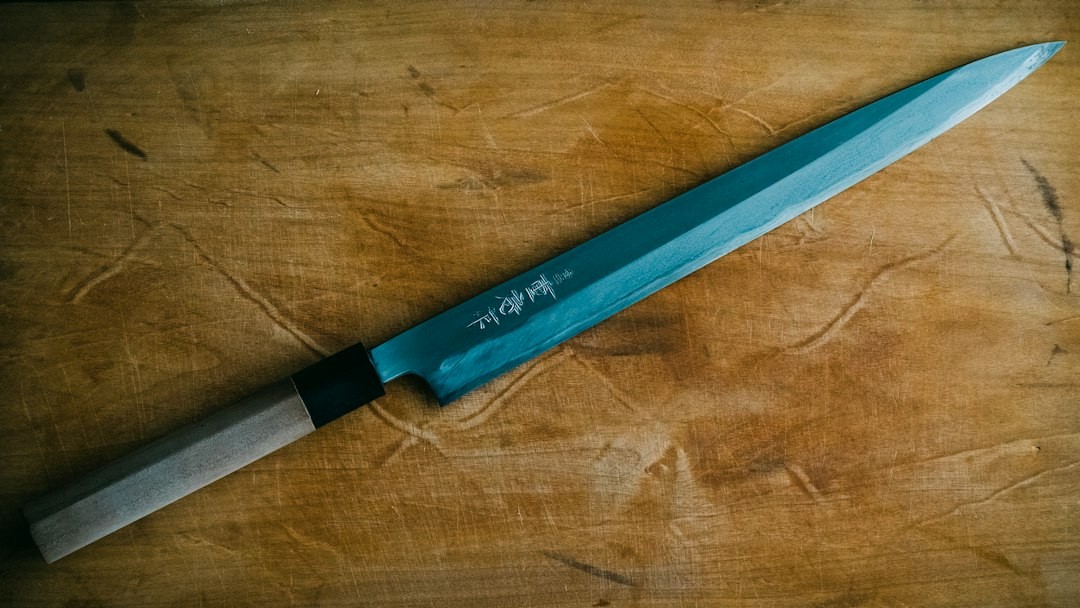
SKD11 is a high-carbon, high-chromium cold work tool steel defined by Japanese standard JIS G4404—the Japanese equivalent of D2 steel. Knife makers adopted it because few steels in its price range resist abrasive wear as well.
| Property | SKD11 |
|---|---|
| Standard | JIS G4404 (Japan) |
| Closest Equivalent | AISI D2 / DIN 1.2379 |
| Common Brand Names | Daido DC11, Hitachi SLD, Böhler K110, ASSAB XW-42 |
| Density | ~7.7 g/cm³ |
| Working Hardness (knives) | 60-62 HRC common; premium heat treats reach 63-64 |
| Edge Retention | 8/10 |
| Toughness | 5/10 |
| Corrosion Resistance | 4/10 (semi-stainless) |
| Wear Resistance | 9/10 |
| Ease of Sharpening | 4/10 |
| Price Tier | Mid-range: above 8Cr13MoV, below VG-10 |
| Best For | Cleavers, workhorse kitchen knives, outdoor utility blades |
Everything after this table explains why the numbers look this way—and where they can mislead you.
The composition of SKD11
- Carbon: 1.40-1.60%
- Chromium: 11.00-13.00%
- Molybdenum: 0.80-1.20%
- Vanadium: 0.20-0.50%
- Manganese: 0.60% max / Silicon: 0.40% max
These ranges come from the JIS G4404 specification. Two numbers drive almost every property in the table:
Carbon ~1.5% + chromium ~12% form a dense field of large chromium carbides. Those carbides deliver the wear resistance and edge retention—and cap the toughness.
The chromium number is a marketing trap. Stainless steel legally starts at 10.5% chromium, and knife-industry practice looks for roughly 13% free chromium. SKD11’s 11-13% total chromium sounds close, but much of it is locked inside carbides. Knife Steel Nerds measured only about 9.3% free chromium in D2, SKD11’s American twin. That is why this family is semi-stainless, whatever the product page says.
How It Performs in Knives
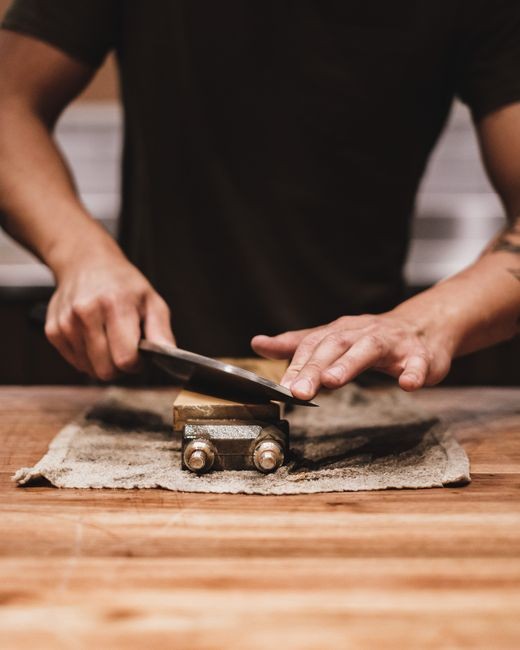
The strengths are real. At 60-62 HRC (Japanese workshops like Yoshikane push some lines to 63-64), SKD11 holds a working edge through cardboard, fibrous vegetables, and rope long after 8Cr13MoV rolls or dulls, and matches or slightly beats VG-10 in abrasive cutting. For end users who sharpen infrequently, that is a marketable benefit, not a spec-sheet detail.
The limits are equally real. The same carbides that resist wear give cracks a path. Thin edges can micro-chip on bones, frozen food, or twisting cuts—SKD11 is not the steel for abuse-heavy outdoor blades. And with free chromium under 10%, a blade left wet or in contact with acidic food will stain. Kitchen lines need care instructions in the box, or the returns will follow.
Sharpening is the hidden cost. Chromium carbides resist standard abrasives, so sharpening sessions run longer than with 440C or 8Cr13MoV. Quality whetstones handle it; diamond plates speed it up. Either way, your customers spend more time at the stone—set that expectation before they buy. Our guide on how to sharpen a Japanese knife covers technique.
One manufacturing trait deserves attention. SKD11 air-hardens with minimal distortion, so blades come out of heat treatment dimensionally stable. For a buyer, that means consistent geometry across a batch and fewer grinding rejects—an advantage that never appears on a consumer product page but shows up in your defect rate.
Launch Your Custom Knife Line Faster with LeeKnives
Complete OEM/ODM support—from design to final shipment—so you can focus on growth.
Backed by warehouses in the U.S. for fast, reliable delivery.
SKD11 vs D2: the Difference Is Vanadium
Functionally, they are the same steel:
zKnives lists SKD11 as the JIS equivalent of AISI D2, and you will meet the alloy under brand names: Daido DC11 and Hitachi SLD are JIS SKD11 grades (confirmed in Daido Steel’s product list); Böhler K110 and ASSAB XW-42 are the European versions (we review K110 steel separately).
| SKD11 (JIS G4404) | D2 (AISI / ASTM A681) | |
|---|---|---|
| Carbon | 1.40-1.60% | 1.40-1.60% |
| Chromium | 11.00-13.00% | 11.00-13.50% |
| Vanadium | 0.20-0.50% | up to 1.10% |
| Knife hardness | 60-62 HRC | 59-62 HRC |
| In practice | Marginally easier to grind and sharpen | Marginally better wear resistance |
Higher vanadium gives some D2 melts slightly better wear resistance; SKD11’s lower vanadium makes it marginally easier to process. In a finished knife, the difference is smaller than the difference between two suppliers’ heat treatments. Treat them as interchangeable in specs—but always name the standard you are buying against.
The 8Cr13MoV vs D2 comparison shows where this family sits against budget steels.
SKD11 vs VG-10: Edge Life or Low Maintenance?
VG-10 is the comparison your customers will actually ask about, because both steels anchor mid-to-premium Japanese-style kitchen lines. They are built for different priorities:
| SKD11 | VG-10 | |
|---|---|---|
| Stainless? | No — semi-stainless (~9% free chromium) | Yes — ~15% chromium plus cobalt |
| Typical knife hardness | 60-62 HRC (up to 63-64) | 59-61 HRC |
| Edge Retention | 8/10 | 7/10 |
| Toughness | 5/10 | 6/10 |
| Corrosion Resistance | 4/10 | 9/10 |
| Ease of Sharpening | 4/10 | 6/10 |
| Price tier | Mid-range | Upper-mid to premium |
The pattern is simple. SKD11 wins on wear resistance and abrasive edge retention at a lower material cost. VG-10 wins on everything that makes ownership easier: stain resistance, toughness, and time at the stone.
For humid markets, coastal regions, or customers who will not dry a blade, VG-10 is the safer line. For workhorse cleavers and utility knives sold on edge life, SKD11 delivers more performance per dollar.
Our best steel for kitchen knives guide maps the full stainless field.
Imported SKD11 vs Cr12MoV: Where Buyers Lose Money
This is the section most steel reviews skip, and the one that matters most if you source from China.
When a supplier quotes “SKD11,” they may mean genuine Japanese mill steel (Daido DC11, Hitachi SLD)—or a domestic Chinese grade. The GB standard has two candidates, and they are not equal:
| Japanese SKD11 | Chinese Cr12Mo1V1 | Chinese Cr12MoV | |
|---|---|---|---|
| Standard | JIS G4404 | GB (true D2 equivalent) | GB (lower-alloy cousin) |
| Molybdenum | 0.80-1.20% | ~0.70-1.20% | 0.40-0.60% |
| Vanadium | 0.20-0.50% | ~0.50-1.10% | 0.15-0.30% |
| Carbide refinement | Fine, clean (ESR options) | Good | Coarser, more inclusions |
| Typical knife hardness | 60-62 HRC | 59-61 HRC | 58-60 HRC |
| Material cost | Highest | Mid | Lowest |
Chemistry is only half the story. In a finished knife, the three grades separate like this:
| Japanese SKD11 | Cr12Mo1V1 | Cr12MoV | |
|---|---|---|---|
| Edge life between sharpenings | Longest | Long | Noticeably shorter |
| Wear resistance | Benchmark (9/10) | Close (≈8/10) | A step down (≈7/10) |
| Consistency batch to batch | High | High with certified mills | Varies by mill |
| Best use | Premium mid-tier lines | Value mid-tier lines | Entry-level budget lines |
As Aobo Steel’s D2 vs Cr12MoV analysis confirms, Cr12Mo1V1 is the true Chinese equivalent; Cr12MoV carries meaningfully less molybdenum and vanadium—so less wear resistance and weaker response to hardening.
None of these grades is a scam. Cr12Mo1V1 with a certified mill and proper heat treatment is an honest way to hit a sharper price point, and Cr12MoV has decades of legitimate use in budget knives. The problem is only the label: paying SKD11 prices for Cr12MoV material.
The check takes one document. Ask for the mill test certificate (MTC). If it shows molybdenum below 0.70% and vanadium below 0.50%, you are looking at Cr12MoV—regardless of what the quote says. A supplier who quotes all three grades openly, with certificates for each, is one you can build a line around.
How to Spec SKD11 Correctly
The grade name on a quote guarantees nothing. Four checks turn “SKD11” into a spec:
- MTC chemistry — Mo and V within JIS ranges, per the table above.
- Target hardness in writing — 60-62 HRC for kitchen and utility blades; 58-60 is acceptable for heavy cleavers that need the extra toughness.
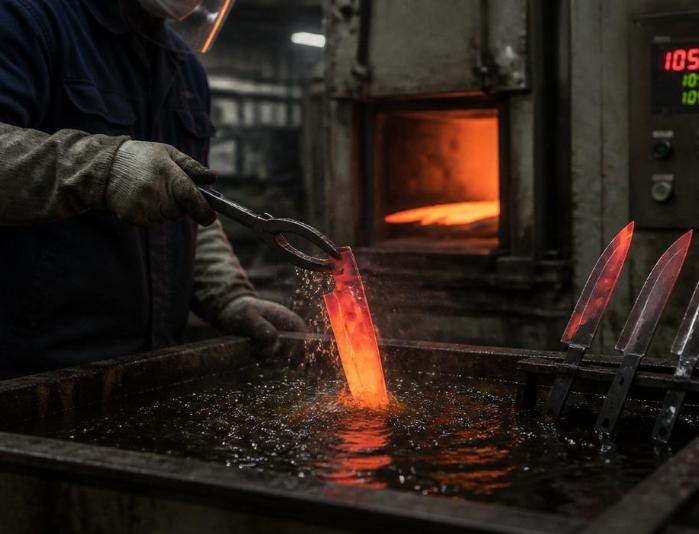
- Heat treatment method — vacuum hardening with double tempering. SKD11’s ceiling is only reachable with proper heat treatment, so supplier capability matters more than the grade name.
- A sample before the batch — one knife, tested for hardness and edge behavior, tells you more than any certificate.
And know when not to spec it. If your market needs a tougher blade at similar hardness, quote DC53—Daido’s 8Cr-2Mo evolution of SKD11, with roughly twice the toughness—as the upgrade path. If customers demand fully stainless, VG-10 is the safer answer, at a higher price.
Where SKD11 Fits in a Knife Line
SKD11 sits in a clean price tier: a meaningful step up from 8Cr13MoV, noticeably cheaper than VG-10 or any powder steel. That makes it a natural mid-range anchor:
- Cleavers and workhorse kitchen knives — edge life matters more than absolute stain resistance; Japanese makers like Yoshikane build mid-tier professional lines on it.
- Outdoor and utility fixed blades — strong for cardboard, rope, and wood; not for batoning or prying.
- Industrial cutters — slitting knives and shear blades are SKD11’s original home; if your customers buy both cutlery and industrial blades, one steel can serve both catalogs.
LeeKnives is a knife manufacturer based in Yangjiang City with over 30 years of blade-making experience. We supply genuine JIS-grade SKD11 and certified Cr12Mo1V1, both with mill test certificates and controlled heat treatment—so you can choose the tier that fits your margin, knowing the material matches the quote. Request a quote or explore our OEM service to spec SKD11 into your next line.
Launch Your Custom Knife Line Faster with LeeKnives
Complete OEM/ODM support—from design to final shipment—so you can focus on growth.
Backed by warehouses in the U.S. for fast, reliable delivery.
Frequently Asked Questions
Is SKD11 steel good for knives?
Yes, for the right knife. SKD11 combines strong edge retention and wear resistance at a mid-range price, suiting cleavers, workhorse kitchen knives, and utility blades. Its limits are moderate toughness and semi-stainless behavior—avoid it for thin slicers or abuse-heavy outdoor use.
What is the hardness of SKD11 knives?
Industrial dies run 58-60 HRC. Knife makers typically harden SKD11 to 60-62 HRC, and premium Japanese heat treatment reaches 63-64. Hitting that range consistently requires vacuum heat treatment—one more reason supplier capability matters more than the grade name.
What is the Chinese equivalent of SKD11?
Cr12Mo1V1 is the true GB equivalent of SKD11/D2. Cr12MoV is a lower-alloy cousin with less molybdenum and vanadium—cheaper, and a step below in performance. Check the mill test certificate to confirm which grade you are actually buying.
How much does SKD11 steel cost?
Material pricing moves with alloy markets and order volume, but the tier structure is stable: SKD11 sits above 8Cr13MoV-class budget steels and below VG-10, with genuine Japanese mill steel at the top of the band and certified Cr12Mo1V1 below it. For a current quote on knives or OEM production, contact our team.
Conclusion
SKD11 wins the two categories that sell workhorse knives: edge retention and wear resistance. It gives back ground on corrosion resistance, toughness, and sharpening effort. At 60-62 HRC and mid-range pricing, it is a proven, honest steel—provided you verify what you are buying.
Use it as your mid-tier anchor for cleavers, kitchen utility knives, and outdoor blades. Demand an MTC on every order, put the target hardness in writing, and treat “SKD11” without a certificate as a claim, not a spec.
Not sure whether SKD11, Cr12Mo1V1, or DC53 fits your market? Contact us for a quote—we will recommend the right material and heat treatment for your product line, wholesale, OEM, or ODM.




 EN
EN  JA
JA  DE
DE