
The butcher knife vs. chef knife question comes up whenever someone shops for a serious kitchen knife. Both are long, capable blades — but they are built for very different jobs.
A chef knife is the all-purpose workhorse, made for slicing, dicing, and chopping every ingredient on the board. A butcher knife is a specialist: longer, heavier, and designed to break down large cuts of meat.
In this guide, we compare their design, cutting action, steel, and best uses — and show which one your customers actually need. Read on to find out what this matchup means for your store.
What Is a Butcher Knife?
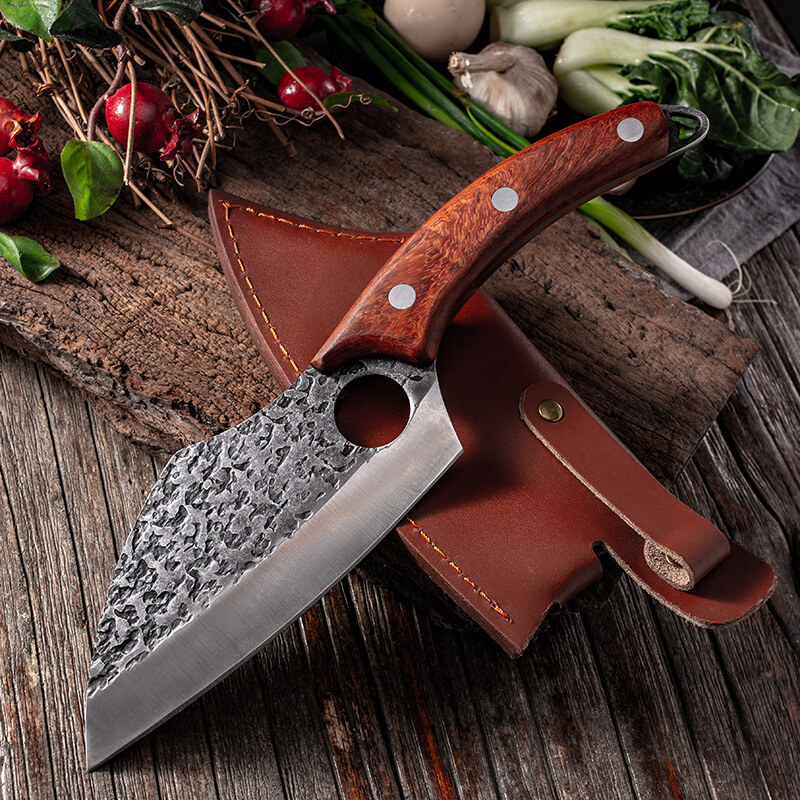
5Cr15 Wooden Handle Butcher Knife 146 mm Hammered Finish
A butcher knife is a long, heavy blade built for one job: breaking down large cuts of meat into portions — work that would exhaust a lighter blade.
The name actually covers a small family of tools: the breaking knife for splitting carcasses, the wider, longer cimeter (or scimitar) for portioning large muscles, and the compact boning knife for working around bones and joints.
Working butchers pair one of the long blades with a boning knife and a honing steel, switching between them through a shift.
Pros
- Power: Long, heavy blade powers through dense meat, fat, and connective tissue without flexing
- Reach: Deep curved belly spans large cuts in a single stroke
- Easy maintenance: Softer steel sharpens quickly on a honing steel — ideal for fast-paced commercial use
- Value: Lower price point makes it accessible for professional and enthusiast buyers
Cons
- Clumsy: Too heavy and unwieldy for fine board work like dicing vegetables or mincing herbs
- Limited precision: Rounded or blunt tip limits piercing and detail tasks
- Niche demand: Most home cooks will use it rarely, if at all
- Edge retention: Softer steel loses its edge faster than harder chef knife steels
What Is a Chef Knife?

Damascus Clad 10Cr15CoMoV G10 Handle Chef Knife 200 mm
The chef knife is the generalist of the kitchen, and the single best-selling knife type worldwide. Its curved blade is built around the rocking chop, letting it slice, dice, chop, and mince across meat, fish, and vegetables — and even handle light butchering in a pinch.
Japanese versions like the Gyuto follow the same philosophy with harder steel and a flatter profile, as covered in our Japanese vs. German knives guide.
Pros
- Versatility: Handles vegetables, fish, boneless meat, and herbs with equal ease — the single most adaptable blade in the kitchen
- Precision: Curved edge and pointed tip enable the rocking chop and fine detail work
- Comfort: Lighter weight reduces fatigue during long prep sessions
- Edge retention: Harder steel holds a sharp edge longer between sharpenings
- Volume play: Universal demand makes it the safest bet for any inventory
Cons
- Underpowered: Too thin and light for breaking down primals, trimming fat, or hacking through cartilage
- Fragility: Harder steel can chip if misused on bone or frozen meat
- Tip vulnerability: Pointed tip requires more care to avoid accidental damage
- Price creep: Premium models can price out budget-conscious buyers
Butcher Knife vs. Chef Knife: The Key Differences
The core difference comes down to scale and resistance. A butcher knife is built for large, dense, and tough material — whole primals, carcasses, thick fat, sinew, and joints. It also handles oversized hard produce like squash or melon when sheer weight and blade length matter more than finesse.
A chef knife handles meat too — boneless cuts, thin slices, diced portions — but its real strength is versatility across the board: vegetables, herbs, fish, and the fine, repetitive work where agility and edge geometry count. It is the knife you reach for when the task is varied, not when the material fights back.
That difference in purpose — brute-force breakdown versus all-purpose precision — shapes everything else about the two knives. The following four design differences decide how each knife actually behaves in the hand.
Blade Length and Shape
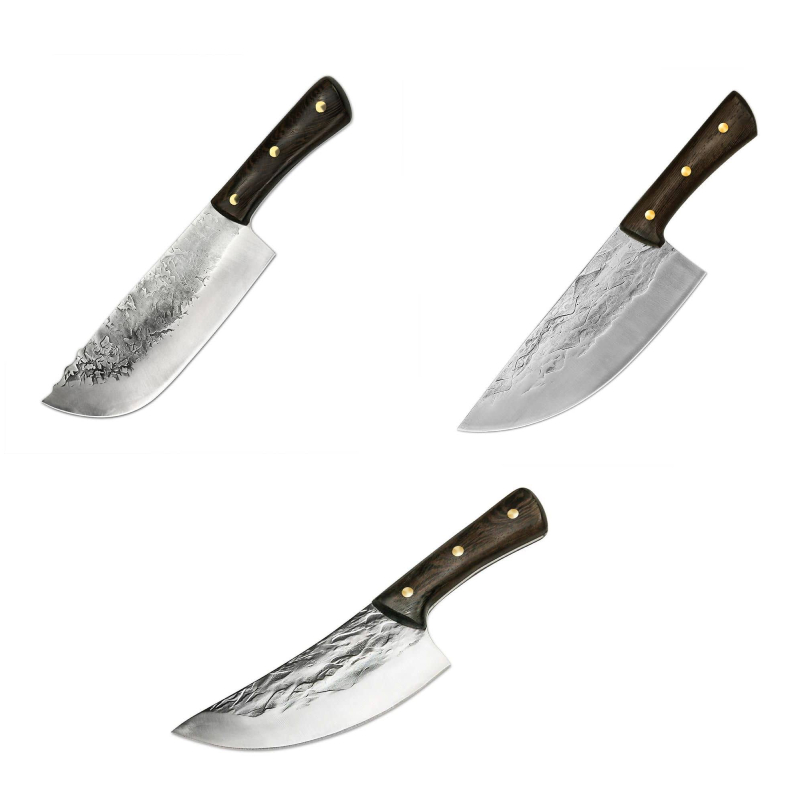
A butcher knife runs long — 8 to 10 inches is standard, and cimeter styles reach 14 inches. The length exists to span large cuts: a whole ribeye roll or a pork shoulder should be portioned in one smooth stroke, not sawed back and forth. The deep belly keeps the edge in contact with meat through the entire pull.
A chef knife tops out around 8 inches for most buyers, with a tighter curve built for board work. Its pointed tip pierces and detail-cuts, while the butcher knife’s tip is often rounded or blunt because piercing is rarely the job.
Blade Thickness and Weight
Put the two knives spine to spine and the butcher knife is visibly thicker — often close to twice the stock of a chef knife. That thickness adds the weight and rigidity needed to separate joints and push through dense, cold meat without flexing.
The trade-off is agility. A typical chef knife weighs 6 to 9 ounces and disappears into prep work; a 10-inch cimeter can top 14 ounces and feels clumsy on a cutting board. Forum users put it bluntly: a proper butchering knife “won’t do a lot of good in chopping on the board.”
Cutting Action
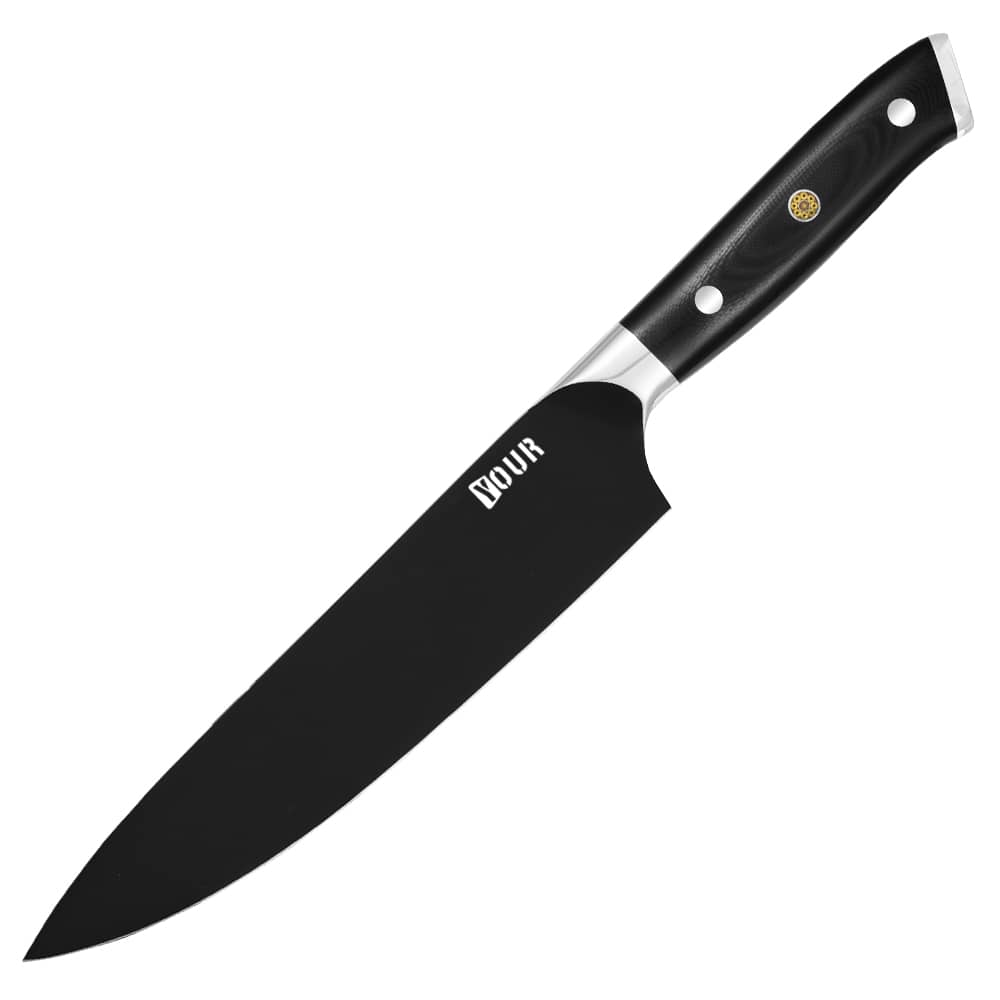
5Cr15MoV G10 Chef Knife 215 mm
The chef knife’s curved edge is made for the rocking chop and fine push cuts — fast, repetitive, precise board work. It rewards technique and keeps fatigue low over a full prep session.
The butcher knife is made for power moves: long pull slices through hanging or laid-out meat, sawing through connective tissue, and hacking through cartilage and small joints. Neither knife substitutes well for the other’s motion, which is why working kitchens own both.
Steel, Hardness, and Sharpening
Here is a difference most buyers never hear about. Commercial butcher knives deliberately use softer stainless steel, usually 55 to 58 on the Rockwell hardness scale. Butchers hone every 15 to 20 minutes on a steel, so easy edge realignment beats long edge retention.
Premium chef knives run 58 to 62+ HRc and hold an edge far longer but take real sharpening time.
Both types dull fast when abused, but the maintenance rhythm differs completely. If your customers ask about steel options, our guide to the best steel for kitchen knives covers the trade-offs in detail.
Launch Your Custom Knife Line Faster with LeeKnives
Complete OEM/ODM support—from design to final shipment—so you can focus on growth.
Backed by warehouses in the U.S. for fast, reliable delivery.
Which Tasks Belong to Which Knife?

1.4116 Pakkawood Chef Knife 198 mm
The fastest way to settle the butcher knife vs. chef knife question is task by task. Use this matrix when advising customers.
| Kitchen task | Better knife |
|---|---|
| Everyday slicing, dicing, and mincing | Chef knife |
| Rock chopping herbs and vegetables | Chef knife |
| Breaking down a whole chicken | Chef knife (a boning knife is even better) |
| Trimming brisket or pork butt | Butcher knife |
| Portioning primals into steaks | Butcher knife |
| Skinning and silver skin removal | Butcher knife |
| Cutting through bones | Neither — use a cleaver |
| Fine tip work and piercing | Chef knife |
One honest note from working butchers and BBQ competitors: about 95% of home meat trimming is handled by a chef knife plus a 6-inch boning knife. The 12-inch cimeter is the knife people buy for how it looks — and then rarely use.
For Your Customers: Which Knife to Recommend
If a customer can only buy one, the answer is always the chef knife. It does everything competently and most things well, and no other blade comes close to its daily utility.
The butcher knife becomes a smart second purchase when a customer passes a simple frequency test: do they break down large cuts, whole animals, or competition-style BBQ at least a couple of times a month?
If yes, the long curved blade will save them real time and cleaner portions. If no, it will gather dust.
Practical buying notes worth passing on at the counter:
- Grip beats steel in meat work. Wet, greasy hands make slippery handles dangerous; textured, non-slip handles matter more than premium steel.
- Stay modest on length. An 8 to 10 inch butcher knife covers nearly everything; 12-inch-plus cimeters need big boards and experienced hands.
- Skip expensive steel. A $30 – $60 butcher knife in honest 55 – 58 HRc stainless outperforms its price; this is a tool category, not a showpiece.
For Your Inventory: How to Stock Each Type
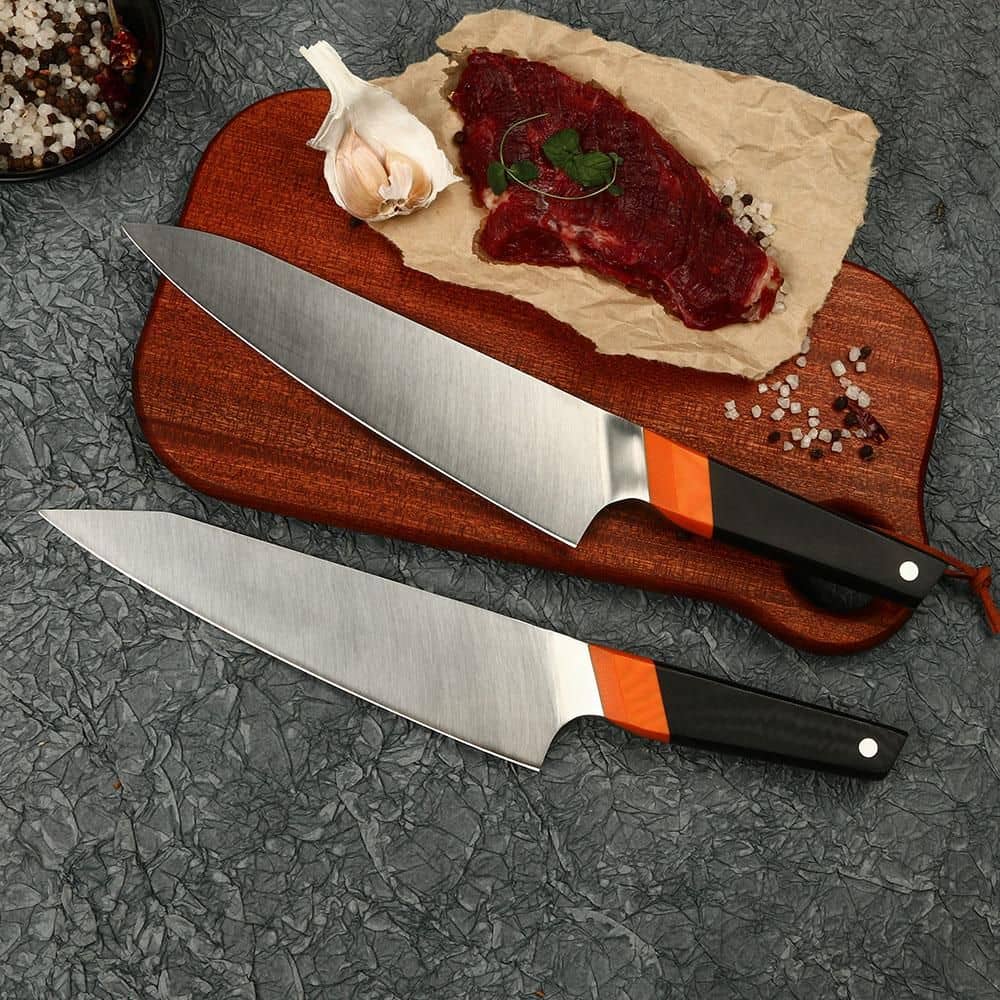
These two knives play very different roles in an inventory. The chef knife is your volume seller and gateway product — every kitchen needs one, it anchors starter sets, and it drives repeat traffic across every price tier from VG-10 mid-rangers to premium Damascus.
The butcher knife is your niche-margin play with a concentrated buyer pool: butcher shops, meat processors, BBQ restaurants, hunting and outdoor customers, and serious home enthusiasts.
These buyers value grip texture, stamped-blade pricing, and easy resharpening over exotic steels — exactly the spec profile where factory-direct sourcing wins on margin. Stocking the family logically (breaking knife, cimeter, and boning knife in two lengths each) covers commercial accounts without burying capital in slow SKUs.
Quick inventory rule of thumb: A 3:1 chef-to-butcher ratio covers most retail demand. If you run a specialty hunting or BBQ store, flip that to 2:1 or even 1:1.
Butcher Knife vs. Chef Knife: A Retailer’s Quick Reference
Everything covered so far — from blade geometry to stocking ratios — condenses into one reference table. Use it to train floor staff and plan your shelf layout.
| Butcher Knife | Chef Knife | Retail Tip | |
|---|---|---|---|
| Primary role | Breaking down and portioning large cuts of meat | All-purpose prep: slicing, dicing, chopping, mincing | Position butcher knives near sharpening steels; chef knives near cutting boards |
| Blade length | 6 – 14 in (8 – 10 in most common) | 6 – 12 in (8 in most common) | Stock 8″ and 10″ as anchors; 12″+ cimeters move slower |
| Blade shape | Long with a pronounced curved belly; sharp or blunt tip | Curved edge with a distinct pointed tip | Display belly profile side-by-side so customers feel the difference |
| Blade thickness | Thicker, often nearly twice as thick | Thinner and more streamlined | Thickness = perceived durability; highlight this for meat-work buyers |
| Cutting action | Slicing, sawing, hacking, trimming | Rock chop, push cut, fine slicing | Demo butcher knives on foam or meat props; chef knives on vegetables |
| Weight | Heavier, typically 8 – 15 oz | Lighter, typically 6 – 9 oz | Weight is a selling point for butcher knives — emphasize power and control |
| Typical steel | Softer stainless, ~55 – 58 HRc, mostly stamped | 56 – 60+ HRc, forged or stamped | Softer steel = easier to resharpen; a strong upsell angle for commercial buyers |
| Price range | $20 – $140 (mostly stamped, budget-friendly) | $25 – $300+ (wider premium range) | Chef knife is your #1 volume SKU — stock across 3 price tiers |
| Best for | Butcher shops, meat processing, BBQ, hunters | Restaurants, home cooks, every kitchen | Butcher knife = niche-margin play; chef knife = gateway product |
Stock Both Knife Types with LeeKnives
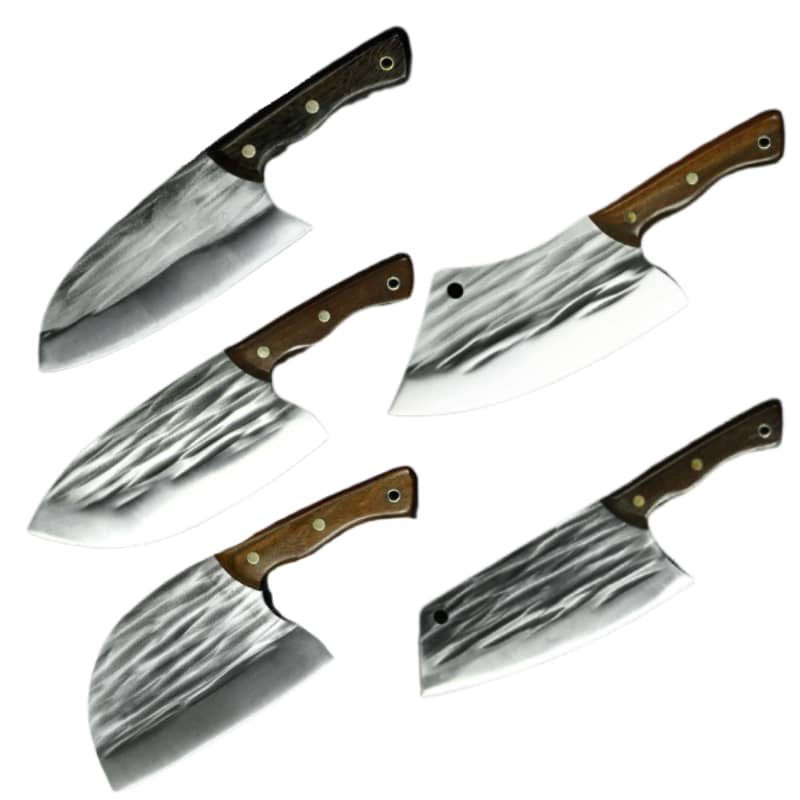
5Cr15MoV Rosewood Butcher Knife
The butcher knife vs. chef knife comparison has a clean bottom line: the chef knife is the universal volume seller, and the butcher knife is the high-intent specialist that commercial and enthusiast buyers actively seek out. Smart retailers stock both — and spec each for its real audience.
LeeKnives has spent over three decades manufacturing kitchen knives in Yangjiang City, supplying North American retailers, wholesalers, and restaurant suppliers.
Whether you need a dependable chef knife range, a commercial-grade butcher knife family with grippy handles and workhorse steels, or a matching collection under your own brand, our OEM and ODM services handle everything from blade geometry and steel selection to branded packaging.
Browse our handmade kitchen knife catalog for ready-to-stock designs, or build a private label line tailored to your market.
Ready to add butcher and chef knives to your catalog? Request a free quote from LeeKnives — send us your target specs and price points, and our sales team will come back with samples and a wholesale plan built for your business.
Launch Your Custom Knife Line Faster with LeeKnives
Complete OEM/ODM support—from design to final shipment—so you can focus on growth.
Backed by warehouses in the U.S. for fast, reliable delivery.
Frequently Asked Questions
Can I use a chef knife to cut meat?
Yes — slicing, dicing, and trimming boneless meat is well within a chef knife’s range, and it can even disjoint a whole chicken. The limits show up with large primals, thick fat caps, and anything involving bone: the blade is too short, too thin, and too light for that work. That is where a butcher knife takes over.
Why is it called a butcher knife?
The name comes straight from the trade it was built for: butchering. The long, curved blade was developed specifically for breaking down carcasses and portioning meat in butcher shops and packing plants.
Interestingly, the English word “butcher” itself traces back to the Old French bouchier, from bouc, meaning goat — originally, one who slaughtered goats.
What knife do most butchers use?
Most working butchers rely on a combination, not a single knife: a breaking knife or cimeter for portioning, a 6-inch boning knife for joints and bones, and a honing steel used constantly through the shift.
In North American meat processing plants, simple stamped knives with grippy, non-slip handles — Victorinox Fibrox being the industry standard, alongside Dexter-Russell, F. Dick, and Mundial — dominate because they are safe with wet hands, easy to resharpen, and cheap to replace.
What are the three knives that everyone should have?
The classic answer is a chef knife for general prep, a paring knife for detail work, and a serrated knife for bread. A butcher knife is the natural fourth knife — the first specialist — for anyone who regularly works with large cuts of meat. For retailers, this trio-plus-one structure is a proven way to build starter sets and upsell paths.
What is the best brand of butcher knives?
There is no single “#1 brand,” but the commercial consensus is clear: Victorinox, Dexter-Russell, F. Dick, and Mundial equip most professional butcher shops, typically at $25 – $65 per knife.
Premium forged options from brands like Wüsthof exist, but most butchers consider the extra cost unnecessary for a tool knife.
Spec matters more than logo — a grippy handle, a 55 – 58 HRc stainless blade, and NSF-grade hygiene are what to look for, which is also why many retailers succeed with well-specced store-brand lines.
Do I need a butcher knife if I already have a chef knife?
Probably not, unless you process large cuts regularly. A chef knife plus a 6-inch boning knife covers the vast majority of home meat work, including breaking down whole chickens.
Apply the frequency test: if you portion primals, trim competition briskets, or process game a couple of times a month or more, a butcher knife will pay for itself in time and cleaner cuts.
Can a butcher knife replace a cleaver?
Only partially. A butcher knife slices, trims, and hacks through cartilage and small joints, but its thin, hard edge is not meant for heavy bone.
A cleaver’s thick, weighted blade is the right tool for splitting ribs and chopping through bone. Many customers need guidance here — they are complements, not substitutes.
What margin should I expect on butcher knives vs. chef knives?
Chef knives typically run on thinner margins (15–25% at retail) because of intense competition and price transparency online. Butcher knives, especially commercial-grade stamped models, often yield healthier margins (25–40%) because buyers prioritize function over brand and are less likely to cross-shop.
Store-brand or private-label butcher knives can push margins even higher when sourced factory-direct.
Should I bundle butcher knives into sets or sell them individually?
Sell individually first. Butcher knife buyers usually know exactly what they need. Once you have individual sales data, create a “Butcher’s Starter Set” (breaking knife + boning knife + honing steel) for commercial accounts and a “BBQ Trimming Kit” (cimeter + boning knife + cutting board) for enthusiast buyers. Bundles work best as upsells, not entry points.





 EN
EN  JA
JA  DE
DE