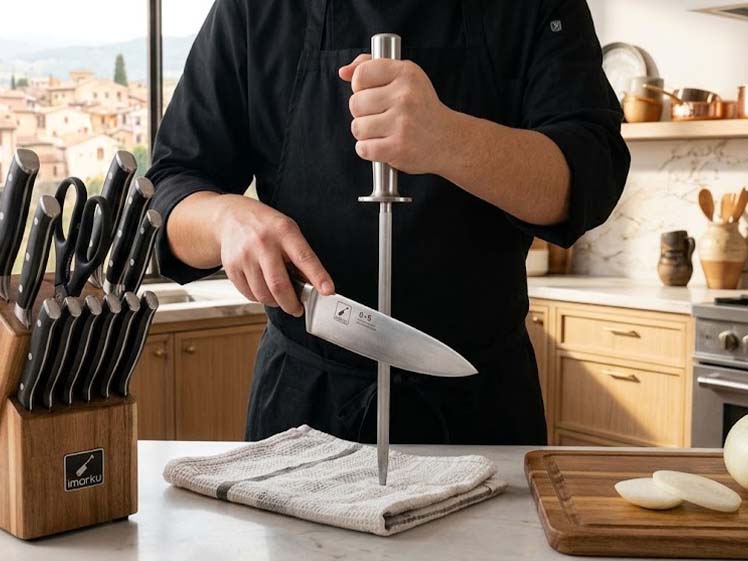
Buying a Japanese-style knife can leave you wondering what the label means. So, where are Imarku knives made?
Independent reviews point to China, though they don’t confirm the origin of every model. Meanwhile, Imarku says some production takes place in Japan and other Asian facilities. Check the exact knife’s country-of-origin label before buying.
This guide helps you sort through those claims, understand cutting-test findings, and compare models. If you sell knives, you’ll also learn how to assess suppliers, explain materials, and write clearer product descriptions for your customers.
Key Takeaways
- Origin: Reviewed models include knives made in China. Imarku also mentions Japanese production but does not identify each model’s factory.
- Japanese Connection: Blade shapes and steel descriptions do not prove where your finished knife was made.
- Cutting Results: One tested chef knife averaged 250 grams in initial sharpness testing, not an edge-retention test.
- Quality Checks: Reviewers found rough handle transitions on some samples. Check recent Imarku knife reviews for your exact model.
- Before Buying: Ask for an origin-label photo if the listing leaves you unsure.
- For Sellers: Explain design, steel, manufacturing origin, and shipping location separately so buyers can compare products clearly.
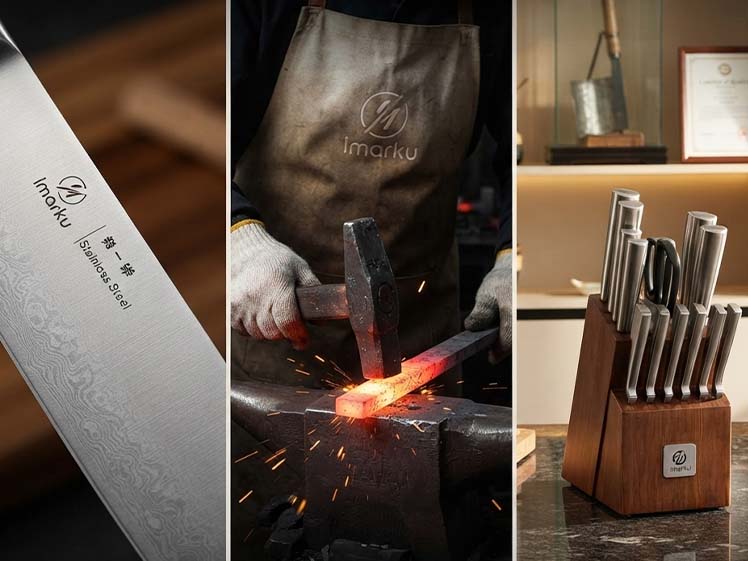
Where Are Imarku Knives Made?
China is the practical answer for many Imarku knives, with Japan and other Asian facilities included in Imarku’s account. The Rational Kitchen tested 5 knives and suspected most, if not all, were made in China. Learning the Kitchen also identifies China in its brand and knife-set coverage.
Imarku says part of production takes place in Japan, with additional facilities in Asia. It also lists warehouses in the US, Canada, UK, and Germany.
| Quick Facts | What Buyers Should Know |
| Brand Position | Affordable kitchen knives combining Japanese and German design influences. |
| Manufacturing | Reviews commonly point to China; Imarku also names Japan and elsewhere in Asia. |
| Japanese Connection | Gyuto, santoku, and deba designs, Japanese-style handles, and some Japanese steel descriptions. |
| Steel | Varies by model, including 7Cr17MoV, SUS440A, and 5Cr15MoV. |
| Warehouses | US, Canada, UK, and Germany, according to Imarku. |
| Practical Answer | Expect Chinese manufacturing for many models, and check each knife’s origin when it matters. |
This brand story differs from Shun’s, which ties its premium identity to production in Seki, Japan. Imarku is closer to online brands such as Seido and Matsato, where Japanese design and international manufacturing play different roles.
Build a Japanese-Style Knife Line With Clearer Specs
Vague origin and material claims can weaken customer trust, while fixed branded products limit your control. With LeeKnives OEM & ODM, define the design, materials, branding and packaging—and approve samples before bulk production.
Does Japanese Style or German Steel Tell You Where Imarku Knives Are Made?
When you shop for kitchen tools, online labels can confuse you. You might see a blade listed with “German steel” or “Japanese design.” But does that mean the knife was actually made in Germany or Japan? Usually, no.
Put plainly, a US warehouse or a German-steel description doesn’t prove US or German manufacture. To figure out where Imarku knives are made, you must separate the shape, the metal, the factory, and the storage facility.
Here is a quick comparison table to help you read product listings the right way.
| Claim Type | What It Actually Means | Imarku Example | Evidence You Need |
| Style & Design | The blade shape, handle type, and intended cutting use. | Gyuto, santoku, or deba shapes with oval handles. | Look at the physical shape to match your daily cutting tasks. |
| Material | The specific metal grade, hardness (HRC), and edge behavior. | 7Cr17MoV or 5Cr15MoV steel (often called “German” or “Japanese” Steel). | Read the exact steel grade on the spec sheet, not just the marketing name. |
| Manufacturing | Where the parts are actually forged, shaped, and assembled. | Many retail listings show China. Imarku also mentions Japan and Asia. | Check the “Country of Origin” field or physical box labels. |
| Warehousing | Where the finished stock sits right now before delivery. | Storage facilities in the US, UK, Canada, or Germany. | Use this to estimate shipping times, not to find the production factory. |
The official 8-inch Imarku chef knife lists 7Cr17MoV high-carbon steel and 56–58 HRC. Those details tell you more about sharpening and edge behavior than a broad “Japanese Steel” label, although the page does not name a production country.
Keep in mind that a Chinese factory label does not mean poor quality. China’s knife industry produces basic stamped blades and precision OEM knives with controlled heat treatment and careful finishing, as our guides to Chinese knife manufacturers and Yangjiang knife manufacturing explain.
Location only tells you the geography. Steel grade and factory quality control determine how well the knife cuts.
Build a Japanese-Style Knife Line With Clearer Specs
Vague origin and material claims can weaken customer trust, while fixed branded products limit your control. With LeeKnives OEM & ODM, define the design, materials, branding and packaging—and approve samples before bulk production.
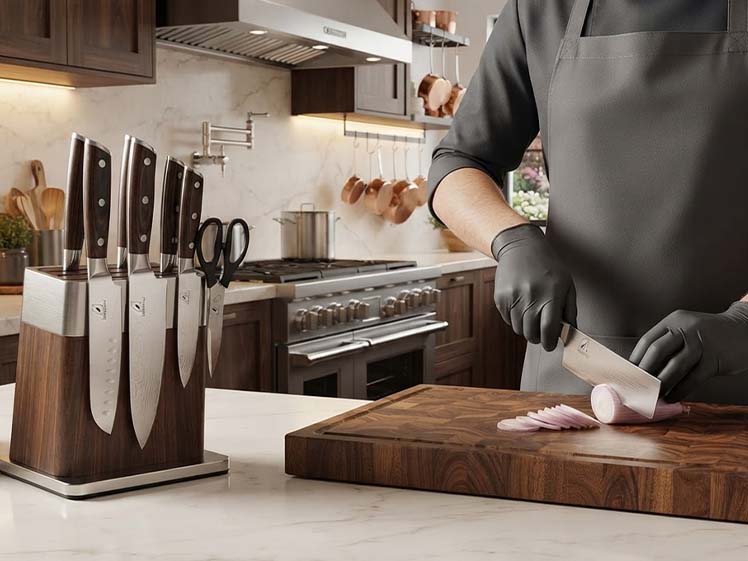
7 Steps to Verify Where Imarku Knives Are Made
Do not rely on a broad brand story. You need a clear process to check the facts. Whether you are picking a single blade for your kitchen or ordering a bulk batch to resell, follow these steps to confirm the true origin.
- Check the Exact SKU and Batch. Save the specific model name and the seller page. Different product lines often come from different factories.
- Request photos of the blade and box. Look for an origin stamp on the blade heel or on the packaging. If it is missing online, ask the seller for a picture of the actual item in stock.
- Get a dated manufacturer declaration. If you resell, ask your supplier for a formal document stating the production country for that specific date.
- Reconcile across sources. Compare retail website descriptions with the physical box label. If the online details conflict with the packaging, always trust the printed box.
- Confirm production-stage locations. Check if the raw steel is forged in one country but the handle is assembled in another.
- Ask for separate steel documentation. A certificate for imported metal proves the material’s source, but not the factory’s location.
- Recheck when things change. Always review the label again if you switch sellers, update the product version, or receive a new inventory shipment.
The metal source and the knife factory are separate details. Just as “ships from” does not mean “made in,” you must read the labels closely. For retailers, keeping these photos and documents on file helps keep your store listings accurate and safe.
Are Imarku Knives Good? What the Reviews Actually Show
Once you know where Imarku knives are made, you probably want to know how well they cut. Generally, these knives offer solid value for home cooks. Their strongest options sit right at the affordable end of the market. Out of the box, they usually deliver sharp edges and comfortable grips.
However, the finishing details and product specs can vary. Your choice of a specific model matters much more than the brand name printed on the packaging.
Let’s look at a quick comparison of what most users and reviewers find:
| Common Praises | Common Criticisms |
| Very sharp right out of the box | Rough metal spots near the handle or spine |
| Comfortable wooden (pakkawood) handles | Vague steel descriptions on some models |
| Helpful Japanese and German blade shapes | Extra weight or wide cutting angles |
| Great packaging and accessible pricing | Weaker value on their high-priced models |
Real-world testing backs up these points. For example, the Rational Kitchen’s 8-inch Gyuto scored a 250-gram BESS sharpness rating with a 56 to 58 HRC hardness. That means it holds a decent edge for daily vegetable prep. Their 7-inch Deba cut incredibly well at just 80 grams, but it proved to be a heavy, right-handed specialty tool.
Meanwhile, the pricier 8-inch Damascus model used harder powdered steel (61 to 63 HRC) and performed like a reliable kitchen workhorse. Still, reviewers noted that Imarku’s more expensive knives face tough competition for perfect fit and finish.
An older review of the 16-piece Imarku knife set is also available. Nothing But Knives liked the overall value but noted a few compromises, such as using basic 3Cr13MoV steel for the steak knives. Since that set is now discontinued, it’s a helpful reminder to check current specs rather than rely on past Imarku knives reviews.
For sellers and buyers alike, the lesson is clear. A sharp edge, a clean presentation box, and a comfortable handle create real value for everyday cooking. But as the price goes up, buyers expect clearer steel details and much smoother handle finishing.
Build a Japanese-Style Knife Line With Clearer Specs
Vague origin and material claims can weaken customer trust, while fixed branded products limit your control. With LeeKnives OEM & ODM, define the design, materials, branding and packaging—and approve samples before bulk production.
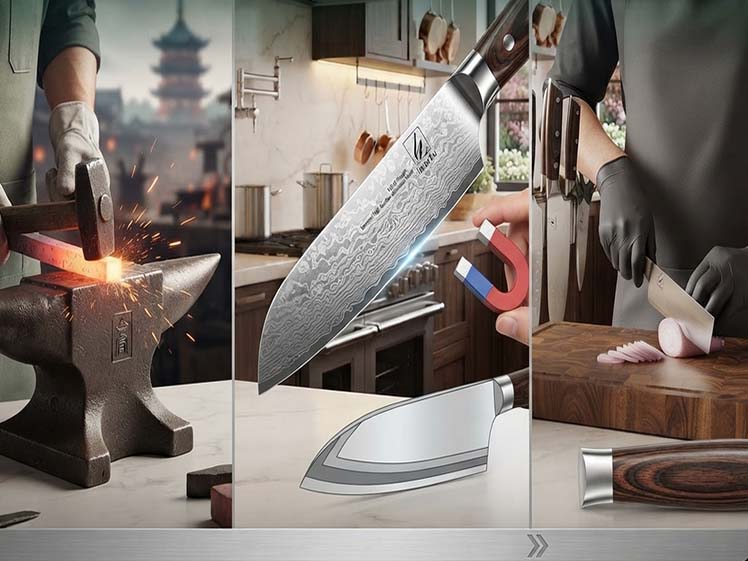
What Imarku’s Origin Story Means for Your Knife Brand
Imarku shows how Japanese design, international materials, and OEM production can work together.
Four lessons apply to your knife business:
- Use familiar design with a purpose. A santoku or gyuto gives customers an instant reference point. Adjust the geometry and handling for the cook you want to serve.
- Separate material sourcing from manufacturing. Your factory can work with Japanese, German, or Chinese steel to meet different performance and cost targets. Name the grade and heat-treat it correctly.
- Use OEM to focus on your market. A manufacturing partner handles production while you develop the product, brand, sales channels, and customer experience.
- Write copy customers can understand. “Japanese-style chef knife made in China with 7Cr17MoV steel” is clearer than vague craft language and sets the right expectations.
LeeKnives is a Yangjiang-based manufacturer with knife-making experience since 1993. Our OEM knife service supports custom designs, logos, and materials, with samples before bulk production and a typical MOQ of 200 pieces, varying by product.
When comparing private-label knife manufacturers, choose a partner that can clearly discuss steel, grinding, handles, packaging, and inspection. Global fulfillment and US warehouse support are also available.
Imarku Knives: Final Advice for Buyers and Sellers
Your next step depends on how you plan to use or sell the knife. Focus on the exact model, not just the brand name.
- If you are a home buyer, start with your daily cutting tasks. Reviewers found affordable Imarku models to cut well, but some samples had rough transitions on the handle. Check comments about grip comfort and cutting effort, not just sharpness scores.
- If you are a retailer listing Imarku products, always inspect the physical box label before entering a country of origin in your store listing. Keep your wording accurate by clearly separating the blade shape, steel type, factory location, and shipping warehouse.
- If you are building a private-label line, pick the design your target shoppers want first. Then partner with a factory that proves its quality control on every batch.
A factory location matters less than matching the right tool to the task. Read the labels closely, and you will always make an informed choice.
FAQs
Are Imarku knives made in China or Japan?
Most of Imarku knives come from China, according to retail listings and independent Imarku reviews. However, the brand states that some specialized production still happens in Japan and other Asian countries. To be sure, always check the physical label on your knife or ask the seller directly.
Which Imarku knives are made in Japan?
The brand doesn’t publish a clear, model-by-model list of its Japanese-made products. While their official manufacturing page mentions Japanese production, it doesn’t list specific models. Because of this, ask the seller for proof before describing a specific blade as made in Japan. Never guess based on the overall brand story alone.
Does “Imarku Japanese chef knife” mean made in Japan?
No, it usually does not. A label like “Japanese chef knife” merely describes the blade shape, cutting style, or handle design. The actual factory location is a different detail. To find out where Imarku knives are made, read the origin stamp on the box or check the specific seller’s stock.
Does Japanese or German steel prove where an Imarku knife was made?
No, it certainly does not. A factory can easily buy raw steel from one nation and forge it into a finished kitchen tool in another. Treat the metal grade and the manufacturing factory as two separate facts. A premium Japanese steel core never automatically proves where Imarku knives are made.
How can I check where my Imarku knife or knife set was made?
Look for a printed country-of-origin mark on the metal blade, the outer box, or the paper insert. If you shop online and the photos look blurry, message the seller for a clear picture of their current stock. Always check these labels again if you switch suppliers or order a brand new product batch.
Is Imarku a good brand?
The Imarku brand offers solid value, especially if you want affordable cooking tools. Independent Imarku knife set reviews highlight their sharp factory edges and comfortable grips. However, testers occasionally notice inconsistent handle finishing and confusing product descriptions on premium models. Always compare models and read recent hands-on tests before adding one to your cart.
Why do Imarku country-of-origin labels conflict?
Different product lines, updated production runs, and messy seller entries cause conflicting answers. Outdated website pages also add to the confusion. Always start by checking the label on the physical box. If the retail website says something different, ask the store to explain the mismatch. Never assume one knife’s origin applies to their entire catalog.
Build Your Knife Brand with a Direct Factory Partner
After learning how big names manage production, you might want to create your own kitchen tools. Partnering directly with a factory removes the guesswork from sourcing.
At LeeKnives, we help you sketch your blade design, choose the exact steel grade, and test physical samples before the factory lines start running. Once your knives are forged and boxed, you can even use our connected US warehouses for fast, simple shipping to your buyers.
To see the math for your project, share your preferred metal, batch size, and timeline. Gather your details and request a free quote to start building.




 EN
 JA
 DE