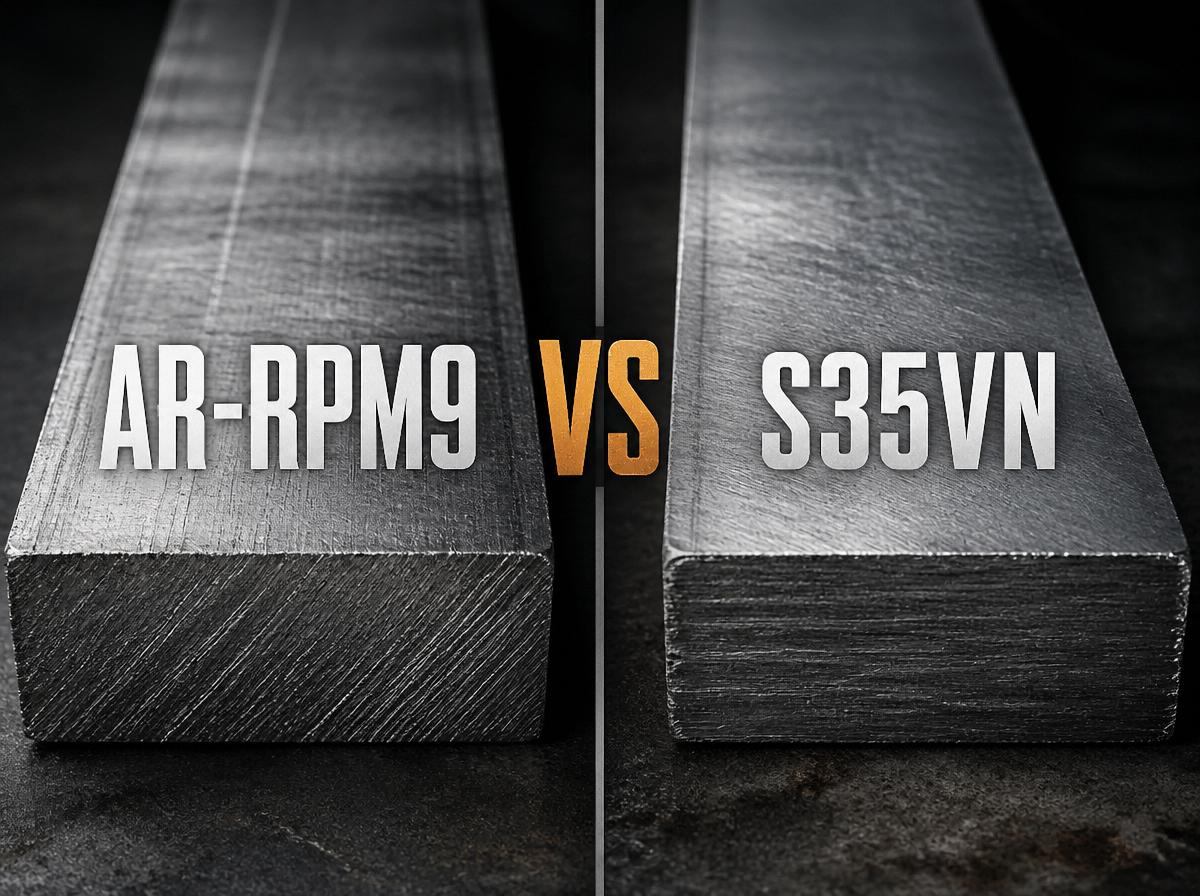
AR-RPM9 and S35VN represent two very different tiers in the knife steel market. While AR-RPM9 has gained traction as an affordable spray-form stainless steel for budget EDC knives, S35VN remains the gold standard for premium blades demanding top performance.
Choosing between them isn’t just about raw specs—it’s about matching the right product to your customer base and margin goals. Whether you serve price-conscious casual users or hardcore knife enthusiasts, understanding these steels helps you stock inventory that moves.
In this guide, we’ll break down the key differences to help you decide which steel drives sales and keeps your buyers coming back.
AR-RPM9 vs S35VN at a glance
If you are short on time, here is the bottom line for your inventory decisions.
- Manufacturing Tier: AR-RPM9 is a budget-friendly spray-form steel; S35VN is a premium CPM powder metallurgy steel.
- Edge Retention: S35VN wins. Its high vanadium content ensures a sharp edge lasts significantly longer under heavy use.
- Corrosion Resistance: AR-RPM9 wins. With 18% chromium, it offers superior rust protection, making it nearly maintenance-free.
- Ease of Sharpening: AR-RPM9 is easier. Casual users can restore the edge quickly with basic tools; S35VN requires more skill and diamond abrasives.
- Retail Pricing: AR-RPM9 targets the $30–$60 “sweet spot”; S35VN commands the $100–$250+ premium segment.
- Business Role: AR-RPM9 drives sales volume and foot traffic; S35VN builds profit margins and brand authority.
The Verdict: Stock AR-RPM9 for the mass market and S35VN for serious enthusiasts to capture both ends of the profit spectrum.
What is AR-RPM9 steel?
AR-RPM9 is a proprietary stainless steel developed by Artisan Cutlery, introduced around 2020 for their budget CJRB lineup.
Originally marketed as powder metallurgy (PM) steel, independent metallurgical analysis confirmed it is produced using spray-form technology. This places its microstructure between conventional casting and true powder metallurgy.
Chemically, AR-RPM9 closely resembles 9Cr18MoV (Chinese equivalent to 440C). The spray-form process refines the grain structure, improving toughness over conventional 9Cr18MoV without reaching the uniformity of CPM steels.
Key characteristics:
- Hardness: 59–61 HRc
- Corrosion resistance: Excellent (18% chromium)
- Edge retention: Moderate
- Toughness: Good for the price tier
- Sharpening ease: Very easy
The high chromium content makes AR-RPM9 a true stainless steel with excellent corrosion resistance. However, the low vanadium content limits its wear resistance and edge retention compared to premium grades.
What is S35VN steel?
CPM S35VN is a powder metallurgy stainless steel developed by Crucible Industries as an evolution of their popular S30V formula. The addition of niobium refined the carbide structure, improving toughness while maintaining excellent wear resistance.
S35VN is widely regarded as one of the most balanced premium knife steels available. It appears in high-end production knives from brands like Benchmade, Spyderco, and Chris Reeve Knives.
Key characteristics:
- Hardness: 58–61 HRc
- Corrosion resistance: Very good (14% chromium)
- Edge retention: Strong
- Toughness: Approximately 15–20% better than S30V
- Sharpening ease: User-friendly for a premium steel
The 3% vanadium and niobium combination creates hard, wear-resistant carbides that significantly boost edge retention. At 14% chromium, it is stainless enough for daily carry, though slightly below AR-RPM9 in pure corrosion resistance.
Steel composition comparison
The table below breaks down the key alloying elements that determine how each steel performs.
| Element | AR-RPM9 | S35VN | Winner |
| Carbon (C) | 0.90% | 1.34% | S35VN (better hardness) |
| Chromium (Cr) | 18.00% | 14.00% | AR-RPM9 (better corrosion resistance) |
| Vanadium (V) | 0.10% | 3.00% | S35VN (better wear resistance) |
| Molybdenum (Mo) | 1.00% | 2.00% | S35VN (better toughness & corrosion resistance) |
| Niobium (Nb) | — | 0.50% | S35VN (grain refinement) |
| Manganese (Mn) | 0.45% | 0.50% | Similar (S35VN slightly higher) |
| Silicon (Si) | 0.20%–0.80% | 0.50% | Similar (overlapping range) |
| Nickel (Ni) | <0.40% | — | AR-RPM9 (improved toughness) |
| Cobalt (Co) | 0.30% | — | AR-RPM9 (improved hot hardness) |
| Phosphorus | — | 0.014% | Both minimal (impurity, lower is better) |
| Sulphur | — | 0.016% | Both minimal (impurity, lower is better) |
Sources: Knife Steel Nerds — AR-RPM9; New Jersey Steel Baron — CPM S35VN
What this means in plain terms: S35VN’s higher carbon and vanadium create harder carbides for better edge retention. AR-RPM9’s 18% chromium gives it a corrosion resistance edge. The niobium in S35VN refines grain structure, improving toughness over older premium formulas.
Quick comparison table: AR-RPM9 vs S35VN
| AR-RPM9 | S35VN | |
|---|---|---|
| Manufacturing | Spray-form | Powder metallurgy (CPM) |
| Hardness | 59–61 HRc | 58–61 HRc |
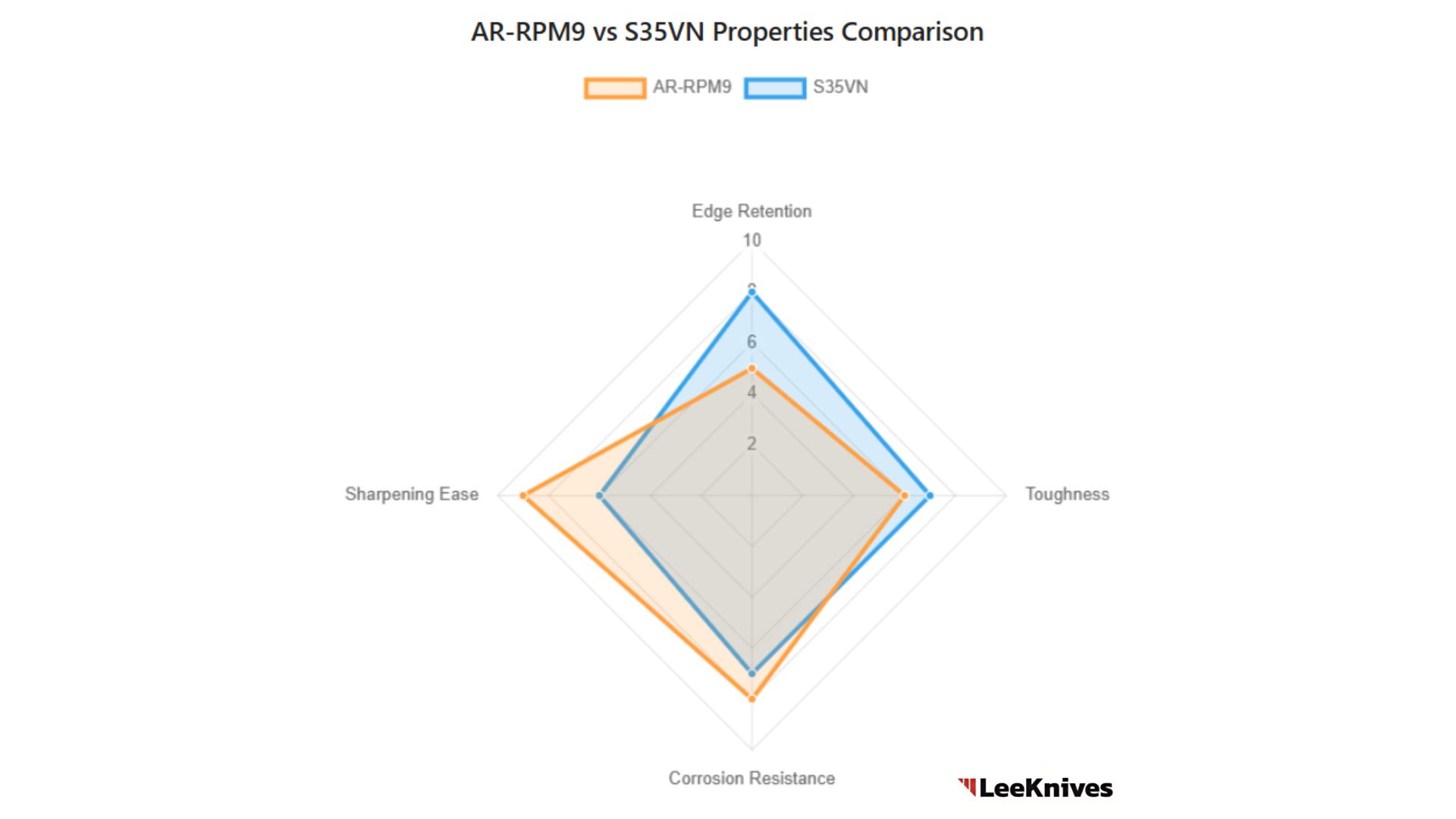
| Edge Retention | 5/10 | 8/10 |
| Toughness | 6/10 | 7/10 |
| Corrosion Resistance | 8/10 | 7/10 |
| Sharpening Ease | 9/10 | 6/10 |
| Typical Knife Price | $30–$60 | $100–$250+ |
| Target Customer | Casual users, budget EDC | Enthusiasts, premium buyers |
AR-RPM9 vs S35VN: Key differences for knife sellers
Edge retention and wear resistance
S35VN is the clear winner for customers who prioritize long-lasting sharpness. The high vanadium content creates hard carbides that resist abrasive wear. AR-RPM9 performs adequately for light daily tasks but requires more frequent touch-ups under heavy use.
For your store, this means S35VN knives appeal to power users and collectors willing to pay premium prices. AR-RPM9 knives satisfy the much larger market of casual users who want decent performance without maintenance headaches.
Corrosion resistance
AR-RPM9 holds a slight advantage with 18% chromium versus S35VN’s 14%. In coastal or kitchen environments where blades face constant moisture, AR-RPM9 demands less care. However, both steels are sufficiently stainless for typical EDC scenarios.
If your customer base includes fishermen, kitchen staff, or outdoor workers in humid climates, highlight AR-RPM9’s maintenance-free nature. For general pocket carry, S35VN’s corrosion resistance is more than adequate.
Toughness and durability
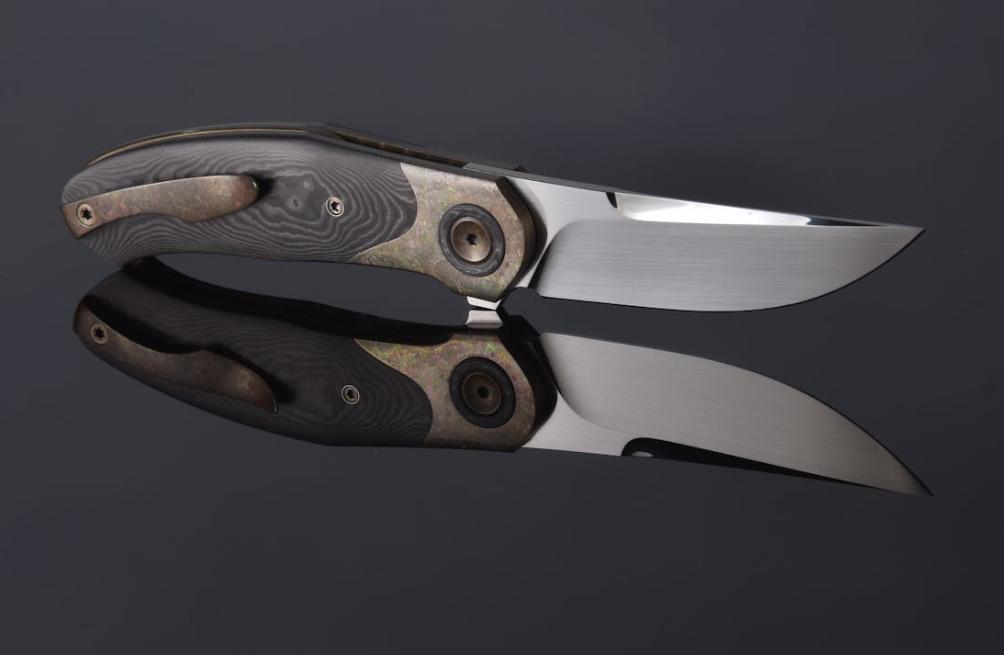
Both steels offer good real-world toughness. S35VN’s niobium-refined microstructure gives it a slight edge in resisting impact damage. AR-RPM9 benefits from spray-form refinement over conventional budget steels.
Either steel handles normal EDC tasks without issue. Neither is designed for prying or batoning, so educate your customers on proper use regardless of their choice.
Ease of sharpening
AR-RPM9 is significantly easier to sharpen. Users can restore a keen edge quickly with basic tools. This is a major selling point for beginners and casual owners who do not own elaborate sharpening systems.
S35VN requires more effort but rewards the user with extended edge life. Position S35VN as a “set it and forget it” option for customers who sharpen proactively rather than reactively.
Pricing, margins & inventory strategy
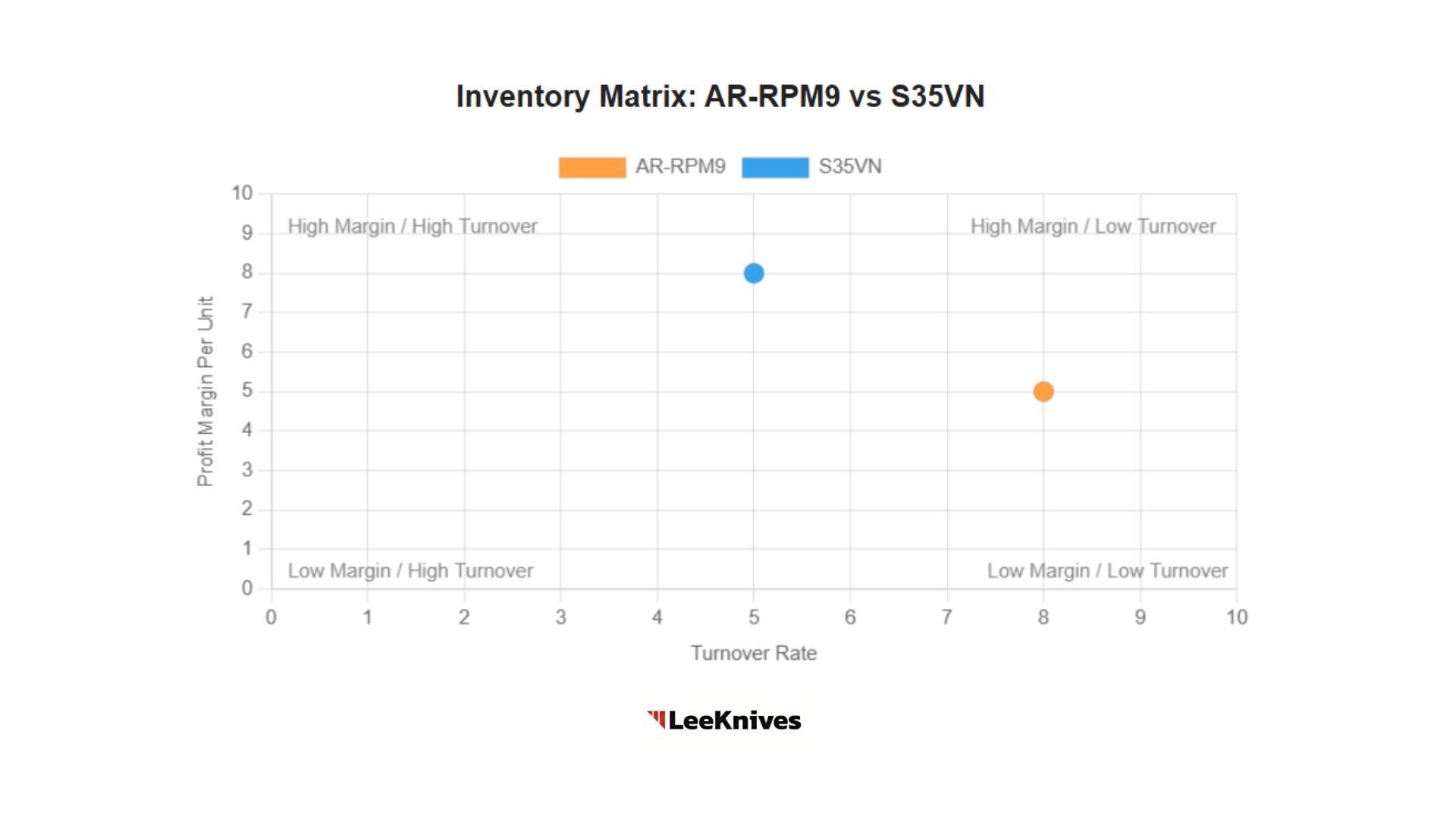
Understanding the price gap between AR-RPM9 and S35VN is key to building an inventory that performs across customer segments.
Retail price ranges
| AR-RPM9 | S35VN | |
|---|---|---|
| Typical Retail | $30–$60 | $100–$250+ |
| Entry Point | ~$30 | ~$100 |
| Premium Examples | CJRB Feldspar ($40) | Benchmade Bugout ($180), CRK Sebenza ($500+) |
Wholesale margins
Budget knives in the AR-RPM9 tier typically carry 40–50% wholesale margins at volume. Premium S35VN knives can reach 50–60% margins on a per-unit basis, but turn over more slowly.
A realistic breakdown:
- AR-RPM9 knife wholesale at ~$15–$25, retail at $40–$60 → ~$20–$35 gross profit per unit
- S35VN knife wholesale at ~$50–$80, retail at $150–$200 → ~$70–$120 gross profit per unit
Inventory strategy
Neither steel alone maximizes revenue. The strongest knife retail businesses typically follow an 80/20 inventory split:
- 80% volume tier (AR-RPM9 and similar budget steels) — drives foot traffic, repeat purchases, and new customer acquisition
- 20% premium tier (S35VN and above) — drives margin, brand credibility, and enthusiast loyalty
The knife market has shown consistent growth, with the global EDC knife segment projected to grow at 4.8% CAGR through 2030. Budget EDC knives lead in unit volume, while premium steels capture disproportionate revenue share among collectors and professionals.
The bottom line: AR-RPM9 fills your register consistently. S35VN builds your reputation and per-unit profitability. Stocking both isn’t just smart—it’s how serious knife retailers scale.
Which steel should your store stock?
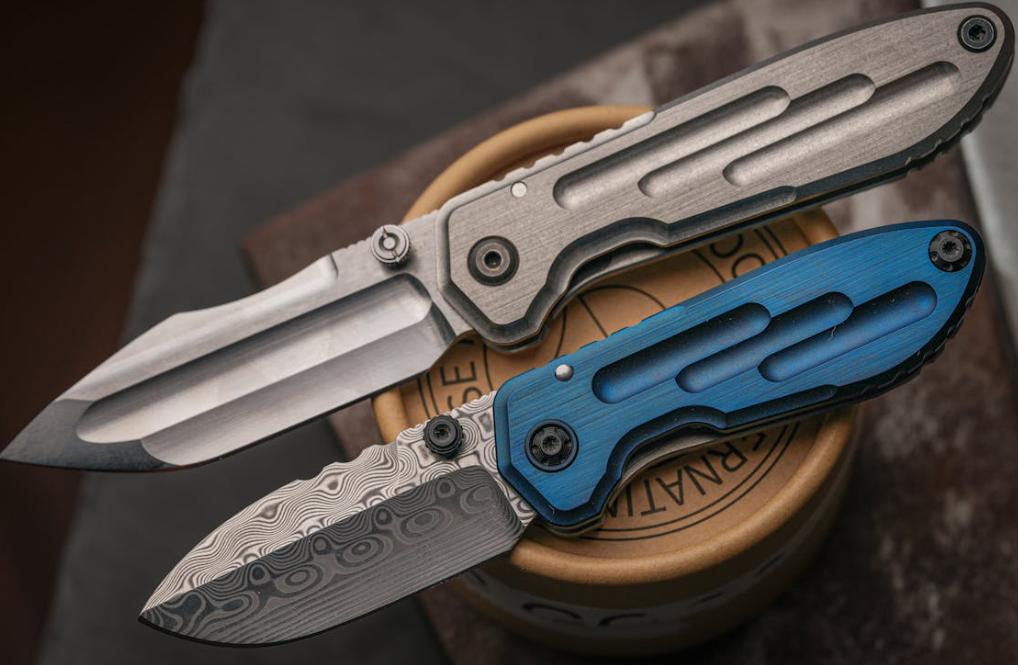
Choose AR-RPM9 if your customers are:
- Price-sensitive buyers seeking their first quality knife
- Users who value low maintenance and easy sharpening
- Retailers targeting the $30–$60 EDC sweet spot
- Businesses needing reliable, corrosion-resistant work knives
Choose S35VN if your customers are:
- Experienced knife enthusiasts who demand top-tier performance
- Buyers willing to invest $100+ for premium edge retention
- Collectors and outdoor professionals using knives intensively
- Stores building a reputation for high-end inventory
Conclusion: Maximizing your knife business
The edge retention and wear resistance of S35VN make it objectively superior steel on paper. However, for many users, these advantages are overkill for opening packages and cutting rope on weekends.
AR-RPM9 delivers genuinely good performance at a fraction of the cost. Its ease of sharpening and excellent corrosion resistance solve real problems for everyday owners. The vast majority of knife buyers will be perfectly happy with AR-RPM9.
That said, every store needs premium options to capture high-margin sales. S35VN attracts the discerning 20% of customers who drive 50% of enthusiast market revenue. Stocking both lets you serve the full spectrum.
LeeKnives: Stock the right steel for every customer
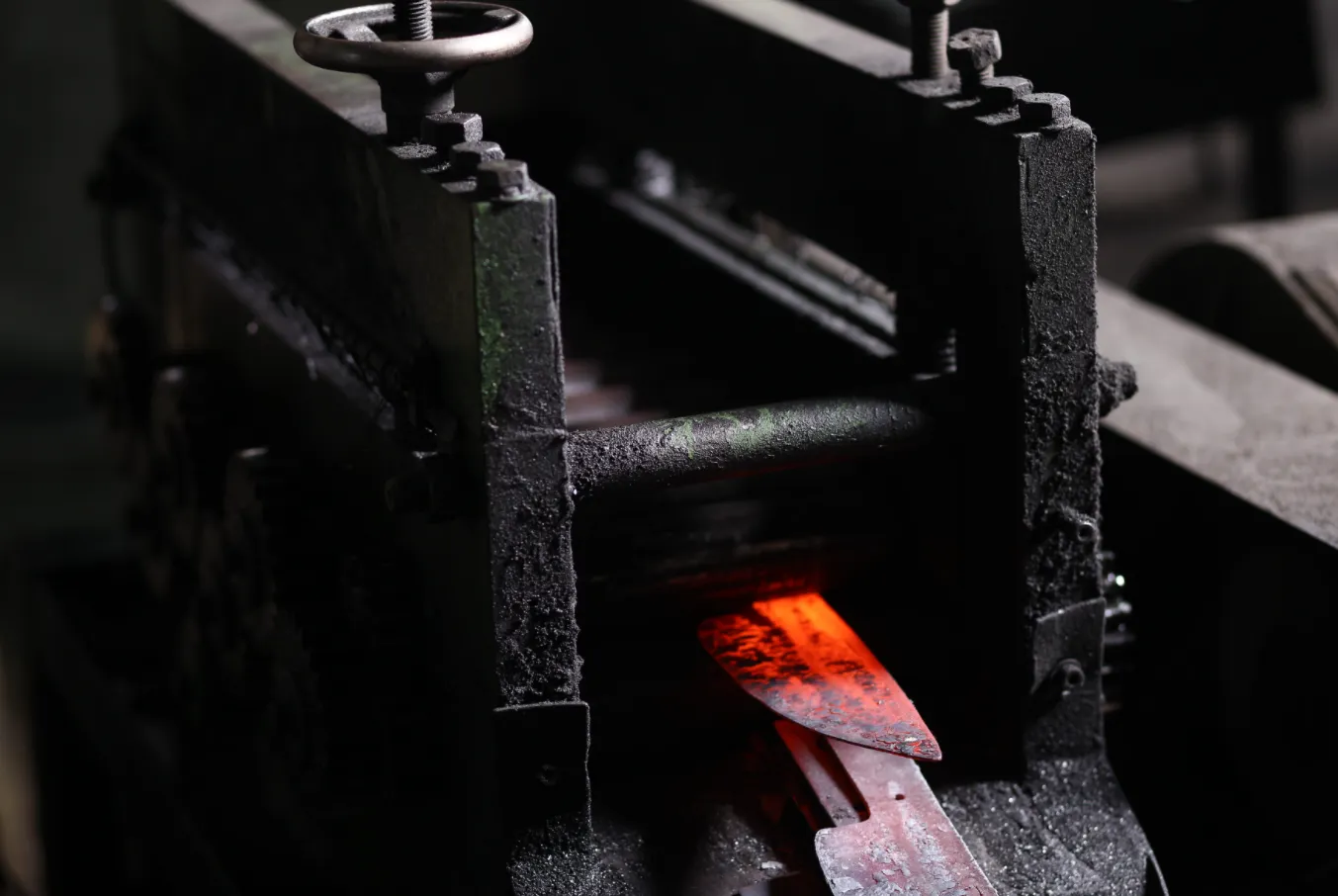
Whether you’re building a budget EDC lineup or curating a premium selection for serious enthusiasts, having the right supplier makes all the difference.
LeeKnives is a Yangjiang-based knife manufacturer with over 30 years of experience supplying North American retailers and wholesalers. We offer both AR-RPM9 and S35VN knives across a wide range of styles—so you can stock every price tier without juggling multiple suppliers.
What we offer:
- Competitive wholesale pricing on budget and premium blades
- OEM and custom knife services for your own branded line
- Consistent quality backed by decades of manufacturing experience
Request a quote for wholesale knives, OEM services, and more.
Launch Your Custom Knife Line Faster with LeeKnives
Complete OEM/ODM support—from design to final shipment—so you can focus on growth.
Backed by warehouses in the U.S. for fast, reliable delivery.
Frequently asked questions
Is AR-RPM9 a real powder metallurgy steel?
No. Independent metallurgical analysis confirmed AR-RPM9 is produced using spray-form technology, not true powder metallurgy. While spray-forming improves grain structure over conventional casting, it does not achieve the microstructural refinement of CPM processes used for steels like S35VN.
Can customers tell the difference between AR-RPM9 and S35VN in daily use?
Casual users rarely notice the difference during normal tasks like opening boxes or cutting food. Heavy users who process large volumes of abrasive material will appreciate S35VN’s superior edge retention.
Which steel offers better profit margins for retailers?
S35VN typically offers higher per-unit margins due to its premium positioning. However, AR-RPM9 generates higher sales volume and repeat business from budget-conscious buyers entering the hobby.
For enthusiasts and heavy users, yes. For casual EDC owners who prioritize value and low maintenance, AR-RPM9 provides better overall satisfaction per dollar spent.
Is AR-RPM9 better than D2?
It depends on priorities. AR-RPM9 offers better corrosion resistance thanks to its 18% chromium content—D2 is semi-stainless and can rust if neglected. D2, however, has better edge retention and wear resistance. For low-maintenance users, AR-RPM9 wins. For heavy cutting tasks, D2 has the edge. See our full AR-RPM9 vs D2 breakdown for a deeper comparison.
Is S35VN considered a super steel?
Not quite. S35VN is widely regarded as a premium steel, but “super steels” typically refers to higher-tier options like M390, Maxamet, or MagnaCut. S35VN sits just below that category—offering excellent real-world performance without the extreme difficulty of sharpening true super steels.
Is S35VN better than VG10?
Generally, yes. S35VN outperforms VG10 in edge retention and toughness. VG10 is more prone to chipping under lateral stress. However, VG10 is easier to sharpen and commonly found in Japanese kitchen knives. For EDC folders, S35VN is the stronger choice. Read our detailed S35VN vs VG10 vs 154CM guide for a full side-by-side.
Is S35VN tougher than MagnaCut?
No. MagnaCut is tougher than S35VN while also offering superior corrosion resistance. MagnaCut represents a newer generation of steel engineering. That said, S35VN remains more widely available and is found in more production knives at accessible price points. Check out our S35VN vs MagnaCut comparison for the complete picture.
Is S35VN good for everyday carry?
Yes—it’s one of the best EDC steels available. S35VN holds a sharp edge through daily tasks, resists corrosion well enough for pocket carry, and is user-friendly to sharpen compared to harder premium steels. It’s a top reason why brands like Benchmade and Spyderco rely on it heavily.





 EN
EN  JA
JA  DE
DE