A great knife sample means little if the full order strains your budget. Please check the MOQ before you commit.
Also, Finding the best knife manufacturers starts with knowing what you need.
- Buying for yourself? Compare brands.
- Stocking a shop? Look for wholesale terms that leave room for profit.
- Building your own knife brand? Focus on factories that can meet your design, budget, and delivery needs.
This guide compares suppliers across 5 countries: China, Japan, Germany, the USA, and the UK. You’ll learn how to weigh prices, minimum order sizes, production times, and custom options so you can move from a promising sample to a purchase order.
Key Takeaways
- Selling established brands requires good wholesale terms. Building your own brand requires a reliable factory.
- Yangjiang, China, handles custom manufacturing for the world. China dominates the industry, leading global tools and cutlery exports at $26.8 billion. Factories here typically require minimum orders of 200 to 500 pieces, with a 30 to 60-day wait.
- The other 4 major regions each serve one distinct purpose. Japan and Germany sell instant label prestige. The USA offers deep everyday carry (EDC) variety and short supply chains. Sheffield, UK, delivers an authentic, artisan history.
- Never buy bulk inventory blind. Feel the sharp edge of a production sample first. Make sure your supplier writes the steel grade and hardness into your contract to avoid costly surprises.
What “Best” Means When You Compare Knife Manufacturers
The best knife manufacturers depend on what you plan to sell: do you need stock to resell or a factory to make your own knife line?
Start by checking who will handle your order:
- Brand House: Kai (Shun), Zwilling, and Benchmade sell knives under their own brands. Ask about dealer terms; do not assume they will replace their branding with yours.
- OEM Factory: Makes knives to agreed specifications. You may use your design or adapt a model, then choose branding and packaging.
- Trading Company or Coordinator: Works with factories through one contact and earns a fee or margin. Ask which factory will make your order.
Check the trade page. “Dealer inquiry” points toward branded resale. “OEM” or “private label” suggests custom production, but does not prove factory ownership.
Brand location and factory location can differ. For example, Japanese styling alone does not establish origin. Yangjiang factories such as LeeKnives are highly skilled at producing Japanese-style kitchen knives. Browse our product range here.
Check resale rules. Rada no longer accepts third-party Amazon or Walmart resellers. DR Cutlery, an authorized Dexter Russell supplier, sets resale conditions. Do not present its agreement as Dexter-Russell’s companywide policy.
Before ordering, get the factory location, branding options, and sales permissions in writing. Compare suppliers on the same basis.
The Best Knife Manufacturers by Country
Compare suppliers, not just countries. China offers own-brand production; Japan offers established brands and craft; Germany offers branded kitchen ranges; and the USA and UK offer domestic and custom options. Here, prices are retail references, not wholesale quotes. Confirm MOQs and lead times before requesting written wholesale knife service.
China Knife Manufacturers: OEM and Wholesale Options
China is a useful starting point when you want control over design, branding, and packaging. The Yangjiang cluster brings blade production, handles, finishing, and export services into one region. However, its factories serve different markets. A premium folding-knife maker may not suit a kitchen range.
Our country guide gives an indicative OEM minimum of 200–500 pieces for kitchen knives, with production taking 30–60 days after sample approval and deposit. These are planning ranges, not fixed terms across China. New tooling, imported materials, and complex finishes can change both.
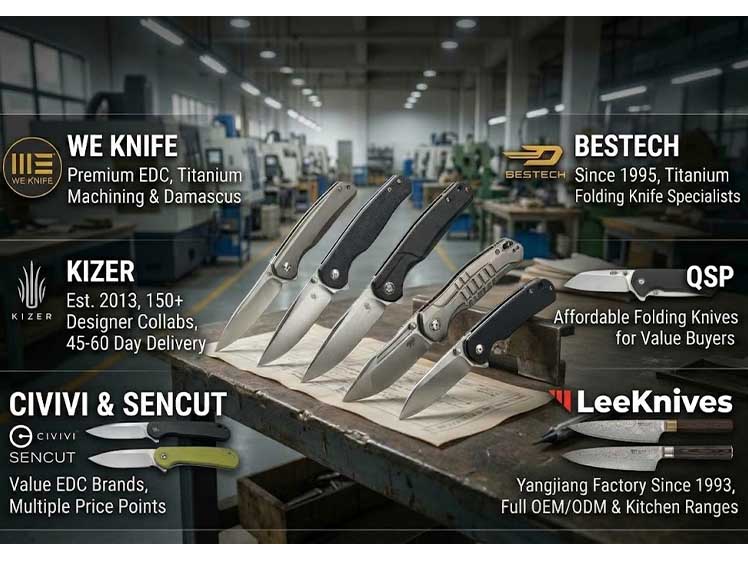
Consider these suppliers:
- WE Knife focuses on premium everyday-carry, or EDC, knives. Its capabilities include titanium machining, Damascus materials, and designer collaborations.
- Kizer, founded in 2013, offers OEM/ODM services. The country guide reports more than 150 designer collaborations and a target delivery window of 45–60 days.
- CIVIVI and SENCUT are WE Knife’s more affordable brands. They can help retailers build assortments at several price points.
- Bestech brings OEM experience dating to 1995 and a focus on titanium folding knives.
- QSP offers a broad folding-knife range aimed at value-conscious buyers.
LeeKnives also belongs on this list. We have been a factory based in Yangjiang since 1993. We supply kitchen knives and pocket knives. Our published order reference is 200-300 pieces, subject to the product. The OEM service page outlines samples, design choices, and roughly 30–45 days of mass production after sample approval.
For your shortlist, match the factory’s usual work to your intended product. Then compare samples made to the same brief. Check blade thickness, handle fit, edge finish, and packaging, not just the steel name.
For the broader shortlist, see our guide to Chinese knife manufacturers.
Japanese Knife Manufacturers: Origin, Industrial OEM, and Craft
Japan makes sense when verified Japanese production matters to your customers. Still, the sourcing route varies by region. Seki has industrial knife production and OEM suppliers. Sakai uses networks of specialist makers, while Tsubame-Sanjo and Echizen add established metalworking and forging expertise.
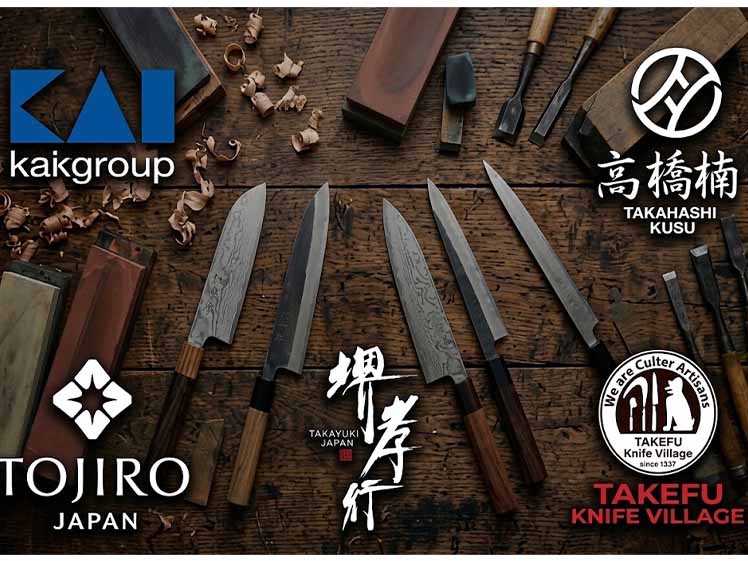
Start with these names:
- Kai Corporation, founded in 1908, makes Shun in Seki. Approach Shun as a branded-distribution opportunity rather than assuming private-label access.
- Seki Corporation publishes an OEM route. The country guide records an initial minimum of 300 pieces and a 4–6 month schedule after confirming details. Treat these as supplier-specific terms.
- Takahashikusu coordinates custom-branded Japanese and Western knives through its Sakai network. Request current quantities, pricing, and delivery dates for your design.
- Tojiro, based in Tsubame, is known for its VG-10 kitchen ranges. Public OEM terms are not listed.
- Aoki Hamono, behind Sakai Takayuki, offers specialist kitchen knives linked to Sakai’s long craft tradition.
- Takefu Knife Village is a cooperative of independent makers, not one factory. Discuss custom projects and export arrangements individually.
Order size alone does not tell you which route costs less. A small artisan batch may carry a much higher unit price than an industrial run. Likewise, an available wholesale knife and a new OEM design have different schedules.
Send a short brief with the knife type, blade length, steel, quantity, budget, and delivery market. If communication needs local support, ask what a coordinator’s fee covers.
Our guide to Japanese knife manufacturers separates brand suppliers, OEM contacts, workshops, and cooperatives.
LeeKnives helps you confirm materials, branding, packaging and order terms before production, with OEM & ODM support, factory-direct pricing and samples before bulk orders.
MOQ from 200-300 pcs, depending on the product.
German Knife Manufacturers: Established Kitchen and Trade Ranges
Germany offers several distinct buying options, from forged kitchen collections to food-processing knives and specialist folders. Solingen is an important production center, but not every German maker operates there. F. Dick, for example, is based in Deizisau.
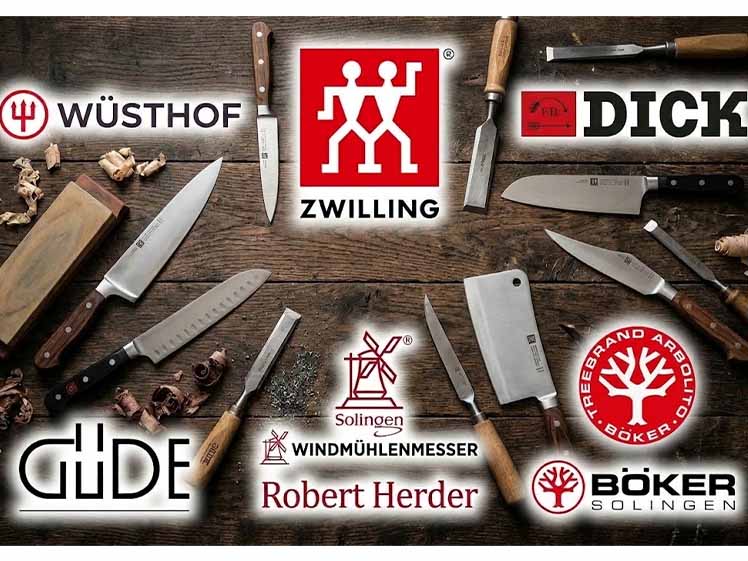
For many buyers, the practical route is branded wholesale. Don’t assume a manufacturer will make your own line just because it owns a factory.
- Wüsthof, founded in 1814, offers coordinated kitchen ranges. Its Classic 8-inch chef’s knife has a published hardness of 58 HRC and a US$170 retail reference.
- Zwilling, founded in 1731, operates a wholesale portal. Its retail engraving service starts at US$14.99. Engraving is not an OEM program.
- F. Dick, founded in 1778, supplies professional knives and sharpening equipment. Premier Plus uses forged X50CrMoV15 steel at 56 HRC.
- GÜDE, founded in 1910, offers hand-forged kitchen knives. Alpha Nakiri retail prices range from €137 to €179, depending on handle options.
- Robert Herder, founded in 1872, makes thin-ground Windmühlenmesser knives and offers corporate-logo engraving.
- Böker has operated its Solingen factory since 1869. Its wider catalog includes knives made in other countries, so check each model.
HRC describes hardness on the Rockwell C scale. It is one specification, not a complete quality score. Blade shape, heat treatment, and edge thickness also affect how a knife cuts and holds up.
For buying purposes, separate branded resale, engraved gifts, and own-brand production. Wüsthof and Zwilling do not publicly advertise general OEM programs. Ask any proposed manufacturing partner to confirm the scope before you pay for development.
Compare the full shortlist in our guide to German knife manufacturers.
USA Knife Manufacturers: Domestic Production and Selected Custom Routes
US sourcing can suit buyers who need documented domestic manufacture, factory access, or local replenishment. Those benefits depend on stock and location; a domestic address alone does not guarantee faster production.
Also, use origin claims carefully. The FTC requires products carrying an unqualified “Made in USA” claim to be “all or virtually all” US-made. Ask for evidence covering the product and wording you plan to use.
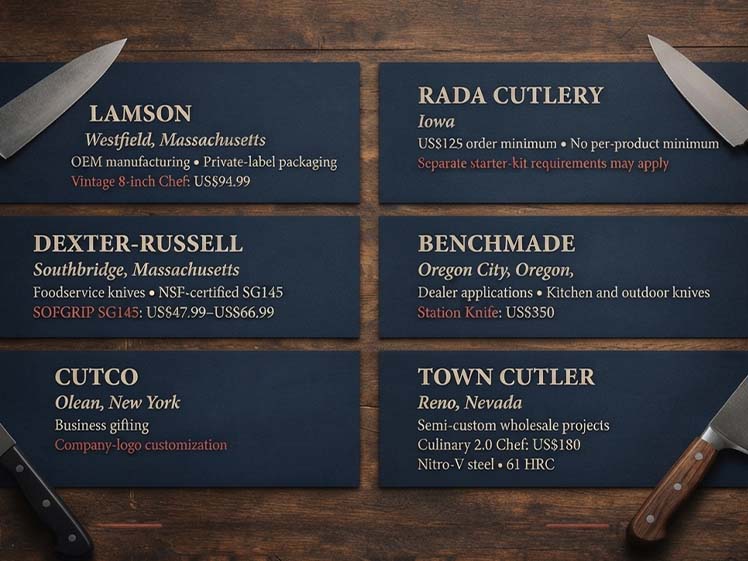
These manufacturers serve different commercial needs:
- Lamson, in Westfield, Massachusetts, explicitly offers OEM manufacturing and private-label packaging. Its Vintage 8-inch Chef has a US$94.99 retail reference.
- Rada Cutlery, in Iowa, publishes a US$125 order minimum with no per-product minimum. Some new applicants face separate starter-kit requirements.
- Dexter-Russell, in Southbridge, Massachusetts, supplies foodservice knives. Its SG145 SOFGRIP range is listed at US$47.99–US$66.99. The product page also identifies NSF certification.
- Benchmade, in Oregon City, Oregon, has a dealer application process and kitchen cutlery alongside its outdoor range. The Station Knife reference is US$350.
- Cutco, in Olean, New York, offers company-logo customization through business gifting.
- Town Cutler, in Reno, Nevada, offers semi-custom wholesale projects. Its Culinary 2.0 Chef reference is US$180, with Nitro-V steel at 61 HRC.
For your own line, start by asking Lamson about design scope and Town Cutler about permitted changes. For gifts, Cutco’s route may be more relevant. A consumer customization tool does not automatically provide manufacturing rights or wholesale access.
Check marketplace eligibility before planning sales. Rada says it no longer accepts third-party Amazon or Walmart resellers. A low opening order does not grant unrestricted selling rights.
See our guide to USA knife manufacturers for the 8-manufacturer comparison.
LeeKnives helps you confirm materials, branding, packaging and order terms before production, with OEM & ODM support, factory-direct pricing and samples before bulk orders.
MOQ from 200-300 pcs, depending on the product.
UK Knife Manufacturers: Working Knives and Small Custom Projects
UK suppliers include professional manufacturers and small workshops. Don’t treat them as a single production model. Sheffield remains important, while makers elsewhere offer custom kitchen knives and specialist retail collections.
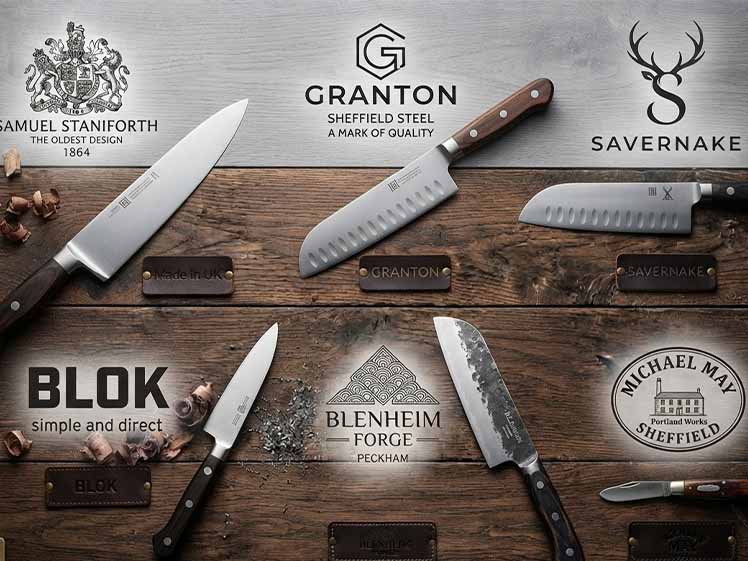
Your shortlist can include:
- Samuel Staniforth, founded in Sheffield in 1864, supplies kitchen and butcher knives. Its Chef Cooks Knife reference is £49.38, with custom shapes and materials available by agreement.
- Granton makes knives in Sheffield and offers bespoke design and engraving services.
- Savernake, in Wiltshire, offers white-label work. Published references start at £250 for custom knives and £1,250 for bespoke development, with an 8–12 week bespoke schedule.
- BLOK, in Derbyshire, makes handmade kitchen knives. Its Giraffe Resin Paring Knife reference is £290.
- Blenheim Forge, in Peckham, forges kitchen knives using Japanese blade material. Santoku references range from £290 to £320.
- Michael May, at Sheffield’s Portland Works, makes traditional pocket knives. The £85 Bog Oak Lambfoot has a published 4–8 week made-to-order window.
Here, compare the ordering route before comparing prices. A £49.38 catalog knife and a £1,250 development project include different work. Ask which drawings, prototypes, revisions, and repeat-order rights the development fee covers.
For matching retail sets, also agree on acceptable handle variation. Wood grain and patterned resin can vary between pieces.
Our guide to UK knife manufacturers covers trade questions and ordering details.
Shortlist 2 or 3 suppliers that make your product type. Send each the same specifications, quantity, packaging needs, and delivery address. Compare samples, delivery costs, and schedules. Keep development fees separate. Choose based on the written offer, not the country’s reputation or an attractive catalog.
The Cross-Region Best Knife Manufacturers Comparison
Use this table to find a match, not a winner. Minimum orders, prices, and schedules vary by supplier. These examples help you choose which buying route to explore:
| Region | Best fit | Order reference | Timing reference |
| China | Own-brand production | 100–500 pieces; LeeKnives: 200 | 30–60 days production |
| Japan | Premium Japanese-made ranges | 5–10 through coordinators; 300 industrial | 4–6 months industrial |
| Germany | Established kitchen brands | Quote required | Project-specific |
| USA | Foodservice and domestic sourcing | Rada: US$125; OEM varies | Confirm stock or project schedule |
| UK | Small batches and bespoke work | Single commissions upward | May: 4–8 weeks; Savernake bespoke: 8–12 weeks |
Compare like with like. Japan’s small coordinated orders differ from industrial production. Germany’s quote-only terms require direct discussion, not assumptions about OEM access. Always separate production from shipping time. Request a written quote covering quantity, custom work, origin, and delivery before choosing your supplier.
Best Knife Manufacturers by Product Category
Your product type further narrows the supplier list. A factory that makes folding knives may not suit a kitchen range. Start with what your customers need, then check the maker’s relevant experience.
Match knife suppliers to your range:
- Kitchen Knives: China offers private-label options, while Japan and Germany provide established branded ranges. Our guide to OEM knife manufacturers compares custom production routes. For boxed sets, also check assembly, storage, replacement knives, and packaging with kitchen knife set manufacturers.
- Pocket and EDC Knives: Benchmade, Spyderco, and Buck serve branded retail markets. WE, Kizer, Bestech, and QSP offer other sourcing options, though services differ. For resale stock, compare pocket knife wholesale distributors and their dealer requirements.
- Damascus Blades: Check construction, not just the pattern. Ask whether the blade contains bonded steel layers or only surface decoration. Our guide to Damascus knife manufacturers covers supplier types and key material questions.
- Sharpeners and Accessories: Consider suitable maintenance tools alongside your knives. Compare stones, manual tools, and guided systems through knife sharpener manufacturers. Confirm compatibility before creating bundles.
Request samples from suppliers with relevant production experience. Assess the complete product and support package before adding it to your range.
LeeKnives helps you confirm materials, branding, packaging and order terms before production, with OEM & ODM support, factory-direct pricing and samples before bulk orders.
MOQ from 200-300 pcs, depending on the product.
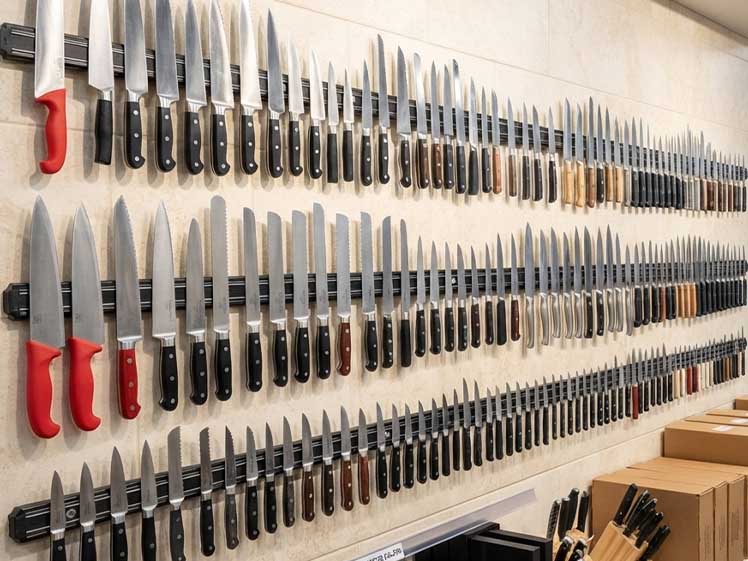
Sourcing Routes for Choosing Knife Manufacturers
Every knife project follows one of these sourcing paths. You must pick your route before picking a country. This helps you find the best knife manufacturers for your specific business goals.
Let’s explore your options:
- Route 1: Brand Wholesale. Buy finished, branded knives at a discount and resell them. This path offers the lowest barrier to entry. For example, Rada Cutlery requires a wholesale minimum of just $125. Japanese wholesalers often start at $200. Your inventory ships in days. The downside? You cannot customize knives, and strict channel rules might block Amazon sales. This route works best for retail stores wanting proven products immediately.
- Route 2: OEM (Your Design, Their Factory). Give the factory your blade geometry, steel type, and packaging specs. The factory builds it from scratch. You get a unique product, but you face higher minimums. Chinese factories usually require 100 to 500 pieces. Japan’s benchmark sits around 300 pieces. This works best for established brands with a clear vision and enough budget for custom tooling.
- Route 3: Private Label (Factory Design, Your Logo). This is the fastest way to launch an own-brand line. You choose a factory’s proven design, tweak the handle, and add your logo. Order minimums and wait times drop significantly compared to full OEM. The catch is that other companies might sell the same base knife. This suits new brands and helps validate the market.
- Route 4: Dropshipping. List the products online, and the supplier ships directly to your buyer. You carry no inventory and face zero minimums. It is the cheapest way to test customer demand. However, you lose control over packaging, and profit margins shrink. This serves as a quick validation step.
Choosing your business model first ensures you partner with the right factory later.
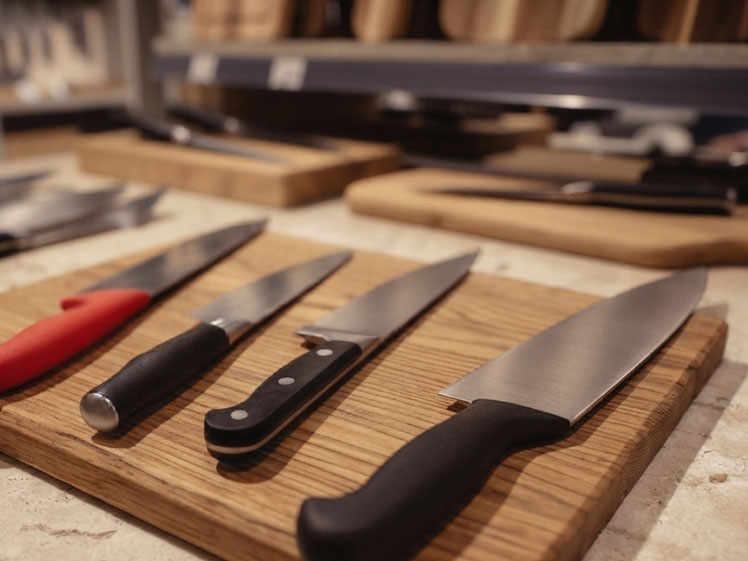
Vetting the Best Knife Manufacturers: A Buyer Checklist
No matter which country you choose, the vetting process stays the same. Before you wire any money, you need a strict system. This protects your inventory and your budget.
Here is what you should demand before signing a contract:
- Lock in the exact steel. “Stainless steel” is not a real specification. Ask for the exact metal grade. You might choose basic 3Cr13 for budget models, or step up to VG-10 and S35VN for premium blades. For large orders, demand written factory mill certificates.
- Get your hardness target. Ask for a specific HRC number. A 56–58 HRC rating for a German-style chef’s knife tells you how the blade will hold an edge.
- Approve a physical sample. Never buy inventory blind. Hold the knife yourself. Check the grind symmetry, edge finish, and handle fit. Keep this physical sample on your desk as your benchmark to judge the final batch. Find our complete guide on how to buy knives wholesale.
- Clarify the minimums. A factory’s opening order, reorder quantity, per-SKU minimum, and custom minimum are usually four different numbers. Get them all in writing.
- Check compliance and tariffs. Ensure FDA or LFGB food-contact compliance, which typically runs between $200 and $1,500 for testing. Also, calculate your import duties early. For instance, US HTS heading 8211 tariffs on Chinese knives can stack up to 50–55% due to Section 301 rules.
- Put payment dates in writing. Separate your deposit terms from the final balance. Set clear calendar dates for sample approval, production, and shipping.
- Test communication early. Do they reply quickly and clearly in English? A supplier who goes quiet during a quote will vanish if a batch fails. Always book a third-party inspector, like V-Trust (around $268 per day), to check the factory floor before shipping.
For realistic pricing details, read how much it costs to make a knife. To learn about shipping rules, see how to import knives from China.
The best knife manufacturers will allow a pilot order. Make your first run the smallest batch the line allows. A manufacturing mistake is always cheaper to fix at 200 units than at 2,000. Scale up only after that first small batch sells out.
Choosing the Best Knife Manufacturers for Your Business
Your final choice depends on your specific business model. Every strategy has a practical factory match.
- Fast Retail Resale: If you want famous names on your shelves immediately, use brand wholesale programs. Learn the setup process in our guide on becoming a knife dealer.
- Custom E-commerce: Need 100 to 500 custom pieces? Chinese OEM is your smartest move. You keep total design control and lock in the lowest unit costs.
- Premium Heritage: If your brand relies on a historic story, head to Seki, Japan, or Solingen, Germany. You will face higher minimums and longer waits, but you secure a prestigious label.
- Low-Risk Testing: Startups should test the waters first. Use dropshipping or a low-MOQ private label before buying expensive custom factory tooling.
- Smart Alternatives: You can actually get strict Japanese or German blade specs from Chinese OEM factories. You skip the famous geographic label, but you save massive upfront costs.
Matching your budget to the right region helps keep the supply chain running smoothly. Pick your route, test your samples, and start building.
Working with LeeKnives: One Factory, Full-Range OEM
If your business plan points to Chinese manufacturing, we can step in directly. LeeKnives has built blades in Yangjiang since 1993. We craft everything from Japanese-style kitchen knives to rugged pocket folders and layered Damascus lines.
Here is what you can expect when you partner with us:
- Accessible Minimums: Most orders start at a 200-300 piece MOQ. We provide free quotes and physical samples before you sign a bulk contract.
- Custom Control: You get full OEM and private-label support. This covers your specific handle materials, custom logos, and retail packaging.
- Reliable Timelines: Production takes 30 to 45 days after you approve the sample. Your knives pass through 4 strict quality-control checks on the factory floor.
- Smooth Logistics: We ship globally by air, sea, or rail. We also operate a US-based warehouse for faster domestic delivery.
LeeKnives helps you confirm materials, branding, packaging and order terms before production, with OEM & ODM support, factory-direct pricing and samples before bulk orders.
MOQ from 200-300 pcs, depending on the product.
Every client gets a dedicated support rep to guide them from the first blueprint to repeat orders. If you prefer ready-made inventory, our wholesale program lets you source kitchen knives immediately.
FAQs
Who makes the best knives in the world?
For personal kitchens, famous names like Wüsthof, Shun, and Victorinox usually win. For the best pocket knife manufacturers, look at Benchmade or Spyderco. However, for a business, you need to find the best knife manufacturers in the world that match your budget and order volume. Always check which region fits your commercial model instead of chasing a popular consumer brand.
Which country makes the best knives?
Germany and Japan provide deep historical craftsmanship. Towns like Solingen and Seki remain famous for traditional forging. Meanwhile, China delivers massive production value, handling over half of all global knife exports. The United States dominates the outdoor and everyday carry markets. Your project goals determine which country offers the best knife manufacturers for your business needs.
What is the best knife manufacturer for a small business?
A Chinese OEM factory generally works for small businesses. They offer low minimum orders, usually starting around 100 to 500 pieces. You also get clear English support and fast 30-day production cycles. Try starting with a private-label design to test your market first. Once your sales grow, you can invest in fully custom OEM development for your growing brand.
Are expensive knife brands worth it?
If you resell them, premium labels attract loyal customers and justify high retail prices. However, if you build your own line, OEM factories offer those same premium steels at a fraction of the cost. With luxury brands, you often pay for the famous label and the historical story, not the raw cutting performance itself.
How do I find a manufacturer for my knife brand?
Choose a manufacturing region that fits your budget. Then, discover reputable factories through global knife shows or industry directories. Request physical samples from 3 to 5 different candidates. Always verify the steel grade and hardness targets in writing. Agree on clear payment terms and run a small pilot order to confirm reliability before scaling up safely.
What is the difference between a knife brand and a knife manufacturer?
A brand designs, markets, and sells the tools under its own recognized name. A manufacturer operates the heavy machinery to build that physical product. Many famous brands outsource their production to overseas OEM factories. These factories build the knives that carry other companies’ labels. When sourcing inventory, always establish who owns the factory making your specific blades.
Who makes the best pocket knives?
Consumers often trust American classics like Benchmade, Spyderco, Kershaw, and Buck. But if you want to build a private label knife brand, you need the best knife manufacturers in the OEM space. Most of the world’s premium folding knives come from EDC factories located in Yangjiang, China. Established industrial leaders like WE Knife, Kizer, Bestech, and QSP handle this heavy production volume.
Which knife manufacturer has the best heat treatment?
Heat treatment controls edge retention, even more than the steel’s name. The top industrial leaders in Seki, Solingen, and Yangjiang all use controlled, repeatable baking cycles. So don’t rank factories by marketing claims alone. Require strict proof. Always ask for the target HRC range in writing, and test it independently on your physical production samples.
Your Next Steps with the Best Knife Manufacturers
Whatever route you choose, you now need a clear plan. Write down your knife type, steel grade, target quantity, and launch deadline.
If Chinese OEM fits your business model, LeeKnives can easily review your project. Operating in Yangjiang since 1993, we build custom lines starting at a 200-piece minimum. You can evaluate a free physical sample before signing any bulk contracts. A local US warehouse also helps your finished inventory arrive faster.
To get started, share your product details, target market, and timeline. You will receive a firm price and production schedule in return.





 EN
 JA
 DE