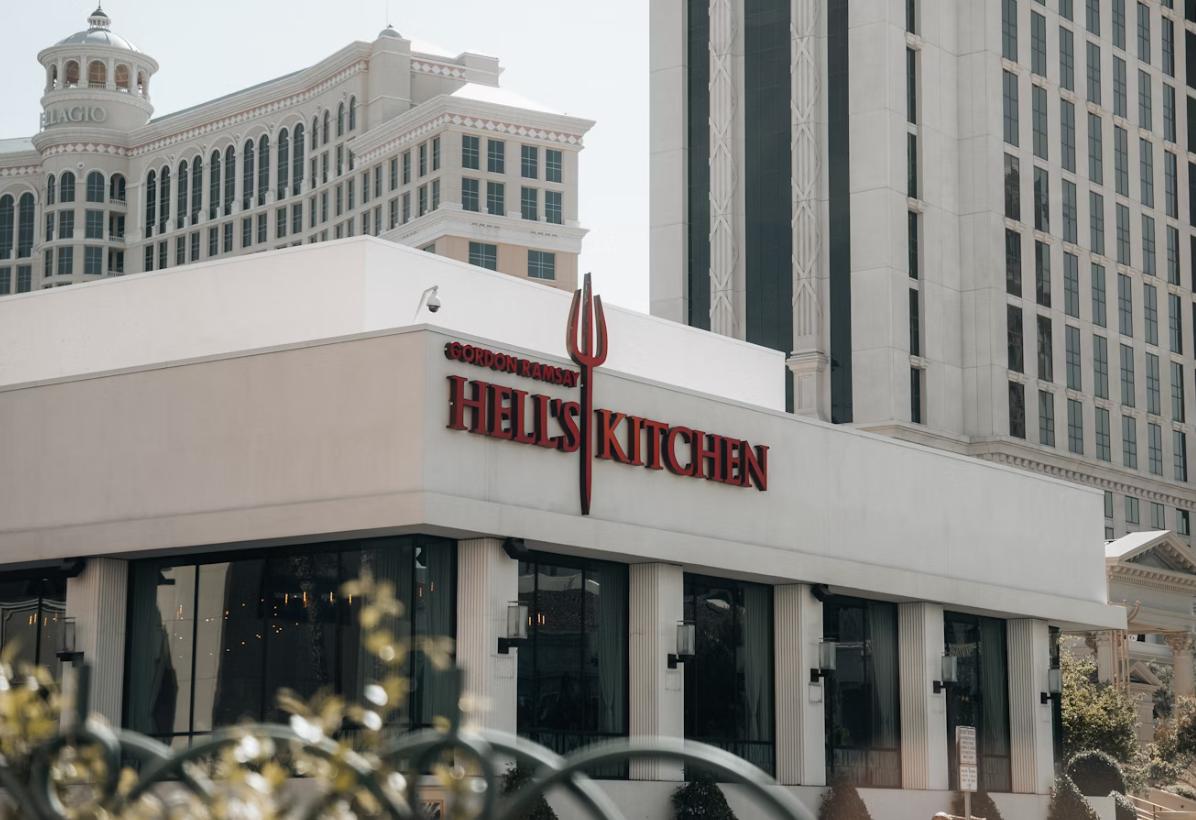
Gordon Ramsay is famous not only for his fiery personality and Michelin-starred cuisine, but also for his insistence on quality, especially when it comes to knives.
The blades in his kitchen are chosen with the same care as his ingredients.
In this guide, we’ll break down what knives Gordon Ramsay uses, why he uses them, and how you as a retailer can source comparable knives.
Quick Answer
Gordon Ramsay currently endorses and uses HexClad Japanese Damascus steel knives (67-layer construction), while historically relying on Wüsthof Classic 8-inch chef’s knives and Zwilling J.A. Henckels in his restaurants, MasterClass, and Hell’s Kitchen.
He also co-created a mid-range home line with Royal Doulton. Regardless of brand, Ramsay insists you only need five knives: a chef’s knife, serrated knife, paring knife, boning knife, and fillet knife.
Quick Facts: Ramsay’s Knives at a Glance
| Question | Answer |
|---|---|
| Current partner brand | HexClad (ambassador & collaborator since 2021) |
| Historical workhorses | Wüsthof, Zwilling J.A. Henckels, Shun |
| His own branded line | Royal Doulton “Gordon Ramsay Maze” (home market) |
| Essential knives | Chef’s, serrated, paring (+ boning & fillet for pros) |
| Steel he favors | High-carbon stainless; 67-layer Damascus (AUS-10 core) |
| Typical hardness | 56–58 HRC (German) / 60+ HRC (Japanese) — see Rockwell hardness (HRC) |
Ramsay’s kitchen essentials: The 5 key knives
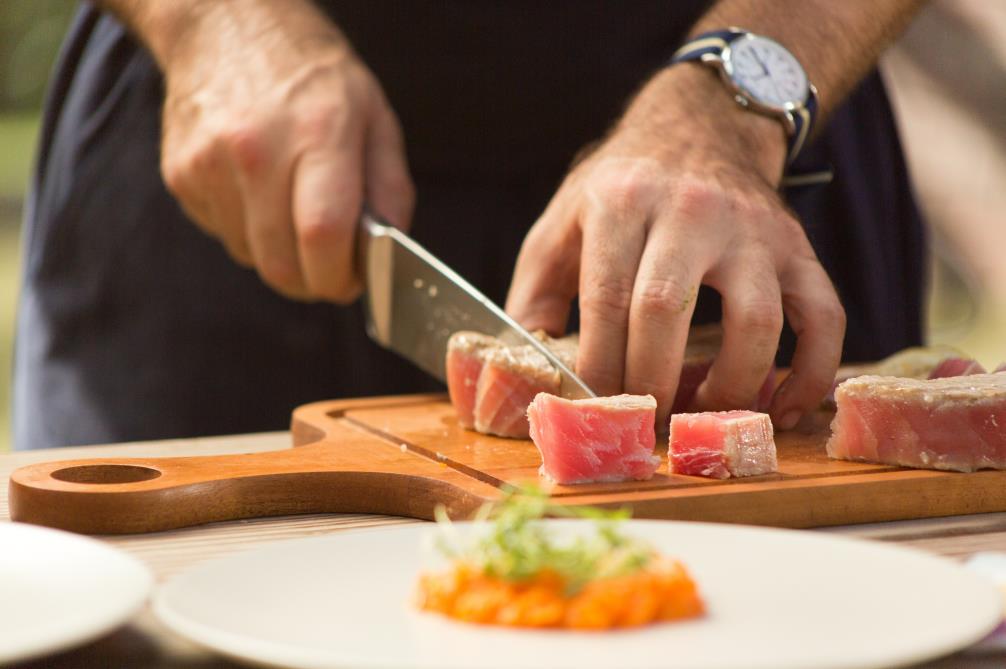
Gordon Ramsay doesn’t believe you need a dozen different knives cluttering up your kitchen.
In fact, he’s famously said that “basically, you need three knives” for everyday cooking.
Those three essentials are a chef’s knife, a serrated knife, and a paring knife – and with just these, Ramsay says, “you can’t go wrong”.
- Chef’s knife – The workhorse of the kitchen. Ramsay uses this all-purpose knife for chopping, slicing, dicing, and mincing. An 8-inch chef’s knife can tackle everything from herbs to meats. He advises choosing one that feels balanced in your hand for maximum control.
- Serrated knife (bread knife) – A long knife with a toothed edge, perfect for foods with a hard exterior and soft interior. Ramsay uses a serrated knife to slice breads, pastries, and even tomatoes without crushing them.
- Paring knife – A small knife for precision tasks. Ramsay calls this one “brilliant for chopping vegetables” and uses it for peeling, trimming, and detail work. Its small blade makes it easy to mince garlic or devein shrimp with finesse.
In a video on choosing kitchen knives, Ramsay also named a 5-inch Santoku alongside the 8-inch chef’s knife as his personal go-to blades for everyday prep — a nod to his preference for Japanese-style agility. (Retailers: the Santoku is one of the highest-margin Japanese profiles to stock.)
However, in a professional setting like Hell’s Kitchen, that essential trio expands. To handle high-volume, precise butchery of meat and fish, two specialized blades complete the set of five knives that truly cover all bases:
- Boning knife — The essential tool for meat fabrication. The thin, sharp, semi-flexible blade works cleanly around bones and through joints, minimizing waste on expensive cuts — think a whole beef tenderloin for Ramsay’s signature Beef Wellington.
- Fillet knife — The master of seafood. Its long, thin, highly flexible blade glides between skin and flesh and navigates the rib cage to produce perfect, bone-free fillets. (See our boning & fillet knives collection for spec references.)
Beyond these basics, Ramsay emphasizes quality. He urges cooks to “hold a knife in your hand and see if it feels right” before buying: “The firmer the grip, the better the chopping. The heavier the handle, the more control you’ve got.“
The brands behind the chef: Ramsay’s go-to knife manufacturers
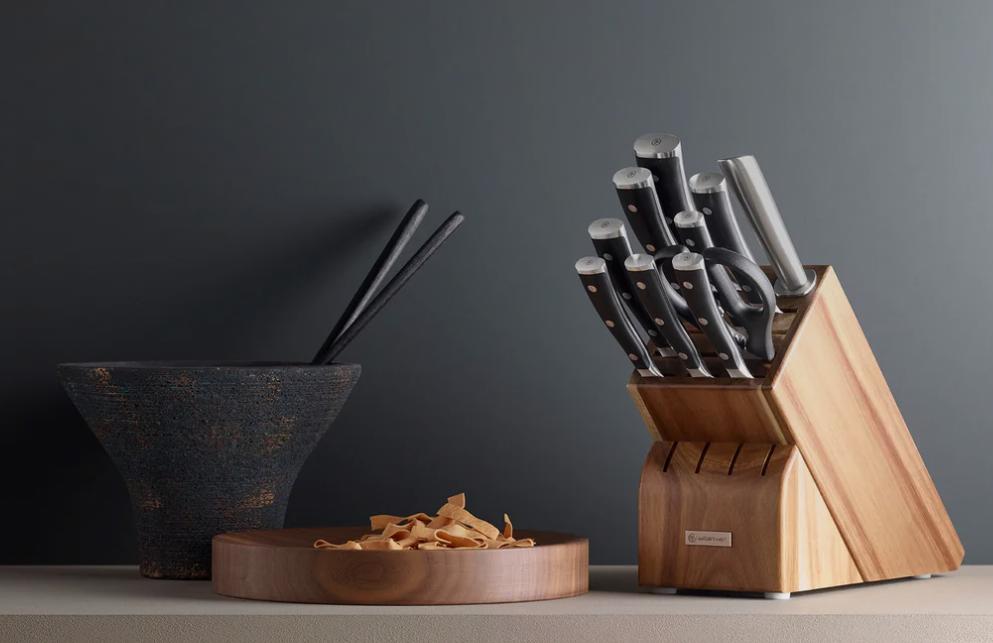
Over the years, Gordon Ramsay has used knives from several well-known manufacturers. What’s changed in 2026 is how clearly those relationships can be graded — some are confirmed commercial partnerships, others are simply brands observed in his hands on screen. Here is how they stack up:
| Brand | Relationship | Evidence Grade | Key Specs |
|---|---|---|---|
| HexClad | Official partner & ambassador since 2021 | Confirmed | 67-layer Japanese Damascus, AUS-10 core, 60+ HRC |
| Royal Doulton | Co-branded “Maze” knife line | Confirmed | Stainless, mid-range, home market |
| Hell’s Kitchen Store line | Official show-branded knives | Confirmed (retail line) | 67-layer Damascus, G10 handles, 15° Honbazuke edge |
| Wüsthof | Seen in tutorials & MasterClass-era content | Observed | Classic 8″, forged X50CrMoV15, 58 HRC |
| Zwilling J.A. Henckels | Hell’s Kitchen stations; MasterClass filming | Observed | Friodur ice-hardened stainless, full tang |
| Shun | Older shows; Classic & Premier lines | Observed | VG-MAX core, Damascus cladding, 16°/side |
| Blenheim Forge | Custom hand-forged London sets in select restaurants | Reported | Artisan, small-batch |
While these brands are not affiliated with LeeKnives, their specs tell you exactly what professional chefs prioritize — useful intelligence when you source or spec knives for your own shelves.
Workhorse Brands: Seen in Ramsay’s Hands
Wüsthof is a heritage brand based in Solingen, Germany, established in 1814 and known for precision-forged knives made from high-carbon stainless steel.
Common design features include full-tang construction, a triple-riveted handle, and a balanced bolster.
Ramsay has used Wüsthof knives — most visibly the Classic 8-inch chef’s knife — throughout his career in professional and instructional settings.
J.A. Henckels is another Solingen-based manufacturer — one of the oldest knife makers in the world, founded in 1731.
Henckels knives are typically forged from high-carbon “NO STAIN” stainless steel, and many lines go through Friodur ice-hardening for additional strength.
In shows like Hell’s Kitchen, Henckels knives have been the long-standing station staple, and Ramsay used Henckels during his MasterClass filming.
Long before any official partnerships, Ramsay was often seen wielding Shun knives, particularly the Classic and Premier lines.
Shun blades typically feature a hard VG-MAX steel core clad in Damascus layers, taking a razor-sharp edge at 16 degrees per side.
This is the brand that represents his appreciation for Japanese precision work — delicate fish prep and fine vegetable cuts.
Launch Your Custom Knife Line Faster with LeeKnives
Complete OEM/ODM support—from design to final shipment—so you can focus on growth.
Backed by warehouses in the U.S. for fast, reliable delivery.
Partnerships & Endorsements
In collaboration with Royal Doulton, Ramsay helped create a branded line tailored to the home kitchen, including the “Gordon Ramsay Maze” set — stainless steel knives blending Western and Japanese design elements, positioned as a reliable mid-range option.
Note for buyers: as of 2026, many Royal Doulton knife sets circulate mainly through secondary markets and liquidators, so verify current availability before building a retail assortment around them.
HexClad partnered with Ramsay in 2021, with the chef serving as brand ambassador and product collaborator.
The knives use 67 layers of Japanese Damascus steel over an AUS-10 core, hardened to around 60+ HRC, with full-tang pakkawood handles.
HexClad hones these blades to a Japanese-style edge — 10–12° per side (product pages cite 12°; support documentation cites 10°) — noticeably keener than the 20° typical of German knives.
Factory Insight:

What do "67 layers of Damascus" actually do? Based on LeeKnives' production experience with Damascus steel knives, the layered cladding primarily protects the hard AUS-10 core, adds lateral strength, and creates the signature wavy pattern — the cutting performance itself comes from the core steel and heat treatment.

When speccing Damascus knives for your own line, the questions that matter are core steel grade, HRC target, and cladding integrity, not layer count alone.*
Kitchen knife set recommendations: What would a Ramsay-spec set look like?
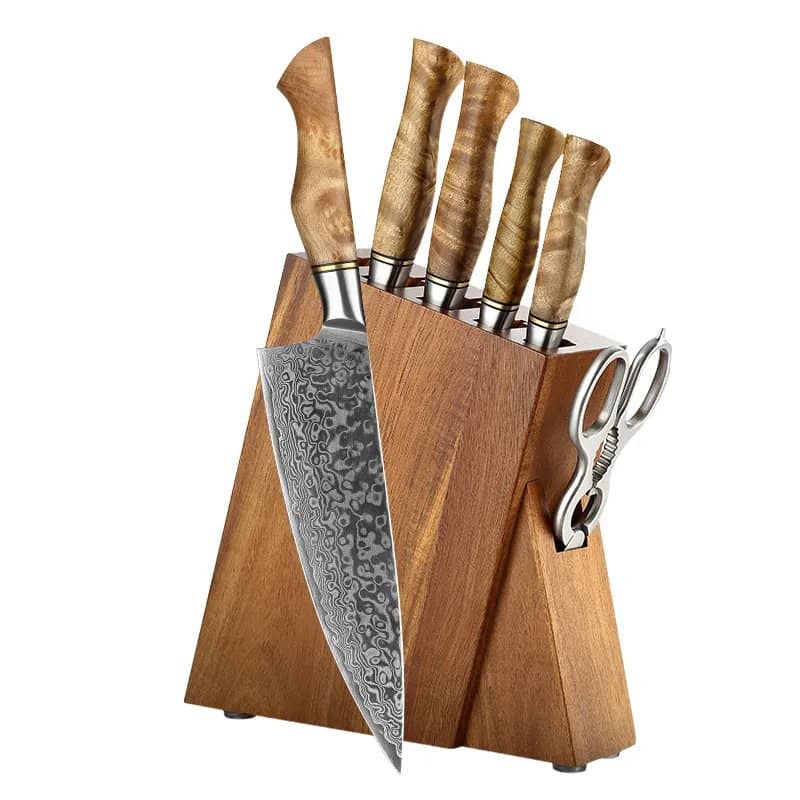
Ramsay officially promotes the HexClad 7-Piece Master Series (8″ chef’s, 7″ Santoku, 8″ serrated bread, 5″ utility, 3.5″ paring, 9″ honing steel, magnetic walnut block), priced in the premium tier — roughly $440–$500 as of 2026, so check current listings. His older Royal Doulton sets covered the same essentials at a mid-range price.
But Ramsay’s own philosophy is anti-block: buy a small number of excellent individual knives. For retailers and private-label buyers, that philosophy translates into a clean spec sheet:
| Knife | Steel Options | Hardness | Edge Angle | Construction |
|---|---|---|---|---|
| 8″ Chef’s knife | X50CrMoV15 (1.4116) / AUS-10 | 56–58 / 60 HRC | 20° or 12–15°/side | Full tang, forged |
| 5–7″ Santoku | VG-10 / AUS-10 | 60–61 HRC | 15°/side | Full tang |
| 8″ Serrated bread | 1.4116 stainless | 56–58 HRC | Serrated | Full tang |
| 3.5″ Paring | 1.4116 / AUS-10 | 56–60 HRC | 15–20°/side | Full or half tang |
| 6″ Boning (semi-flex) | 1.4116 stainless | 56–58 HRC | 20°/side | Full tang |
| Handles | Pakkawood / G10 / ergonomic polymer | — | — | Triple-riveted or seamless |
For wholesale buyers: the specs above are all standard, producible configurations — German 1.4116 for durability-focused lines, AUS-10/VG-10 for premium Japanese-style lines. LeeKnives manufactures both, with MOQ flexibility starting at 100-200 units. Browse our kitchen knife sets or get batch pricing.
What to look for in a professional knife: a buyer’s guide
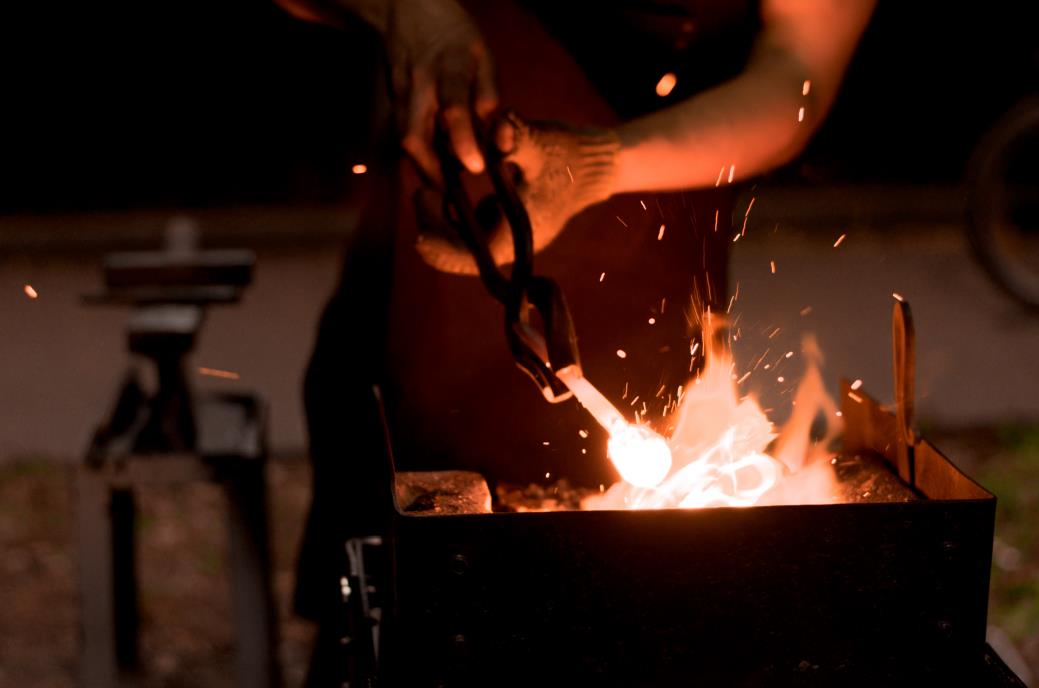
Now that we know which knives Gordon Ramsay favors, let’s talk about why.
What makes these knives stand out?
The answer comes down to materials and design. Ramsay’s preferred knives share certain qualities: they use high-grade steel (German or Japanese, often high-carbon), they have a solid full-tang construction, and they’re built for sharpness, balance, and durability.
Here are a few key points:
German vs. Japanese steel
Ramsay uses both German and Japanese knives, each for their own strengths. German knives (like Wüsthof and Henckels) typically use slightly “softer” high-carbon stainless steel (around 55–58 HRC hardness). This makes them tough and forgiving – ideal for heavy-duty chopping and rocking motions without chipping.
The steel (often X50CrMoV15 in German blades, resists corrosion well and is easy to re-sharpen.
Japanese knives, on the other hand, use harder steel (often 60+ HRC) for a screaming-sharp edge, perfect for precision slicing. Ramsay loves Japanese blades for their ability to slice effortlessly with smooth, clean cuts, crucial for fine work and delicate ingredients.
The trade-off is that hard Japanese steel can be more brittle, but in the hands of a skilled user it yields beautifully thin, exact cuts.
In short, German steel gives durability and weight, while Japanese steel offers sharpness and agility. Ramsay leverages both: German knives when he needs robust versatility, Japanese when he demands ultra-sharp accuracy.
Learn more
An In-Depth Look at Japanese vs. German Knives
High-carbon stainless steel
Whether German or Japanese, most of Ramsay’s knives are made of high-carbon stainless steel alloys. High carbon content (often ~0.5% to 1% in these knives) is what allows a blade to be hardened for better edge retention.
For example, Wüsthof and Henckels use proprietary high-carbon stainless blends that balance hardness with rust resistance (adding chromium for the stainless factor).
This means their knives can take a very sharp edge and keep it, but also won’t rust easily like plain carbon steel. Ramsay benefits from this because he can go longer between sharpenings even with heavy use.
As a retailer, explaining “high-carbon stainless” to customers is worth it – it’s essentially the best of both worlds for kitchen knives. (If you’re curious about the differences, see our primer on carbon steel vs stainless steel knives for more details on edge retention and maintenance.)
Learn more
Carbon Steel vs. Stainless Steel: A Knife Steel Comparison
Full Tang Construction
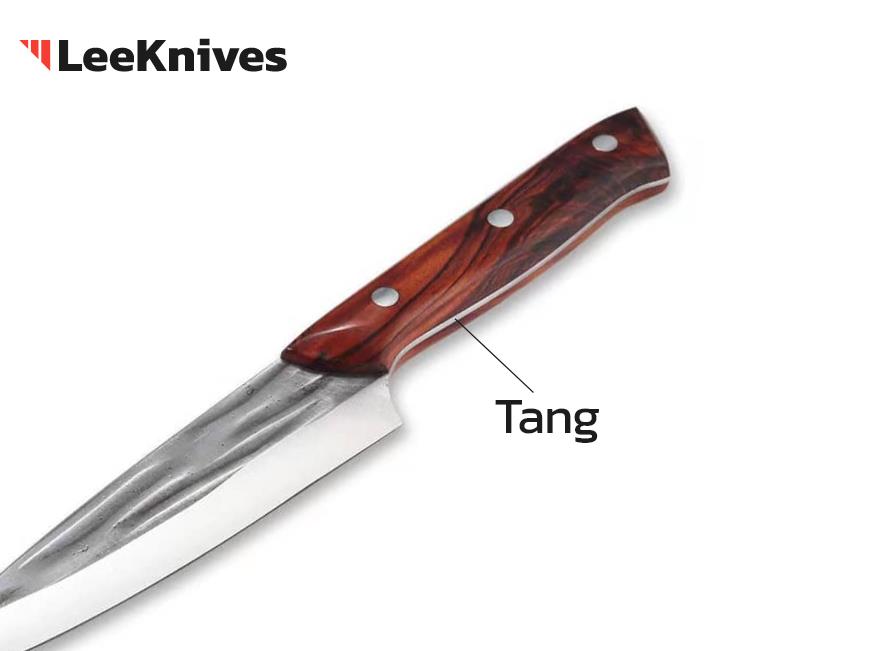
All of Ramsay’s favored knives feature a full tang, meaning the blade’s metal extends through the handle to the end. This isn’t just a trivial design point, it dramatically improves a knife’s strength and balance.
A full-tang knife won’t snap at the handle under stress, and it gives a reassuring heft.
Ramsay’s German knives have visible full tangs with riveted handles, and even the Japanese-style knives he uses (like HexClad) are engineered as full tang for stability.
For buyers, a quick way to judge quality is to look for that tang. (You can literally point this out to customers in your store – it’s an easy visual indicator of a well-built knife.
Learn more
Full Tang vs. Partial Tang Knife: Which Is Better?
Edge grind and blade design
Ramsay’s knives generally have a double-beveled edge (sharpened on both sides), which is standard for Western knives and many Japanese hybrids.
This makes them versatile for right or left-handed use and for various cutting techniques.
The angle of the edge can differ, German knives often around 20 degrees per side, Japanese around 15 degrees or even less. For instance, HexClad’s knives are honed to a 12-degree angle per side, reflecting Japanese-style keenness.
The blade profiles also vary: German chef’s knives have a pronounced curve (belly) suitable for rocking chops, whereas Japanese gyutos and santokus are straighter for slicing.
When stocking knives, think about including both styles to cater to these different preferences. Some customers will want the classic German chef’s knife shape, others might prefer the flatter profile of a santoku, and Ramsay has shown there’s merit to both.
Learn more
What Is a Knife Bevel?
Handle and balance
Ramsay often mentions the importance of a comfortable handle grip.
The knives he uses have well-thought-out handles: Wüsthof and Henckels with ergonomic polymer or wood handles (often with a bolster for a smooth thumb grip at the blade), HexClad with contoured pakkawood, etc.
The balance point on these knives is usually right where the blade meets the handle – a sign of good design that makes the knife feel nimble. Retailers should note that professional chefs like Ramsay choose knives that become an extension of their hand.
All the brands we discussed invest in handling engineering for this reason. A well-balanced knife reduces fatigue and improves precision, which is invaluable in both restaurant kitchens and home kitchens.
Learn more
Everything You Need to Know about Kitchen Knife Handles
Tips for selling knives as a wholesaler
1. Work with quality knife manufacturers
Well-known names like Wüsthof, Henckels, Royal Doulton, and HexClad carry weight with customers.
If you can source similar quality to these brands through distributors, they practically sell themselves.
You can also compete by offering German or Japanese knives with comparable specs: forged high-carbon stainless steel, strong balance, and professional durability.
Position them as “equivalent in quality to Ramsay’s favorites” to build confidence.
Learn more
Forged vs. Stamped Knives: Break Down the Differences
2. Highlight the features Ramsay values
When pitching to buyers or marketing to consumers, don’t just say “sharp.” Point out the exact features Ramsay emphasizes: full tang construction, high-carbon German steel, Japanese Damascus layers, forged not stamped blades.
A restaurant supply manager, for example, understands why a full-tang forged knife will outlast a stamped one. And even home cooks recognize buzzwords like “German steel” or “Damascus finish.”
Using Ramsay’s standards in your sales copy or conversations makes your offering sound authoritative and credible.
Learn more
Damascus Steel vs. Carbon Steel: Which Is Better?
3. Educate your customers
Ramsay’s popularity gives you a ready-made teaching angle. A blog post or in-store display titled “What knives does Gordon Ramsay use?” can double as a mini buying guide.
Explain the logic of his “holy trinity” (chef’s knife, serrated knife, paring knife) and walk customers through German vs. Japanese steel differences.
By educating them, you’re also nudging them toward higher-value knives.
A shopper who understands why Rockwell hardness or full tang matters will see more value in investing in quality, and you’ll build trust in the process.
4. Explore private label and custom manufacturing
Ramsay did it himself with Royal Doulton: identify the essentials, work with a manufacturer, and launch a branded line. Retailers can replicate this playbook.
Through private label or OEM/ODM partnerships, you can design knives that match Ramsay-approved specs (e.g., German 1.4116 steel, ergonomic pakkawood handles) but carry your own branding.
This path gives you higher margins, unique positioning, and long-term brand equity.
Partnering with experienced manufacturers like LeeKnives ensures the knives aren’t just marketable, but genuinely high-performance.
Launch Your Custom Knife Line Faster with LeeKnives
Complete OEM/ODM support—from design to final shipment—so you can focus on growth.
Backed by warehouses in the U.S. for fast, reliable delivery.
5. Leverage Ramsay’s name ethically
You don’t need an official endorsement by Ramsay to grow your business but you need to be tactful.
Use phrasing like “This knife is crafted from Japanese Damascus steel with a 60 HRC hardness – the same type of construction favored by chefs like Gordon Ramsay.” Or use one of his famous quotes in your marketing to emphasize knife quality.
Just be clear you’re drawing inspiration, not claiming endorsement. Done well, this taps into his authority while keeping your messaging honest.
How LeeKnives can help
Understanding Ramsay’s knife preferences highlights one thing: quality matters.
Whether it’s German durability or Japanese sharpness, the principles behind his choices are the same ones that guide serious buyers and chefs.
At LeeKnives, we help retailers, e-commerce brands, and restaurants bring that same level of quality to their own shelves. Our services include:
- Wholesale program: competitive pricing on bulk orders of premium knives.
- Private labeling: add your logo to our existing designs for fast, market-ready products.
- OEM/ODM manufacturing: create fully custom knives, from blade steel to handle material.
- Premium materials: German and Japanese steels, pakkawood handles, full-tang construction, and more.
If you’re ready to stock knives that meet chef-level standards, or build your own signature line, we’d love to partner with you.
Get a wholesale quote today and discover how Leeknives can sharpen your competitive edge in the knife market.
FAQs
What knives are used on Hell’s Kitchen?
For most of the show’s run, contestants used J.A. Henckels knives (such as the Zwilling Pro series) supplied through sponsorship. In recent seasons, HexClad — Ramsay’s partner brand — has appeared increasingly, and there’s now an official Hell’s Kitchen Store knife line featuring 67-layer Damascus steel with G10 handles and a 15° Honbazuke-honed edge. Ramsay himself has demonstrated with Wüsthof in instructional settings. The exact mix varies by season, but every knife on set follows his core principles: durable, sharp, professional-grade tools that can survive high-volume service.
Does Gordon Ramsay own HexClad?
No. Gordon Ramsay does not own HexClad — he is a partner, brand ambassador, and product collaborator who has worked with the company since 2021, helping develop and promote its cookware and knife lines. Ownership stays with HexClad’s founding team. The partnership is similar in structure to his earlier Royal Doulton collaboration: his name, input, and endorsement, without equity control. For buyers, the practical takeaway is that HexClad products are designed to his stated standards — 67-layer Damascus blades, AUS-10 cores, around 60+ HRC hardness.
What is Gordon Ramsay’s favorite knife?
Ramsay has never named one single “favorite knife,” but in a video guide on buying kitchen knives he highlighted two personal go-to blades: a 5-inch Santoku for precise, everyday chopping and slicing, and an 8-inch chef’s knife as the heavy-duty workhorse for dicing, mincing, and breaking down proteins. Brand-wise, he currently promotes HexClad’s Japanese Damascus knives, while Wüsthof and Henckels remain the German staples seen throughout his career. His consistent advice: ignore brand hype, hold the knife, and judge balance and grip for yourself.
What knife set does Gordon Ramsay recommend?
Ramsay officially promotes the HexClad 7-Piece Master Series — 8″ chef’s, 7″ Santoku, 8″ serrated bread, 5″ utility, 3.5″ paring, honing steel, and a magnetic walnut block — priced in the premium tier (roughly $440–$500 as of 2026; verify current listings). Philosophically, though, he advises against big pre-packaged blocks: his repeated guidance is to buy three to five excellent individual knives rather than a 20-piece set full of filler blades. For retailers, that means curated essentials sets outsell bloated blocks when merchandised around his “quality over quantity” message.
Are HexClad knives worth it?
On specs, HexClad knives are genuinely solid: 67-layer Damascus cladding over an AUS-10 core, roughly 60+ HRC hardness, full-tang pakkawood handles, and a keen 10–12° edge per side. User and reviewer opinion is more mixed — most praise out-of-box sharpness, light weight, and looks, while value-focused enthusiasts note that brands like Shun, Tojiro, or MAC offer comparable performance for less. The honest verdict: worth it if you want the Ramsay-endorsed design and hybrid feel; less compelling if pure cutting performance per dollar is your only priority.
What does Gordon Ramsay use to sharpen his knives?
Ramsay’s routine pairs a honing steel with a whetstone. The honing steel is used frequently — often before each prep session — to realign the edge and keep it feeling sharp, while the whetstone does the actual grinding when the edge dulls, typically at the knife’s original angle (around 20° per side for German knives, 15° or less for Japanese). He also stresses proper storage and hand-washing to protect edges, and advises against dishwashers entirely. For retailers, honing steels and whetstones are natural, high-margin attachments to any knife sale.
Is it worth investing in an expensive knife set?
Yes — with a caveat. A high-quality set costs more upfront but lasts longer, stays sharper, and performs more safely than cheap alternatives; for restaurants and retailers, that means reliability and satisfied customers. The caveat is composition: a curated set of five essential, well-made knives beats a 20-piece block of mediocre ones. Ramsay’s own philosophy — “basically, you need three knives” — supports buying fewer, better blades. For home cooks that means less frustration and cleaner cuts; for businesses, fewer returns and stronger reviews.
What cutting board does Gordon Ramsay use?
Ramsay recommends sturdy wooden or composite cutting boards because they protect the knife’s edge and give a stable cutting surface; sharp-eyed viewers have identified a John Boos Block — a thick Northern hard-rock maple butcher block made in the USA — in his home kitchen videos. Whatever the brand, his logic is consistent: soft, edge-friendly surfaces extend the time between sharpenings, while glass and hard stone boards destroy edges quickly. Want to dig deeper? See our guides on the best cutting board materials and the best cutting boards for knives.




 EN
EN  JA
JA  DE
DE